
If you have ever wondered who invented the wrap dress, the answer is most closely associated with Belgian-American fashion designer Diane von Furstenberg. She introduced her famous jersey wrap dress in the early 1970s, and it quickly became one of the most recognizable garments in modern fashion.
The wrap dress is celebrated for its practical construction, adjustable fit, and ability to move easily between casual and more polished occasions. Rather than relying on buttons, zippers, or complicated closures, the design wraps around the body and secures with long fabric ties. This simple concept made the dress easy to wear while giving it a distinctive silhouette.
Although earlier garments used wrapping and tie closures, Diane von Furstenberg is widely credited with popularizing the modern wrap dress. Her version transformed an uncomplicated clothing concept into a major fashion phenomenon. The dress became especially influential because it combined comfort, versatility, and a stylish appearance.
Understanding who invented the wrap dress requires looking not only at Diane von Furstenberg but also at the history of wrap-style clothing, the fashion industry of the 1970s, and the design choices that made her version so successful.
Who Invented the Wrap Dress? Diane von Furstenberg
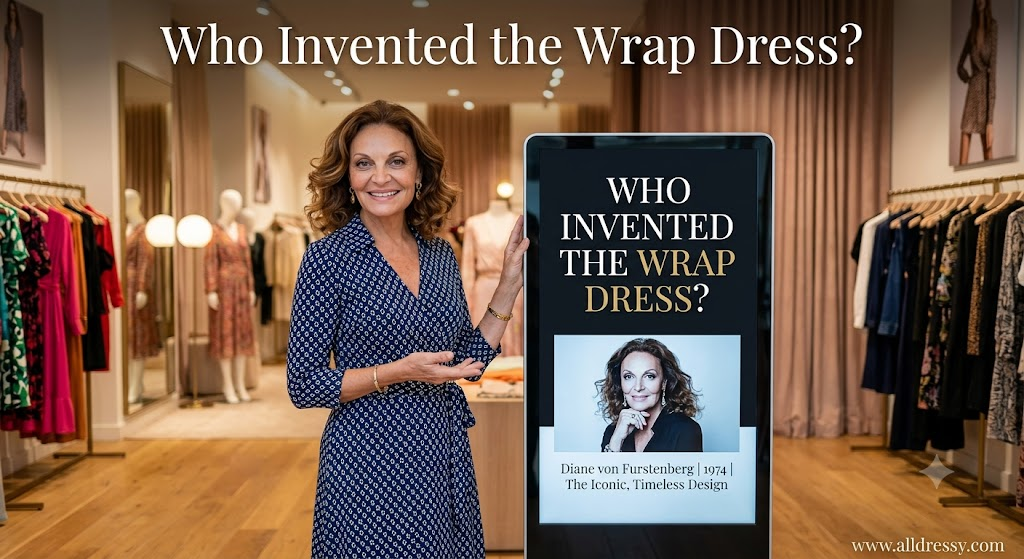
When people ask who invented the wrap dress, they are generally referring to Diane von Furstenberg, who introduced her signature wrap dress in 1974.
Von Furstenberg was born in Brussels, Belgium, in 1946. She entered the fashion industry during a period when women’s clothing was undergoing significant changes. Fashion was becoming more relaxed, expressive, and adaptable to women’s increasingly active professional and social lives.
Her wrap dress stood out because it was different from many traditional dresses of the time. Instead of requiring a structured fit, the garment used a wrap construction that could be tied around the waist.
The design became particularly famous for its combination of:
- A V-shaped neckline
- A fitted but flexible waist
- Long fabric ties
- A front or side wrapping construction
- Soft jersey material
- A comfortable, body-following shape
- Easy dressing and removal
These features helped make the wrap dress practical as well as fashionable.
Was Diane von Furstenberg the First Person to Invent Wrap-Style Clothing?
This is where the history becomes more interesting.
It would be inaccurate to say that Diane von Furstenberg invented the basic concept of wrapping fabric around the body. Wrap-style garments have existed in different cultures for centuries. Various traditional garments have used overlapping fabric, ties, belts, or other methods of wrapping.
For example, garments such as robes, saris, sarongs, and other draped clothing demonstrate that wrapping fabric around the body is an extremely old clothing technique.
Therefore, the better answer to who invented the wrap dress is that Diane von Furstenberg is credited with creating and popularizing the modern fashion wrap dress, rather than inventing the fundamental idea of wrapping clothing.
Her major contribution was turning this practical construction into a fashionable Western ready-to-wear dress that became a cultural phenomenon.
The History Behind the Wrap Dress
To understand who invented the wrap dress, it helps to understand how wrap clothing developed before the 1970s.
For centuries, people have used garments that rely on overlapping or wrapping fabric. These designs often had practical advantages because they could accommodate different body shapes without requiring precise tailoring.
Traditional wrapped garments can be found across many regions and cultures. Some use belts, while others depend on knots, pins, or fabric tension to remain secure.
The underlying concept is simple:
- Fabric is positioned around the body.
- One section overlaps another.
- The garment is secured with a tie, belt, knot, or fastening.
- The wearer can adjust the garment for comfort.
The modern wrap dress borrowed this basic principle but adapted it to Western fashion.
Diane von Furstenberg’s achievement was making the design recognizable, commercially successful, and fashionable on a large scale.
When Was the Wrap Dress Invented?
The modern wrap dress associated with Diane von Furstenberg emerged in the early 1970s, with the iconic design becoming especially prominent in 1974.
The early 1970s were an important period in fashion. Women were increasingly interested in clothing that could work for different parts of their lives. The traditional distinction between highly formal clothing and everyday clothing was becoming less rigid.
The wrap dress fit perfectly into this changing environment.
It could be worn to work, social events, dinners, parties, and casual occasions depending on the accessories and styling.
This versatility helped distinguish it from many other dresses available at the time.
How Did Diane von Furstenberg Come Up With the Wrap Dress?
The story behind who invented the wrap dress also involves experimentation with clothing construction.
Diane von Furstenberg was interested in creating garments that were attractive but also practical. She experimented with knitted jersey fabric, which offered flexibility and comfort.
One of the most important ideas was the combination of a wrap construction with jersey material.
Jersey could move with the wearer instead of creating the rigid feeling associated with some structured garments. The wrap construction also allowed the wearer to adjust the fit.
The resulting dress was relatively simple in construction but highly effective in use.
Its design could create a defined waist without requiring a rigid corset-like structure or complicated tailoring.
Why Was the Wrap Dress So Revolutionary?
The significance of the wrap dress goes beyond its appearance.
Before its widespread popularity, many women’s dresses depended on fixed closures and structured construction. A dress might need to fit very precisely to look and feel comfortable.
The wrap dress approached the problem differently.
Its adjustable construction meant that the wearer had greater control over the fit.
Adjustable Fit
One of the biggest advantages was adjustability.
The wearer could tighten or loosen the ties depending on personal comfort and styling preferences.
Easy to Wear
The design did not require complicated fastening systems. This made it relatively straightforward to put on and take off.
Comfortable Fabric
Jersey fabric helped give the dress flexibility and movement.
Versatile Styling
The same dress could look different depending on shoes, jewelry, handbags, jackets, and other accessories.
Flattering Silhouette
The overlapping front and waist tie created a recognizable silhouette that became strongly associated with the Diane von Furstenberg brand.
The Role of Jersey Fabric in the Wrap Dress
One reason the answer to who invented the wrap dress is closely connected to Diane von Furstenberg is her successful use of jersey.
Jersey is a knitted fabric known for its flexibility and comfortable drape. It can move naturally with the body and is often easier to wear than stiff woven fabrics.
For a wrap dress, these qualities are especially useful.
The fabric needs to:
- Wrap smoothly around the body
- Allow comfortable movement
- Sit naturally when tied
- Avoid excessive stiffness
- Maintain an attractive drape
The combination of jersey and wrap construction helped make the garment feel modern.
The Famous 1970s Wrap Dress
Diane von Furstenberg’s wrap dress became one of the defining fashion pieces of the 1970s.
Its popularity was helped by the changing role of women in society and the increasing demand for clothing that could work in multiple settings.
The dress offered an appealing combination of femininity and practicality.
It was not simply an evening garment. Women could style it for professional environments, daytime activities, dinners, and social occasions.
This flexibility contributed significantly to its success.
How the Wrap Dress Became a Fashion Icon
The wrap dress did not become famous solely because of its construction.
Its popularity was also connected to strong branding, media attention, celebrity visibility, and the broader cultural atmosphere of the 1970s.
Diane von Furstenberg became closely identified with the design, and the wrap dress became almost synonymous with her name.
The garment appeared in magazines and became associated with fashionable women of the era.
As more women adopted the style, the wrap dress moved from being a new fashion idea to becoming a recognizable wardrobe staple.
The Wrap Dress and Women’s Changing Lifestyles
Another reason the wrap dress became so successful was that it matched the lifestyle changes taking place during the period.
Women increasingly needed clothing that could move between different environments.
A garment that could work during the day and be styled differently for an evening event offered obvious advantages.
The wrap dress could be dressed up with:
- Heels
- Statement jewelry
- Structured handbags
- Blazers
- Elegant accessories
It could also be dressed down with:
- Flats
- Simple jewelry
- Casual handbags
- Cardigans
- Minimal accessories
This adaptability helped give the wrap dress long-lasting appeal.
Why the Wrap Dress Is Still Popular Today
Although the original famous wrap dress emerged decades ago, the design remains relevant.
Fashion trends change, but practical clothing often survives because it solves everyday problems.
The wrap dress offers several qualities modern consumers still appreciate.
Versatility
A single wrap dress can potentially be styled for several occasions.
Adjustability
The waist ties allow some control over how closely the garment fits.
Comfort
Soft, flexible fabrics can make the style comfortable for extended wear.
Timeless Design
The basic construction does not depend heavily on a particular seasonal trend.
Easy Styling
A wrap dress can become the central piece of an outfit without requiring complicated coordination.
Different Types of Wrap Dresses
Today, the term “wrap dress” can refer to several variations.
Traditional Wrap Dress
This style has two overlapping front panels that are secured using fabric ties.
Faux Wrap Dress
A faux wrap dress creates the appearance of a wrap but may use a hidden zipper, button, or other fastening.
Jersey Wrap Dress
This version uses stretchy jersey material and is particularly associated with the classic wrap-dress aesthetic.
Maxi Wrap Dress
A longer version extends toward the ankles and can be suitable for formal or evening styling.
Midi Wrap Dress
A midi design typically falls around the lower leg and works well for everyday and semi-formal occasions.
Mini Wrap Dress
A shorter version creates a more youthful or casual appearance while retaining the wrap construction.
Printed Wrap Dress
Floral, geometric, abstract, and other prints can make the wrap silhouette more visually distinctive.
How to Identify an Authentic Wrap Dress Design
Knowing who invented the wrap dress can also help shoppers understand the design’s defining characteristics.
A classic wrap dress generally includes a few recognizable elements.
Look for:
- Two overlapping front sections
- A waist tie
- A V-neckline
- Flexible construction
- Fabric that drapes naturally
- An adjustable waist
- A recognizable wrap silhouette
However, not every garment described as a wrap dress uses exactly the same construction.
Some modern designs imitate the appearance while using hidden closures.
Wrap Dress vs. Faux Wrap Dress
The difference between these styles is important.
A genuine wrap dress actually wraps around the wearer and is secured with ties or similar fastening methods.
A faux wrap dress looks like a wrap dress but is constructed more like a conventional dress.
Real Wrap Dress
- Adjustable
- Overlapping panels
- Usually secured with ties
- More customizable fit
Faux Wrap Dress
- Fixed construction
- Often uses a zipper
- Easier to keep consistently positioned
- Provides the visual effect of a wrap
Both styles can be attractive, but they offer different experiences.
What Made Diane von Furstenberg’s Design Different?
The question who invented the wrap dress is not only about giving a designer’s name. It is also about understanding what made the design influential.
Diane von Furstenberg successfully combined several useful ideas:
Simplicity + comfort + adjustability + fashionability + versatility
That combination was powerful.
The dress did not require an elaborate construction to look sophisticated. Its design was straightforward enough for everyday use but distinctive enough to become a recognizable fashion statement.
The Business Success of the Wrap Dress
The wrap dress also demonstrated how a relatively simple garment could become a powerful fashion-business product.
Its repeatable design made it suitable for production in different fabrics, prints, and colors.
The basic silhouette could remain recognizable while the surface design changed.
This gave the garment flexibility across seasons.
Designers could experiment with:
- Floral prints
- Geometric patterns
- Solid colors
- Animal-inspired patterns
- Different sleeve lengths
- Different hem lengths
- Different fabrics
The underlying wrap concept remained recognizable.
Diane von Furstenberg and Fashion History
Diane von Furstenberg’s name has become permanently connected to fashion history because of the impact of the wrap dress.
Her design demonstrated that a garment could be:
- Stylish without being overly complicated
- Comfortable without appearing overly casual
- Feminine without being restrictive
- Practical without sacrificing visual appeal
This balance helped establish the wrap dress as one of the important designs of modern women’s fashion.
The Cultural Impact of the Wrap Dress
The wrap dress became more than a clothing item.
It represented a broader movement toward practical, adaptable women’s clothing.
Its popularity demonstrated that women wanted garments that could accommodate movement and changing daily activities.
The wrap dress also became associated with independence and modernity because it provided a relatively simple way to create a polished outfit.
Over time, the design became recognizable even among people who were not deeply interested in fashion.
How to Style a Wrap Dress
A wrap dress can be styled in many different ways.
For a professional outfit, consider pairing it with:
- A tailored blazer
- Simple flats or low heels
- Minimal jewelry
- A structured handbag
For an evening look, consider:
- Dressier shoes
- Statement earrings
- A small handbag
- More noticeable accessories
For casual wear:
- Comfortable flats
- A cardigan
- Simple jewelry
- A casual shoulder bag
The key advantage is that the dress itself provides much of the outfit structure.
Choosing the Right Wrap Dress Fabric
When purchasing a wrap dress, fabric is an important consideration.
Jersey
Soft, flexible, and comfortable, jersey is a classic choice.
Cotton
Cotton can be breathable and practical for warmer weather.
Linen
Linen can provide a lightweight option for summer, although it may wrinkle more easily.
Satin
Satin creates a smoother, dressier appearance and can work well for evening occasions.
Chiffon
Chiffon provides a lightweight, flowing effect but may require lining.
The best fabric depends on the occasion, weather, and desired appearance.
How to Choose the Right Wrap Dress
When shopping for a wrap dress, consider more than color or print.
Check the Tie Placement
The waist tie should sit comfortably and allow the dress to stay secure.
Consider the Neckline
A V-neckline is common, but the depth varies significantly between designs.
Examine the Fabric
Choose fabric according to the occasion and climate.
Look at the Length
Mini, midi, and maxi styles create different levels of formality.
Check the Construction
If you prefer adjustability, choose a genuine wrap construction rather than a faux wrap.
Caring for a Wrap Dress
Proper care can help a wrap dress maintain its appearance.
Always check the garment’s care label before washing.
For delicate fabrics, gentle washing may be appropriate. Avoid unnecessarily harsh washing methods that can damage fibers or affect the shape.
When drying the garment, follow the manufacturer’s recommendations. Some fabrics may benefit from air drying rather than high heat.
Storage also matters. Hanging a wrap dress properly can help reduce unwanted wrinkles.
For printed garments, excessive heat and harsh detergents may affect the appearance of the fabric over time.
Why the Wrap Dress Remains a Wardrobe Staple
The enduring popularity of the wrap dress can be explained by its ability to solve several common clothing problems at once.
It provides an adjustable waist, comfortable movement, recognizable style, and broad versatility.
Instead of being tied to one particular fashion era, the design can be updated through fabrics, colors, prints, sleeve shapes, and accessories.
That adaptability is one reason the wrap dress continues to appear in modern fashion collections.
The Legacy of the Wrap Dress
The answer to who invented the wrap dress is therefore more nuanced than simply naming one person.
Diane von Furstenberg did not invent the ancient concept of wrapping fabric around the body. Wrapped clothing existed long before the twentieth century.
However, she is widely credited with creating and popularizing the modern Western wrap dress that became a major fashion icon in the 1970s.
Her innovation was taking a familiar clothing principle and transforming it into a commercially successful, stylish, practical garment.
The wrap dress ultimately became a symbol of modern fashion because it combined ease and elegance in a remarkably simple design. Its adjustable construction, comfortable fabric, and styling flexibility helped it survive changing trends.
Today, when shoppers search for information about who invented the wrap dress, they are discovering not just the story of Diane von Furstenberg, but also a broader history of how fashion evolves. The modern wrap dress represents the meeting point between centuries-old wrapping techniques and twentieth-century ready-to-wear design.
Its continuing presence in contemporary wardrobes shows why thoughtful clothing design can remain relevant long after the trend that originally popularized it has passed.
Here are the SEO-friendly FAQs and conclusion to complete your article.
Frequently Asked Questions About Who Invented the Wrap Dress
1. Who invented the wrap dress?
Diane von Furstenberg is widely credited with inventing and popularizing the modern wrap dress. She introduced her iconic jersey wrap dress in the early 1970s, with the design becoming especially famous around 1974.
2. Did Diane von Furstenberg invent the first wrap garment?
Not exactly. Wrapped clothing existed in many cultures long before the 1970s. Diane von Furstenberg is credited with creating and popularizing the modern Western wrap dress as a fashionable ready-to-wear garment.
3. When was the wrap dress invented?
The modern wrap dress associated with Diane von Furstenberg was introduced in the early 1970s and became a major fashion success in 1974.
4. Why did the Diane von Furstenberg wrap dress become so popular?
The dress combined comfort, adjustability, versatility, and fashionable styling. Its jersey fabric and wrap construction made it practical for everyday wear while still looking polished.
5. What fabric is commonly used for a wrap dress?
Jersey is strongly associated with the classic wrap dress because it is flexible, soft, and drapes naturally. Modern wrap dresses can also be made from cotton, linen, satin, chiffon, and other fabrics.
6. What makes a wrap dress different from a regular dress?
A traditional wrap dress uses overlapping fabric panels that wrap around the body and are generally secured with ties. This allows the wearer to adjust the fit around the waist.
7. What is a faux wrap dress?
A faux wrap dress has the appearance of a traditional wrap dress but does not actually open or wrap around the body. It may use a zipper, button, or another fixed fastening system.
8. Are wrap dresses still fashionable?
Yes. Wrap dresses remain popular because their adjustable construction, comfortable fit, and versatile appearance work across different fashion trends and occasions.
9. Can a wrap dress be worn casually?
Yes. A wrap dress can be styled casually with flats, sneakers, simple jewelry, or a cardigan. The overall appearance depends largely on the fabric, length, print, and accessories.
10. Can you wear a wrap dress to a formal event?
Yes. A wrap dress made from a dressier fabric such as satin or an elegant jersey can work for many formal or semi-formal occasions. Accessories and footwear can make the outfit more sophisticated.
11. Why is the wrap dress considered an iconic fashion design?
The wrap dress became iconic because it successfully combined practicality and style. Its simple construction, adjustable waist, comfortable fabric, and versatility helped it remain relevant for decades.
12. Is Diane von Furstenberg still associated with the wrap dress?
Yes. Diane von Furstenberg’s name remains closely associated with the modern wrap dress, and the design is an important part of her fashion legacy.
Conclusion
The answer to who invented the wrap dress is most commonly Diane von Furstenberg, who introduced her now-famous modern wrap dress in the early 1970s and helped make it a defining fashion item of the decade.
Although wrapped garments existed for centuries before her design, von Furstenberg transformed the basic concept into a stylish, practical, and commercially successful Western dress. The combination of jersey fabric, an adjustable waist, overlapping panels, and versatile styling made the garment remarkably influential.
The lasting popularity of the wrap dress demonstrates why good fashion design can survive changing trends. It offers comfort, flexibility, and an easily recognizable silhouette while allowing designers to experiment with fabrics, prints, lengths, and details.
For anyone researching who invented the wrap dress, Diane von Furstenberg’s contribution is essential to understanding the history of this iconic garment. Her design did more than create a popular dress—it helped establish a new approach to women’s fashion that valued both elegance and practicality.