
Understanding how Mennonites dress compared to Amish communities can be fascinating because both groups are known for their religious traditions, modest clothing, and distinctive lifestyles. Although Mennonites and Amish share historical roots in the Anabaptist movement, their clothing styles can look quite different depending on their beliefs, community rules, and individual interpretations of modesty.
Some Mennonite communities wear plain clothing that closely resembles traditional Amish outfits, while others dress similarly to people in mainstream society. Amish clothing is generally more recognizable because many Amish communities follow established rules about simple garments, limited colors, and traditional styles. Mennonite clothing, however, varies considerably from one congregation to another.
If you have ever wondered how do Mennonites dress compared to Amish people, this guide explains their similarities, differences, traditional garments, colors, head coverings, footwear, and the cultural and religious reasons behind their clothing choices.
How Do Mennonites Dress Compared to Amish?
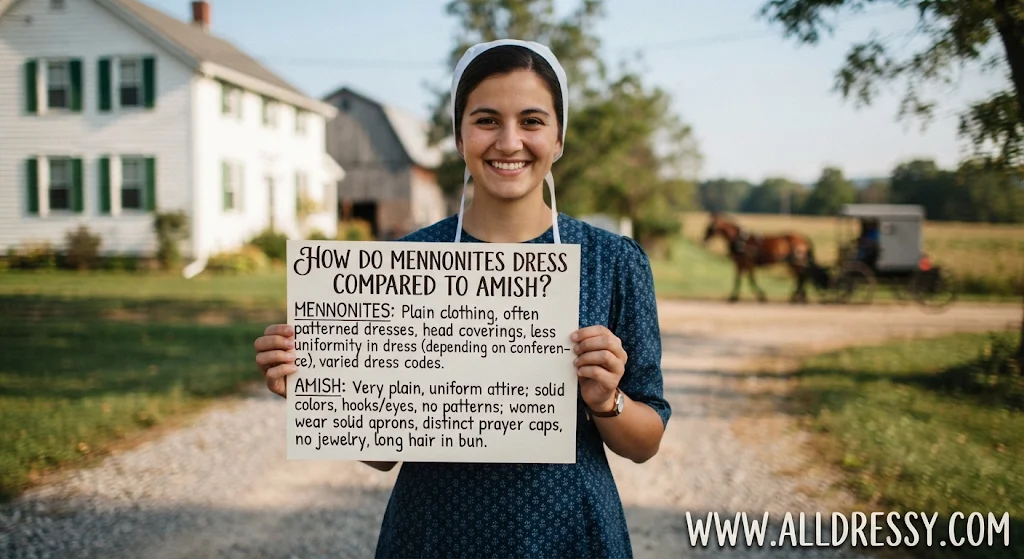
The main difference between Mennonite and Amish clothing is the level of uniformity. Amish communities generally follow more clearly defined community standards for clothing, while Mennonite communities have a wider range of clothing practices.
Traditional Amish clothing is usually plain, modest, and practical. Women commonly wear long dresses, aprons, and head coverings. Men often wear simple shirts, trousers, suspenders, and hats or other traditional headwear, depending on their community.
Mennonite clothing ranges from traditional plain dress to ordinary modern clothing. Conservative Mennonite women may wear long dresses, capes, aprons, and head coverings. Mennonite men may wear plain shirts and trousers or contemporary outfits, depending on their church’s expectations.
Here is a general comparison:
| Clothing feature | Amish | Mennonites |
|---|---|---|
| Women’s clothing | Usually plain dresses and aprons | Ranges from plain dresses to modern clothing |
| Men’s clothing | Often simple shirts and trousers | Traditional or contemporary outfits |
| Head coverings | Common among women in most traditional communities | Common in conservative groups, optional or uncommon in others |
| Colors | Generally subdued and simple | Varies by community |
| Patterns | Usually limited or avoided in conservative communities | Depends on church standards |
| Fashion trends | Generally discouraged in traditional communities | Accepted to different degrees |
| Clothing rules | Often guided by community Ordnung | Depend on congregation and denomination |
These are broad patterns rather than universal rules. Neither Amish nor Mennonite people all dress exactly alike.
Why Do Mennonites and Amish Dress Differently?
To understand their clothing differences, it helps to understand their shared religious history.
Both groups developed from the Anabaptist movement, which began during the Protestant Reformation in Europe in the 16th century. Anabaptists emphasized adult baptism, community responsibility, discipleship, and a commitment to living according to Christian teachings.
Over time, different Anabaptist communities developed different approaches to religious practice and everyday life.
The Amish movement emerged as a distinct group in the late 17th century under the leadership associated with Jakob Ammann. The movement became particularly known for its emphasis on church discipline, separation from certain aspects of mainstream society, and community traditions.
Mennonites developed from the earlier Anabaptist movement and eventually included a wide variety of congregations. Some maintained very conservative practices, while others adopted modern technology, contemporary clothing, and different forms of worship.
These historical developments help explain why Amish clothing is often more consistent within a community, while Mennonite clothing can vary significantly.
The Role of Modesty
Modesty is an important principle in many Amish and Mennonite communities. Clothing is often expected to avoid excessive attention, emphasize simplicity, and reflect religious values rather than changing fashion trends.
However, modesty does not have one universal definition across all Anabaptist groups.
For a conservative Amish woman, modesty may involve wearing a long, loose-fitting dress, an apron, and a head covering. A Mennonite woman in another congregation may consider a modest blouse and skirt appropriate, while a more progressive Mennonite woman may wear ordinary modern clothing.
The underlying religious principle can be similar even when the clothing looks different.
The Importance of Community Standards
Amish communities commonly follow a set of unwritten or written community rules known as the Ordnung. The Ordnung guides many aspects of daily life, including clothing, technology, worship, and social behavior.
Different Amish districts may have different expectations. As a result, clothing styles can vary between communities.
Mennonite congregations also have religious expectations, but these differ widely. Some conservative congregations maintain detailed standards for clothing, while others leave most clothing decisions to individual members.
This difference in community organization is one of the main reasons Amish clothing often appears more uniform.
How Do Amish Women Dress?
Traditional Amish women’s clothing is designed to be modest, practical, and consistent with community expectations. Although details differ between Amish groups, several garments are commonly associated with Amish women’s dress.
1. Plain Dresses
<PRIVATE_PERSON> Amish women commonly wear long dresses with simple designs. These dresses generally cover the shoulders, arms, and legs and are not designed to emphasize the body’s shape.
Traditional dresses may have:
- Long sleeves
- High necklines
- Loose-fitting shapes
- Simple closures
- Solid colors or limited patterns
- Calf-length or longer skirts
The exact style depends on the Amish community. Some groups have stricter rules about fabric, colors, and construction than others.
2. Aprons
Aprons are another recognizable part of traditional Amish women’s clothing.
Many Amish women wear aprons over their dresses for practical and cultural reasons. Aprons help protect clothing during household activities, cooking, gardening, and other everyday tasks.
Depending on the community, women may wear different types of aprons for daily activities, church gatherings, or special occasions.
3. Prayer Coverings and Headwear
Traditional Amish women generally wear head coverings as part of their religious practice.
These coverings are often called prayer coverings, caps, or bonnets, depending on their design and community terminology.
The covering represents religious commitment and the belief that women should maintain a visible sign of their faith. The specific shape, color, and style can help distinguish one Amish community from another.
4. Simple Footwear
Amish women’s footwear is generally practical rather than fashionable. Common choices include simple shoes suitable for walking, working, and everyday activities.
The style can vary depending on weather, work requirements, age, and community expectations.
How Do Mennonite Women Dress?
Mennonite women’s clothing is much more varied than Amish women’s clothing. Some Mennonite women wear traditional plain dresses, while others wear contemporary clothing that looks similar to what people outside the community wear.
1. Traditional Mennonite Dresses
Conservative Mennonite women may wear long, modest dresses with simple cuts and limited decoration.
These dresses often feature:
- Long or three-quarter-length sleeves
- High necklines
- Loose-fitting designs
- Long skirts
- Solid or subdued colors
- Minimal decorative details
In some congregations, women wear dresses as a religious expectation. In others, dresses are simply a personal preference.
Traditional Mennonite dresses can look similar to Amish dresses, especially when both communities emphasize plain clothing.
2. Head Coverings
Head coverings are important in many conservative Mennonite communities.
Women may wear small white coverings, veils, bonnets, or other simple headwear. The style depends on the congregation’s traditions.
Some Mennonite women wear a head covering throughout the day, while others wear it primarily during prayer, worship, or religious gatherings.
Many modern Mennonite congregations do not require women to wear head coverings.
3. Skirts and Blouses
Some Mennonite women choose skirts and blouses instead of traditional one-piece dresses.
These outfits may still follow modesty guidelines, such as avoiding revealing designs or overly tight clothing. However, their appearance can be more contemporary than traditional Amish clothing.
4. Modern Mennonite Clothing
Mennonite communities that have fewer restrictions on dress may wear everyday modern clothing.
Women may choose jeans, trousers, sweaters, dresses, skirts, blouses, and other contemporary garments.
Some may wear clothing that follows mainstream fashion trends while maintaining their personal understanding of modesty.
This is why it is important not to assume that every Mennonite woman wears a traditional dress or head covering.
How Do Amish Men Dress?
Traditional Amish men’s clothing is usually simple, durable, and practical. It often avoids decorative details and fashionable designs.
1. Plain Shirts
Amish men commonly wear plain shirts with simple collars and practical designs.
Shirts may be solid-colored and can have long or short sleeves depending on the season and community traditions.
Some Amish groups have particular expectations about shirt colors, fabric, or style.
2. Trousers and Suspenders
Traditional Amish men’s outfits often include plain trousers held up with suspenders.
Suspenders are a familiar part of Amish clothing and are commonly associated with the traditional style.
Trousers are generally designed for comfort and practical activities rather than following changing fashion trends.
3. Plain Coats and Jackets
Some Amish men wear simple coats or jackets for church, formal occasions, and colder weather.
The design is generally conservative, with limited decoration. Specific coat styles and colors vary between communities.
4. Hats and Hair
Amish men may wear broad-brimmed hats, especially outdoors. Hat styles can vary depending on age, occupation, and community traditions.
Many Amish men also wear beards after marriage. In traditional Amish communities, married men commonly grow beards, while mustaches are often avoided.
Beards are a cultural and religious tradition in many Amish communities, although grooming expectations vary.
How Do Mennonite Men Dress?
Mennonite men’s clothing also varies significantly according to denomination and community expectations.
1. Conservative Mennonite Clothing
Men in conservative Mennonite communities may wear plain shirts, trousers, suspenders, and simple coats.
Their outfits may resemble traditional Amish clothing, especially in communities that emphasize plain dress.
Some conservative groups also encourage simple hairstyles and discourage clothing that appears excessively fashionable.
2. Contemporary Shirts and Trousers
Many Mennonite men wear ordinary modern clothing, including:
- Button-down shirts
- Polo shirts
- T-shirts
- Jeans
- Casual trousers
- Sweaters
- Jackets
These clothing choices are common in Mennonite communities that do not follow strict plain-dress rules.
3. Beards and Hairstyles
Beard practices differ between Mennonite groups.
Some conservative Mennonite men grow beards as an expression of religious tradition. Other Mennonite men shave regularly and maintain contemporary hairstyles.
Unlike traditional Amish expectations, there is no single beard style followed by all Mennonite men.
Amish vs. Mennonite Head Coverings: What Is the Difference?
Head coverings are among the most noticeable differences between traditional Amish and Mennonite women’s clothing.
Amish Head Coverings
In many traditional Amish communities, women wear a prayer covering as a regular part of daily dress.
The covering is connected to religious teachings about prayer, humility, and women’s appearance within the faith community.
Different Amish groups may use different shapes, fabrics, and colors. The style can be an important visual indicator of community tradition.
Mennonite Head Coverings
Many conservative Mennonite women also wear head coverings, but the designs and expectations vary.
Some wear small white coverings, while others use veils or different styles of fabric coverings.
In more progressive Mennonite churches, women may not wear head coverings at all.
Are Amish and Mennonite Head Coverings the Same?
Not necessarily.
Although both traditions may use head coverings for religious reasons, the designs, meanings, and rules can differ.
It is also important to remember that there is no single Mennonite head-covering style. Different congregations have different practices.
Amish and Mennonite Clothing Colors
Color is another area where Amish and Mennonite clothing may differ.
Traditional Amish Colors
Traditional Amish clothing often uses subdued colors and simple combinations.
Common colors may include:
- Navy blue
- Dark brown
- Black
- Gray
- Burgundy
- Deep green
- Purple
- Muted shades of blue
However, color rules vary between Amish communities. Some allow a wider range of colors than others.
The general preference for simplicity is often more important than following one universal color chart.
Mennonite Clothing Colors
Mennonite clothing colors depend on the congregation.
Conservative Mennonite women may wear subdued shades similar to those found in Amish clothing. Other Mennonites wear a full range of contemporary colors.
Men in modern Mennonite communities may wear ordinary patterned shirts, colorful sweaters, or other mainstream styles.
Therefore, clothing color alone cannot reliably identify whether someone is Amish or Mennonite.
Amish vs. Mennonite Clothing Patterns and Decorations
Patterns and decorations can also help explain the differences between the two traditions.
Traditional Amish clothing usually avoids elaborate decorations, large logos, and highly fashionable designs.
Plain fabrics and simple construction are common because they reflect community values of humility and simplicity.
Conservative Mennonite communities may follow similar expectations. However, other Mennonite congregations allow printed fabrics, decorative details, and contemporary designs.
For example, a conservative Mennonite woman may wear a simple floral dress, while another may choose a modern printed blouse and skirt.
The differences are determined by individual church traditions rather than one rule shared by every Mennonite.
Amish and Mennonite Wedding Clothing
Weddings provide another interesting example of how clothing traditions differ.
Amish Wedding Clothing
Traditional Amish weddings generally emphasize modesty, religious commitment, and community participation.
An Amish bride commonly wears a simple dress that follows her community’s expectations. The dress may be a solid color rather than the elaborate white gown commonly seen in mainstream weddings.
The outfit may include a traditional apron, head covering, and other garments associated with the community.
Groom’s clothing is also generally simple and conservative.
Mennonite Wedding Clothing
Mennonite wedding clothing varies widely.
A conservative Mennonite bride may wear a plain dress that resembles everyday traditional clothing. A bride from a more contemporary Mennonite congregation may choose a conventional white wedding dress.
Similarly, Mennonite grooms may wear plain traditional clothing or modern formal suits.
This difference reflects the wide range of Mennonite traditions.
Amish and Mennonite Clothing for Children
Children’s clothing also reflects the beliefs and expectations of their families and communities.
Amish Children’s Clothing
Amish children generally wear simple, practical clothing.
Girls may wear modest dresses, while boys commonly wear shirts and trousers. As children grow older, their clothing may become more closely aligned with the expectations of their particular community.
The colors, patterns, and designs are usually simple in traditional Amish settings.
Mennonite Children’s Clothing
Mennonite children’s clothing depends on family and congregation.
Children in conservative Mennonite families may wear traditional plain clothing. Children in more modern Mennonite families may wear ordinary contemporary clothes, including jeans, T-shirts, dresses, and sweaters.
There is no single style that represents all Mennonite children.
Do Mennonites Wear Modern Clothes Compared to Amish?
Yes, many Mennonites wear modern clothing, although this depends on their church and personal beliefs.
Mennonite communities include a broad range of religious practices. Some maintain conservative dress traditions, while others participate fully in contemporary society.
For example, a Mennonite man may wear jeans, a casual shirt, and a modern jacket. A Mennonite woman may wear a skirt, blouse, or trousers.
Traditional Amish communities generally maintain more recognizable clothing customs. Their clothing often follows community guidelines that discourage fashionable changes and emphasize consistency.
However, it would be inaccurate to say that all Mennonites dress in modern clothing or that all Amish people follow exactly the same dress rules.
Do Amish and Mennonites Wear Shoes Differently?
Footwear is not always the easiest way to distinguish Amish people from Mennonites.
Traditional Amish and conservative Mennonite communities generally favor practical shoes suitable for everyday activities.
Depending on the season and occupation, people may wear:
- Simple leather shoes
- Work boots
- Practical sandals
- Weather-resistant footwear
- Comfortable everyday shoes
Some communities may discourage certain fashionable footwear, while others have fewer restrictions.
Modern Mennonites can wear the same types of shoes commonly found in mainstream stores.
The biggest difference is usually not the shoe itself but the broader clothing standards followed by the community.
How Technology and Lifestyle Influence Mennonite and Amish Clothing
Clothing differences are connected to wider lifestyle and religious practices.
Traditional Amish communities often maintain boundaries around certain forms of technology and mainstream culture. Their clothing traditions are part of a broader commitment to community identity, humility, and separation from aspects of modern society.
Mennonite communities have different approaches to technology and cultural participation.
Some use modern technology extensively and wear contemporary clothing. Others maintain conservative lifestyles and traditional garments.
However, technology use and clothing style are not perfectly linked. A community’s rules about clothing, transportation, phones, and other technologies may be separate decisions.
It is therefore better to understand each community on its own terms rather than assuming that clothing reveals every aspect of someone’s lifestyle.
Can You Tell the Difference Between an Amish and a Mennonite Person by Clothing?
Sometimes, but not always.
A person wearing a traditional Amish-style dress, a particular prayer covering, and other recognizable garments may belong to an Amish community. However, conservative Mennonite clothing can look very similar.
Likewise, modern Mennonite clothing may look no different from mainstream clothing.
Here are some clues that may help explain the differences:
- Uniformity: Traditional Amish clothing often follows consistent local standards.
- Women’s head coverings: Many traditional Amish women wear distinctive coverings, while Mennonite practices vary.
- Men’s clothing: Amish men may wear traditional suspenders, plain shirts, and community-specific hats.
- Modern fashion: Contemporary clothing is common in many Mennonite congregations.
- Community differences: Local traditions matter more than a single clothing rule.
These clues should not be treated as proof of someone’s religious identity. Clothing alone cannot reliably establish whether someone is Amish or Mennonite.
Common Misconceptions About Amish and Mennonite Clothing
Several misunderstandings make it difficult to compare these groups accurately.
Misconception 1: All Mennonites Wear Plain Dresses
This is incorrect. Some conservative Mennonite women wear plain dresses, but many Mennonite women wear contemporary clothing.
Misconception 2: All Amish Wear Exactly the Same Clothes
Amish clothing is often more uniform within a community, but different Amish groups have different standards. Clothing can vary in color, cut, fabric, and accessories.
Misconception 3: Mennonites and Amish Have Identical Clothing Rules
Both groups share historical and religious connections, but their communities developed different traditions. Their clothing expectations are not identical.
Misconception 4: Clothing Determines How Religious Someone Is
Clothing can express religious beliefs and community membership, but it is not a complete measure of someone’s faith. Religious commitment is personal and involves far more than appearance.
Misconception 5: Modern Mennonites Are Not Traditional Mennonites
Mennonite identity includes many different congregations and approaches to religious life. Wearing modern clothes does not automatically make someone less Mennonite.
The Most Important Differences Between Amish and Mennonite Clothing
When comparing Amish and Mennonite clothing, the most important point is that Amish dress is generally more standardized within traditional communities, while Mennonite dress is much more diverse.
Traditional Amish clothing usually includes plain dresses, aprons, prayer coverings, simple shirts, trousers, and community-specific styles.
Mennonite clothing can include those same traditional garments, but it can also include modern dresses, jeans, trousers, shirts, sweaters, and other contemporary outfits.
The differences are influenced by history, church expectations, local customs, and individual choices.
Why Understanding These Clothing Traditions Matters
Learning about Amish and Mennonite clothing is not simply about recognizing different outfits. It also provides insight into the values, history, and community practices of two important Anabaptist traditions.
For many Amish people, plain clothing helps express humility, religious commitment, and connection to their community. For conservative Mennonites, traditional garments may communicate similar values.
Other Mennonites express their faith without following distinctive clothing traditions.
Understanding these differences helps avoid stereotypes and encourages respectful discussion. Instead of assuming that everyone in either group follows the same rules, it is more accurate to recognize the diversity within both communities.
The best way to understand how Mennonites dress compared to Amish people is to consider their shared religious roots alongside their different community traditions. Although traditional Amish and conservative Mennonite clothing can look remarkably similar, Mennonite fashion generally offers a wider range of styles, while traditional Amish clothing tends to follow more consistent local standards.
10 Frequently Asked Questions About How Mennonites Dress Compared to Amish
1. How do Mennonites dress compared to Amish people?
Mennonite clothing varies widely depending on the congregation. Some conservative Mennonites wear plain dresses, head coverings, and simple garments similar to Amish clothing. Traditional Amish communities generally follow more consistent clothing standards, emphasizing modesty, simplicity, and limited fashion changes.
2. Do Mennonite women wear the same dresses as Amish women?
Not always. Conservative Mennonite women may wear long, modest dresses that look similar to Amish dresses. However, many Mennonite women wear skirts, blouses, or contemporary clothing. Amish women’s clothing is generally more closely guided by community traditions.
3. Do Mennonite women wear head coverings?
Many conservative Mennonite women wear head coverings as part of their religious practice. Other Mennonite congregations do not require them. The style, frequency, and meaning of head coverings vary between communities.
4. Why do Amish people wear plain clothing?
Amish clothing reflects values such as humility, modesty, simplicity, and community identity. Plain clothing also helps reduce emphasis on individual fashion and changing trends. Specific clothing expectations differ among Amish communities.
5. Can Mennonites wear jeans and modern clothes?
Yes. Many Mennonites wear modern clothing, including jeans, shirts, trousers, dresses, and sweaters. However, conservative Mennonite congregations may maintain stricter dress expectations that emphasize modesty and plainness.
6. Do Amish men and Mennonite men dress differently?
Traditional Amish men commonly wear plain shirts, trousers, suspenders, and community-specific hats or coats. Conservative Mennonite men may dress similarly, while many other Mennonite men wear contemporary clothing such as jeans, polo shirts, and modern jackets.
7. Are Amish and Mennonite clothing colors the same?
Not necessarily. Traditional Amish clothing often features subdued colors such as navy, brown, black, gray, and burgundy. Conservative Mennonites may choose similar colors, while other Mennonites wear a much wider range of colors and patterns.
8. Do Amish and Mennonite women wear the same head coverings?
Their head coverings may look similar, but styles and religious expectations differ. Traditional Amish women commonly wear prayer coverings, while conservative Mennonite women may wear veils or other coverings. Many modern Mennonite women do not wear head coverings.
9. Can you identify an Amish or Mennonite person by clothing?
Sometimes clothing provides clues, but it cannot reliably establish someone’s religious identity. Traditional Amish clothing often has recognizable features, while conservative Mennonite clothing can look very similar. Many Mennonites wear ordinary modern clothing.
10. What is the biggest difference between Amish and Mennonite fashion?
The biggest difference is the level of uniformity. Traditional Amish communities generally maintain more consistent clothing standards. Mennonite communities have a broader range of clothing practices, from conservative plain dress to contemporary fashion.
Conclusion
Understanding how Mennonites dress compared to Amish people requires looking beyond their clothing and considering their religious beliefs, history, and community traditions. Both groups share Anabaptist roots and often value modesty, humility, and simplicity. However, their clothing practices have developed differently over time.
Traditional Amish clothing is generally plain, modest, and guided by community standards. Amish women commonly wear long dresses, aprons, and prayer coverings, while men often wear simple shirts, trousers, and suspenders. These recognizable garments reflect their commitment to community identity and traditional values.
Mennonite clothing is more diverse. Conservative Mennonite communities may follow dress practices similar to those of the Amish, while other Mennonites wear contemporary clothing such as jeans, skirts, shirts, and modern dresses. Head-covering practices and expectations about colors and patterns also vary.
Ultimately, neither group follows one universal clothing style. Understanding their differences requires recognizing the diversity within each community and avoiding assumptions based solely on appearance. The most useful distinction is that traditional Amish clothing tends to follow more consistent local standards, whereas Mennonite clothing ranges from traditional plain dress to modern everyday fashion