
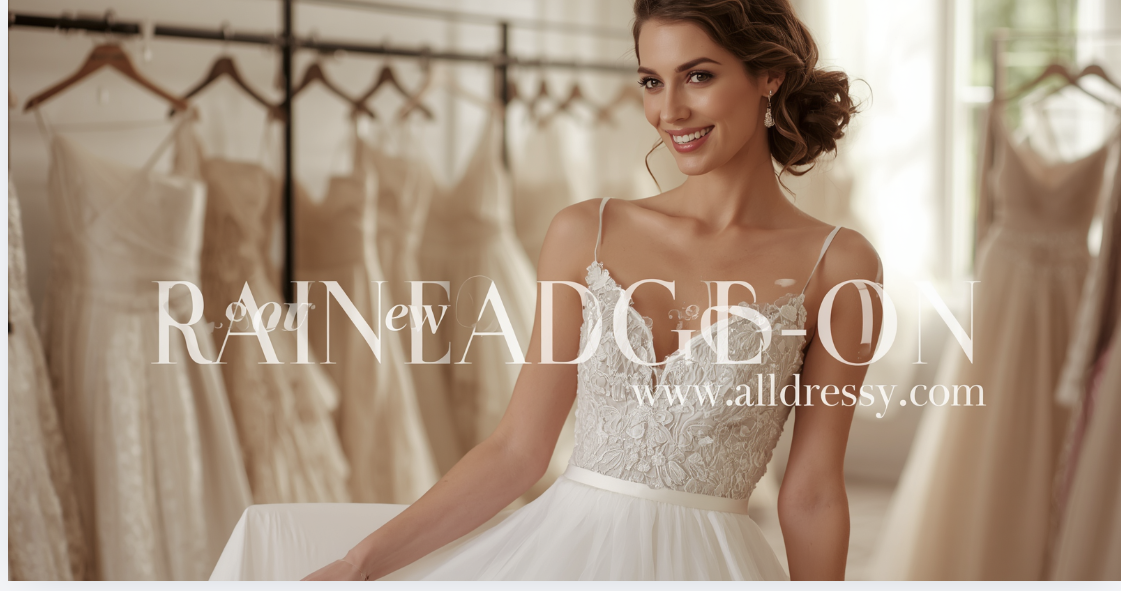
Choosing a bridal gown is one of the most significant aesthetic decisions a bride makes, as the gown sets the visual foundation for the entire wedding day. Among the diverse array of bridal gown silhouettes available in luxury ateliers and bridal boutiques worldwide, one silhouette consistently reigns as the most requested, versatile, and enduring choice: the A-line gown. But what is an a line wedding dress, and what specific architectural elements make this design a staple in modern bridal fashion?
At its most fundamental level, an A-line wedding dress is a floor-length bridal gown featuring a fitted bodice across the bust and natural waist that smoothly flares outward from the waistline down to the hemline, forming a silhouette that structurally mirrors the outline of a capital letter “A”. Unlike ball gowns—which utilize heavy, crinoline-supported bell skirts—or form-fitting mermaid gowns that hug the hips and thighs before flaring at the knee, an A-line wedding dress gently skims over the lower body. This structural balance provides subtle contouring around the ribcage while offering complete freedom of movement through the hips and legs.
Whether crafted from crisp, structured silk Mikado or flowing, ethereal layers of French tulle, the defining characteristic of an A-line dress is its proportional geometry. By drawing the eye upward toward the narrowest point of the torso and extending outward in a continuous, uninterrupted line toward the floor, this silhouette creates an elongating visual effect that has made it a cornerstone of high-fashion and bridal design for decades.
Understanding the Architecture: What Is an A Line Wedding Dress in Garment Construction?
To fully grasp what is an a line wedding dress, it is essential to examine how fashion designers and master patternmakers engineer this garment. The silhouette is defined by specific anatomical proportions, internal boning structures, and skirt gathering ratios that distinguish it from other dress styles.
ANATOMY OF AN A-LINE WEDDING DRESS SILHOUETTE

  [ Upper Torso ]  ──► Fitted Bodice (Bust & Ribcage support)
                           │
  [ Waistline ]    ──► Natural Waist / Empire / Drop-Waist Transition Point
                           │
  [ Lower Body ]   ──► Continuous Diagonal Flare (Skims Hips & Thighs)
                           │
  [ Hemline ]      ──► Wide Perimeter Sweep (Resembles Capital Letter "A")
1. The Bodice Construction
The top portion of an A-line wedding gown is designed to fit snugly against the torso. Depending on the formal level of the gown, the bodice may incorporate internal corset boning—crafted from spiraled steel or high-density plastic—to support the bust and smooth the waist without restricting breathing. Because the skirt flares away at the waistline, the bodice carries much of the gown’s structured weight, distributing it evenly across the shoulders or ribcage.
2. The Waistline Transition
The point where the bodice meets the skirt is crucial in defining the overall aesthetic of an A-line gown. While a classic A-line joins at the natural waist (the narrowest point of the torso between the ribs and hips), variations exist:
- Natural Waistline: Sits directly above the belly button, creating balanced 1:2 body proportions.
- Empire Waistline: Sits immediately below the bust, elongating the lower body.
- Basque Waistline: Features a V-shaped point at the front of the abdomen, emphasizing a snatched waistline.
- Drop Waistline: Extends 2 to 4 inches below the natural waist before expanding outward.
3. The Skirt Incline and Flare Ratio
Unlike a gathered circle skirt that balloons out immediately from the waist, a true A-line skirt expands at a steady, diagonal angle. The flare ratio typically falls between 30 and 45 degrees relative to the vertical line of the body. This angle ensures the fabric flows cleanly away from the hips without creating excess bulk around the midsection.
Historical Origins: How Christian Dior Defined What Is an A Line Wedding Dress
While gathered skirts have existed for centuries, the precise terminology and design concept behind what is an a line wedding dress originated in 20th-century French haute couture.
THE EVOLUTION OF THE A-LINE SILHOUETTE

1947: The "New Look"        1955: Dior's A-Line          1958: YSL's Trapeze        1960s–Present: Bridal Standard
─────────────────────       ───────────────────          ───────────────────        ──────────────────────────────
Christian Dior introduces   Dior names the explicit      Yves Saint Laurent         A-line adopted as the ultimate
cinched waists and full     "A-Line" collection with     simplifies the line into   universal bridal silhouette
padded skirts.              triangular silhouettes.      floating tent shapes.      combining grace & comfort.
In 1947, Christian Dior revolutionized post-war women’s fashion with his “New Look,” which emphasized extreme hourglass curves using heavily padded hips, tight corsets, and voluminous skirts. However, by the mid-1950s, women sought more fluid, comfortable tailored garments that retained elegance without requiring restrictive undergarments.
In the spring of 1955, Christian Dior introduced his groundbreaking collection explicitly titled the “A-Line.” This collection featured jackets and dresses with narrow shoulders, a fitted bust, and a smooth, ungathered waistline that widened gradually down to a broad hem, creating a clear triangular shape.
In 1958, Dior’s successor, a young Yves Saint Laurent, expanded upon this concept with his “Trapeze Line,” which flared continuously from the shoulders down. Over the subsequent decades, bridal designers refined these haute couture concepts, fusing Dior’s cinched A-line proportion with traditional bridal tailoring to create the modern A-line wedding dress we recognize today.
Key Silhouette Variations of What Is an A Line Wedding Dress
While all A-line gowns share a flared triangular skirt structure, designers alter the fullness, waist placement, and seam lines to create distinct sub-categories. Understanding these variations helps brides identify the exact style that matches their personal taste and wedding venue.
1. The Classic A-Line
The classic A-line gown features a fitted bodice terminating at the natural waistline, followed by a smooth, medium-volume skirt that flares out cleanly to the floor. It offers moderate volume without requiring heavy petticoats or hoops, making it appropriate for every style of wedding, from cathedral ceremonies to outdoor garden celebrations.
2. The Modified A-Line
A modified A-line gown fits snugly through the bust, waist, and upper hips before gently widening into an A-shape around the mid-thigh.
- Key Distinction: It offers more hip definition than a classic A-line, bridging the gap between an A-line and a trumpet or fit-and-flare gown.
- Best For: Brides who want to highlight their hip curve while maintaining the walking comfort and ease of a flared skirt.
3. The Princess-Cut A-Line
In a princess-cut A-line gown, there is no horizontal waist seam connecting the bodice to the skirt. Instead, the dress is constructed using long, continuous vertical seams (princess seams) that run from the shoulders or bustline all the way down to the hem.
- Architectural Effect: The uninterrupted vertical lines pull the eye downward, creating a strong lengthening effect that adds visual height.
VARIATION VISUALIZATION

  Classic A-Line            Modified A-Line          Princess-Cut A-Line
  ──────────────            ───────────────          ───────────────────
      \    /                    \    /                    |    |
       \  /                      \  /                     |    |  (Continuous
     ====Waist====             ====Waist====              \    /   Vertical
     /          \              |   Hips    |               \  /    Seams)
    /            \              \        /                  \/
   /              \              \      /                  /  \
  /                \              \    /                  /    \
4. The Flowy / Boho A-Line
Popular for beach, destination, and rustic outdoor weddings, the boho A-line trades heavy structural fabrics for lightweight, breathable textiles like chiffon, organza, and soft netting. The skirt cascades softly over the body with minimal structure, emphasizing movement, comfort, and fluid draping.
5. The Architectural / Ball Gown-Adjacent A-Line
Often referred to as a “grand A-line,” this style uses heavyweight fabrics like Mikado, satin, or dupioni to construct a voluminous skirt held outward by box pleats or light internal petticoats. It provides royal grandeur while remaining lighter and easier to manage than a full ball gown.
A Line vs. Other Popular Bridal Silhouettes: A Comprehensive Comparison
When shopping for a wedding gown, brides often compare the A-line silhouette against other popular options like ball gowns, mermaid dresses, and column gowns. Examining the structural differences between these styles helps clarify why the A-line remains the most adaptable option.
| Silhouette Style | Bodice Fit | Hip & Thigh Fit | Skirt Volume | Mobility & Comfort | Formality Level |
| A-Line | Fitted across bust & waist | Skims loosely over hips | Moderate flare from waist | Excellent; full range of motion | Versatile (Casual to Black-Tie) |
| Ball Gown | Fitted with internal corsetry | Covered by dramatic volume | High volume (bell-shaped) | Moderate; heavy skirt weight | Highly Formal / Traditional |
| Mermaid | Fitted through bust & waist | Very tight through thighs | Flares dramatically below knee | Restricted stride; sitting takes care | High Fashion / Evening Formal |
| Fit-and-Flare | Fitted through bust & waist | Fitted through mid-hip | Flares softly at mid-thigh | Good; easier than mermaid | Modern / Semi-Formal |
| Sheath / Column | Fits close to the torso | Follows body straight down | Minimal to no flare | High; lightweight construction | Minimalist / Beach / Modern |
Why the A-Line Outperforms Competitors in Wearability
- Vs. Ball Gowns: While ball gowns offer drama, their heavy layers of crinoline and stiff tulle can make sitting, walking through narrow aisles, and dancing challenging. An A-line provides a romantic flared silhouette while drastically reducing weight and garment bulk.
- Vs. Mermaid/Trumpet Gowns: Mermaid dresses hug the knees, limiting stride length. An A-line gown allows the bride to walk, sit, bend, and dance with complete ease.
- Vs. Sheath Gowns: Sheath gowns hang close to the hips, which can occasionally cling or bunch during movement. The gentle flare of an A-line creates clean, smooth drape lines without clinging.
Answering What Is an A Line Wedding Dress for Different Body Types
The phrase “universally flattering” is frequently applied to A-line wedding dresses. This reputation stems from the gown’s balanced proportion, which highlights the narrowest section of the upper body while creating a smooth line over the lower torso.
BODY GEOMETRY MATRICES

Body Type            Key Visual Challenge            How the A-Line Solves It
───────────────────────────────────────────────────────────────────────────────────────────
Pear Shape           Broader hip-to-shoulder ratio   Skims over lower body, balancing shoulders
Petite Frame         Overwhelmed by heavy gowns      Elongates torso & legs without bulk
Hourglass            Highlighting waist definition   Cinches waist while framing bust/hips
Plus-Size / Curvy   Seeking support & comfort       Provides waist structure & flowing skirt
Inverted Triangle    Broader shoulders/bust          Adds gentle lower volume to balance top
Apple / Round        Unclear waist definition        Empire or natural waist creates waistline illusion
1. Pear-Shaped Figures
Brides with hips wider than their shoulders benefit immensely from an A-line gown. The fitted bodice accents the narrower ribcage and bust, while the flared skirt glides over the hips and thighs, creating a balanced silhouette.
2. Petite Figures
Petite brides can easily be overwhelmed by the massive volume of a ball gown. An A-line gown—especially a princess-cut or high-waisted style—draws long vertical lines from the bust down to the floor, creating the optical illusion of added height without heavy material.
3. Hourglass Figures
For brides with balanced bust and hip measurements paired with a defined waist, an A-line dress anchored at the natural waist highlights the midsection while offering a classic, graceful drape.
4. Plus-Size and Curvy Figures
The structural support offered by an A-line gown makes it a staple in plus-size bridal collections. A boned bodice supports the bust and defines the waist, while the A-line skirt flows comfortably without clinging to the hips or midsection.
5. Inverted Triangle Figures
Brides with athletic, broad shoulders or a full bust can use an A-line skirt to add visual volume to their lower half, bringing their upper and lower body proportions into harmony.
Fabric Selections for A-Line Wedding Gowns and Their Structural Impact
The textile chosen to construct an A-line wedding dress dramatically alters how the skirt holds its shape, moves, and reflects light.
FABRIC WEIGHT vs. SILHOUETTE BEHAVIOR

Fabric Type            Weight & Texture            Visual & Structural Result
───────────────────────────────────────────────────────────────────────────────────────────
Silk Mikado / Satin    Heavy, structured, crisp    Clean, architectural folds; holds sharp shape
Tulle & Organza        Ultra-light, sheer mesh     Ethereal, floating volume without heavy weight
Chiffon & Georgette    Lightweight, fluid drape    Soft, cascading vertical folds that move easily
Lace Overlays          Textured, detailed, woven   Romantic dimension layered over structured linings
1. Structured Fabrics: Mikado, Satin, and Taffeta
When an A-line gown is crafted from high-density textiles like silk Mikado, Duchess satin, or structured taffeta, the skirt retains a crisp, smooth shape.
- Behavior: The fabric holds its own diagonal line away from the body without collapsing inward.
- Aesthetic: Clean, regal, architectural, and sophisticated.
2. Lightweight, Ethereal Fabrics: Tulle and Organza
Tulle and organza are delicate, semi-sheer fabrics layered to build soft, airy volume.
- Behavior: Multiple thin layers float over one another, creating dimensional depth while keeping the gown lightweight.
- Aesthetic: Romantic, fairytale, soft, and ideal for twirling on the dance floor.
3. Fluid Fabrics: Chiffon, Crepe, and Georgette
For brides seeking a minimalist or bohemian look, chiffon and silk crepe offer a soft, vertical drape.
- Behavior: Instead of standing out sharply in a wide triangle, chiffon hangs close to the body when stationary and flutters dramatically when walking.
- Aesthetic: Effortless, modern, breezy, and comfortable.
4. Textured Fabrics: Lace and Embroidery
Lace can serve as an overlay across the entire dress or cascade down from the bodice into the skirt.
- Common Lace Types: Alençon (corded lace), Chantilly (delicate floral lace), Guipure (heavy openwork lace), and 3D botanical appliques.
- Aesthetic: Vintage-inspired, detailed, and rich in visual texture.
Popular Neckline and Sleeve Combinations for A-Line Gowns
Because the A-line skirt offers a clean, balanced lower half, designers can pair it with virtually any neckline or sleeve combination without throwing off the gown’s visual harmony.
NECKLINE & SLEEVE SELECTION MATRIX

Neckline Style           Visual Impact                        Ideal Complementary Features
───────────────────────────────────────────────────────────────────────────────────────────
Sweetheart               Heart-shaped; accents décolletage     Off-the-shoulder straps or strapless
Plunging V-Neck          Draws eye vertically down torso      Slender spaghetti straps or sheer mesh
Off-the-Shoulder         Frames collarbones & upper back       Fitted lace sleeves or draped bands
Bateau / High Neck       Classic, modest, Meghan Markle style  Illusion lace back panels
Portrait                 Soft wide scoop across shoulders     Structured satin or Mikado fabrics
Neckline Variations
- Sweetheart Neckline: Shaped like the top curves of a heart, this style highlights the collarbones and bust, creating a classic bridal profile.
- Plunging V-Neckline: Extends down toward the sternum, adding a modern touch that elongates the torso.
- Off-the-Shoulder: Sits below the collarbones to wrap around the upper arms, framing the bride’s face and shoulders.
- High Neck / Bateau: Extends horizontally near the collarbones, providing coverage while maintaining a sleek, modern look.
Sleeve Options
- Long Lace Sleeves: Offers traditional, regal coverage popularized by iconic royal brides.
- Cap Sleeves: Covers just the top of the shoulders for a delicate touch.
- Spaghetti Straps: Provides delicate support while keeping the shoulders open.
- Detachable Flutter / Bishop Sleeves: Allows brides to transform their look between the ceremony and reception.
Undergarments, Bustles, and Alterations for an A-Line Wedding Dress
Ensuring an A-line gown fits perfectly requires understanding the internal mechanics, supportive undergarments, and alteration processes involved in bridal tailoring.
BUSTLE MECHANICS FOR A-LINE TRAINS

  American (Over-Bustle)           French (Under-Bustle)          Austrian Bustle
  ──────────────────────           ─────────────────────          ───────────────
  Outside hooks pull skirt up      Underneath ribbons lift &      Drawstring system pulls fabric
  to sit atop the waistline seam.  tuck train inward underneath.  up along central vertical seams.
1. Selecting the Right Undergarments
Because an A-line gown fits snugly at the top and flares over the hips, undergarment choices should focus primarily on bodice support:
- Strapless Longline Bras / Corsets: Provide structured bust and back support for strapless or low-back gowns.
- Sewn-In Bust Cups: Eliminates the need for a separate bra entirely by securing supportive cups directly inside the bodice lining.
- Petticoats and Crinolines: While an A-line skirt can be worn without underskirts, adding an A-line slip or light crinoline underneath prevents the fabric from stepping inward between the legs while walking.
2. Bustling the A-Line Train
Most A-line wedding dresses feature a chapel train (extending 3 to 4 feet behind the dress) or a cathedral train (extending 6 to 8 feet). To allow the bride to dance comfortably during the reception, a seamstress will construct a bustle:
- American Bustle (Over-Bustle): Securely lifts the train by attaching small hidden hooks on the outer skirt to delicate loops along the waistline seam.
- French Bustle (Under-Bustle): Uses numbered ribbons sewn inside the skirt lining that tie together, folding the excess train fabric inward under itself to create a clean, tailored hemline.
- Austrian Bustle: Uses a hidden pull-string mechanism threaded through the back seams, gathering the train upward similar to a theatrical curtain.
3. Essential Tailoring Alterations
Bridal gowns are ordered based on the bride’s largest measurement and must be altered by a skilled bridal tailor:
- Hemming the Skirt: The hem of an A-line gown must be cut precisely so it floats roughly 1/4 to 1/2 inch off the floor with the wedding shoes on, preventing tripping.
- Bodice Bust & Waist Intake: The seamstress takes in the side or princess seams to ensure the bodice fits snugly without slipping or gaping.
- Boning Adjustments: Ensuring internal boning is trimmed correctly prevents it from digging into the ribs when seated.
Frequently Asked Questions (FAQs)
What is the main difference between an A-line wedding dress and a ball gown?
The primary difference lies in the skirt structure, weight, and volume. An A-line wedding dress flares out steadily from the waist in a smooth, diagonal triangle shape that skims gently over the hips. A ball gown features a significantly fuller, bell-shaped skirt that flares out abruptly at the waist, often supported by heavy layers of crinoline, hoops, or petticoats.
Can an A-line wedding dress make you look taller?
Yes. The uninterrupted diagonal lines of an A-line skirt draw the eye down the full length of the body. Princess-cut A-line dresses (which feature continuous vertical seams without a horizontal waist seam) and high-waisted/Empire A-line dresses are especially effective at elongating the legs and creating the optical illusion of added height.
Do you need to wear a petticoat or hoop skirt under an A-line wedding dress?
Usually, no. Most A-line gowns are constructed to hold their natural flared shape using their fabric weight or light built-in lining. However, if you prefer extra volume, want to keep the fabric away from your legs while walking, or want to showcase intricate lace details on the skirt, adding a lightweight, single-ring A-line petticoat can be helpful.
Is an A-line wedding dress comfortable for dancing and moving around?
An A-line gown is considered one of the most comfortable and functional bridal silhouettes available. Because the skirt widens below the hips, it offers complete freedom of movement, allowing you to walk, sit, bend, and dance easily without the stride-restricting tightness of a mermaid dress or the heavy, bulky weight of a formal ball gown.
What undergarments work best under an A-line wedding gown?
Because the skirt flares away from the waist and hips, you generally do not need high-compression shapewear across your lower body. Instead, focus on bodice support: a longline strapless bra, supportive low-back bodysuits, or sewn-in cups work best. Seamless nude underwear is ideal to prevent show-through on lighter silk or chiffon fabrics.
Can you style an A-line wedding dress for a casual or outdoor wedding?
Yes. The A-line silhouette transitions seamlessly across all wedding dress codes depending on fabric selection. A simple chiffon, crepe, or lace A-line dress is ideal for beach, garden, or rustic outdoor ceremonies, while a structured Mikado or heavy satin A-line dress fits black-tie indoor or cathedral venues perfectly.
Conclusion
Understanding what is an a line wedding dress highlights why this classic design remains the quintessential choice for brides across generations. By harmonizing a supportive, fitted bodice with a soft, diagonal skirt that glides gracefully over the lower body, the A-line silhouette offers an ideal balance of visual proportion, timeless style, and physical comfort. Whether crafted in crisp, architectural satin for a formal cathedral aisle or layered in ethereal tulle for a breezy outdoor celebration, an A-line gown adapts effortlessly to every body type and wedding theme—ensuring a graceful, flattering look on your special day.