
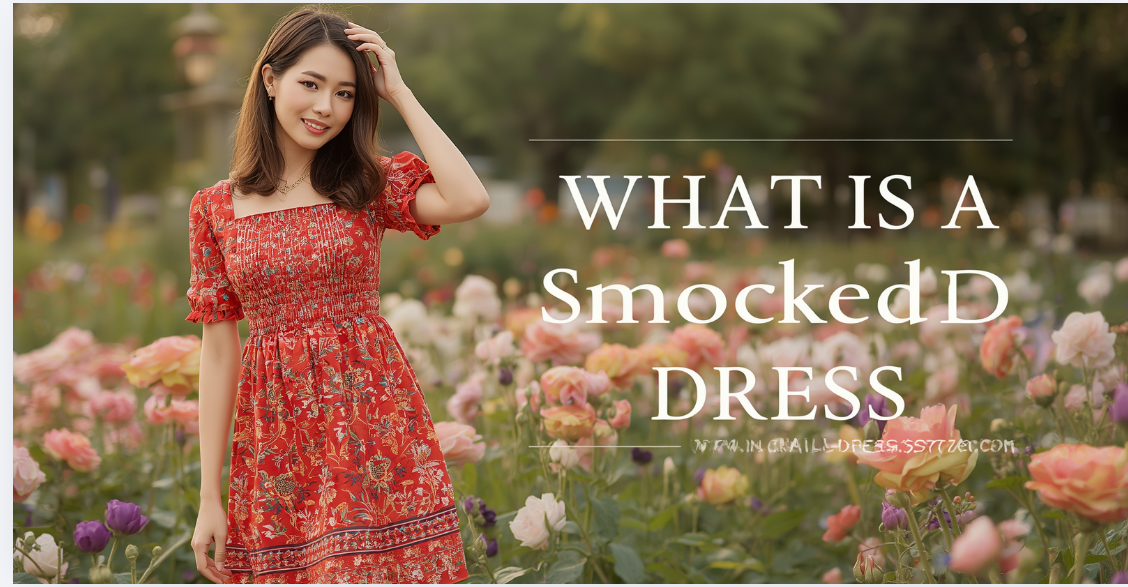
When browsing fashion boutiques, runway reports, or vintage apparel collections, you will frequently encounter garments adorned with intricate, gathered needlework across the bodice, waist, sleeves, or neckline. But what is a smocked dress, and what makes this garment technique so timelessly popular across centuries of fashion history?
At its core, a smocked dress is a garment that incorporates smocking—an ancient textile technique in which lightweight fabric is systematically gathered into uniform micro-pleats and secured with elastic thread or decorative embroidery stitches. This unique process transforms flat, non-stretch woven fabrics like cotton, linen, silk, and lawn into dynamic, three-dimensional garments that stretch and contract naturally over the body.
Unlike conventional fitted dresses that rely on rigid darts, metal zippers, plastic boning, or sewn-in elastic bands, a smocked dress achieves its body-contouring structure entirely through the physics of gathered fabric and stitched tension. The result is a flattering garment that provides flexible comfort, uninhibited range of motion, and a distinct, romantic texture.
Defining the Aesthetic: What Is a Smocked Dress in Modern Fashion?
To understand what is a smocked dress in contemporary fashion, one must look at how this historical craft has merged with modern manufacturing techniques. A smocked dress is defined by its tactile, accordion-like gathered panels that expand to accommodate the wearer’s movements before snapping cleanly back into shape.
In modern retail, smocked dresses appear across a broad range of aesthetics—from breezy cottagecore sun-dresses and resort-wear maxis to elegant formal gowns and classic children’s heirloom attire. The smocking can cover the entire bodice, cinch the waistline, form comfortable elasticized cuffs on puff sleeves, or create an intricate decorative panel across the shoulders and back.
THE CORE MECHANICS OF FABRIC SMOCKING

  [ Flat Woven Fabric ]
         │
         ▼  (Systematic micro-pleating / gathering along grid lines)
  [ Parallel Pleat Columns ]
         │
         ▼  (Cross-stitching with elastic bobbin thread or embroidery floss)
  [ 3D Smocked Panel ] ──► Provides 4-way mechanical & elastic stretch
                       ──► Eliminates need for zippers, buttons, or rigid seams
                       ──► Creates built-in body sculpting & flexible comfort
What distinguishes a smocked dress from ordinary elasticated clothing is the visual art of the gathered folds. Rather than pulling fabric into irregular bunches under a hidden casing, smocking organizes the textile into crisp, parallel ridges. These ridges are held together by parallel rows of stitches, forming geometric patterns such as honeycombs, diamonds, waves, or cables.
The Historical Evolution: What Is a Smocked Dress from Medieval Utility to Runway Glamour?
Understanding what is a smocked dress requires exploring a rich history that spans over five centuries. Long before the invention of synthetic spandex, rubber elastics, or automated sewing machines, tailors and needleworkers relied on smocking as a brilliant structural solution.
Medieval and Renaissance Roots (15th–17th Centuries)
Smocking originated in rural England and continental Europe during the 15th century. The word itself derives from “smock,” the archaic term for an unshaped linen shift or chemise worn as a primary undergarment.
During this era, agricultural laborers, waggoners, and shepherds wore thick outerwear garments called “smock-frocks”. These smock-frocks were crafted from heavy, durable coarse linen or wool to protect workers against harsh weather and physical wear. Because rigid, fitted seams would restrict physical labor, artisans added hand-smocking across the chest, back, and cuffs. This created “mechanical stretch,” allowing workers to swing scythes, handle livestock, and lift heavy loads without tearing their clothing.
HISTORICAL TIMELINE OF SMOCKING

15th Century        18th–19th Century      Late Victorian Era    1950s–Present
────────────        ─────────────────      ──────────────────    ─────────────
Utilitarian work    Regional embroidery    Adopted into nursery  Invention of elastic
smocks for English  patterns emerge for    and children's dress  bobbin thread and
agricultural        distinct trades and    fashion; praised by   multi-needle pleaters
laborers.           craftspeople.          Arts & Crafts movement. enable mass fashion.
Regional Embroidery Patterns in the 18th and 19th Centuries
By the 18th century, smocking transformed from a basic utilitarian trick into a highly stylized, decorative craft. In the English countryside, distinct smocking patterns emerged to indicate a worker’s trade:
- Shepherds: Favored tree-like “feather stitches” representing foliage.
- Carters and Waggoners: Incorporating wheel-and-whip motifs into chest panels.
- Fishermen: Utilizing heavy sailcloth smocks with tight cable stitching designed to resist salt spray.
These traditional garments were designed to be fully reversible. The collars and smocked bodices were patterned identically on the front and back so workers could wear the garment inside-out to double its lifespan before washing.
The Victorian Nursery and Aesthetic Movement
During the late 19th century, the Industrial Revolution replaced traditional farm smocks with factory uniforms. However, smocking did not disappear; instead, it was reclaimed by high fashion and the Aesthetic Movement.
Influential artists and designers—notably Arthur Liberty of Liberty London and illustrator Kate Greenaway—championed hand-smocked dresses as a reaction against restrictive Victorian corsetry. Smocked garments were praised for their natural, organic drape and soft, romantic silhouette. During this period, smocking became deeply entrenched in nursery fashion, becoming the gold standard for baby rompers, christening gowns, and young girls’ party dresses due to its ability to stretch as children grew.
Mechanical vs. Elastic Machine Smocking: Technical Differences in What Is a Smocked Dress
When evaluating what is a smocked dress, it is critical to distinguish between the two primary manufacturing methods used today: traditional hand smocking and modern machine elastic smocking. While both produce gathered texture, their mechanical properties, longevity, and production techniques differ significantly.
COMPARISON OF SMOCKING METHODS

Method              Thread Type          Stretch Source         Production & Durability
──────────────────────────────────────────────────────────────────────────────────────────
Hand Smocking       Embroidery floss     Mechanical flexing of  Handcrafted; lasts decades
                    (Cotton / Silk)      gathered pleat grid    without degrading.

Machine Smocking    Top: Standard thread Built-in synthetic     Automated mass-market;
                    Bottom: Thin elastic rubber/spandex core    degrades with high laundry heat.
1. Traditional Hand Smocking (Embroidery-Based Mechanical Stretch)
Traditional hand smocking relies entirely on precise hand needlework and non-elastic embroidery threads (such as crewel cotton or silk).
- Preparation: The fabric is first marked on the reverse side with an evenly spaced grid of dots (historically marked by hand or iron-on transfer dots, and today often pulled through a mechanical multi-needle pleater machine).
- Gathering: Temporary basting threads pull the fabric into uniform pleats.
- Stitching: The artisan uses non-stretch embroidery thread to stitch decorative stitches (cable, honeycomb, trellis) across the peaks of the pleats.
- The Elastic Mystery: Even though the embroidery thread itself does not stretch, the geometric structure of the stitches allows the pleats to open like an accordion. Because it contains no synthetic rubber elastics, hand-smocked garments can last for generations without losing their shape or deteriorating in the laundry.
2. Modern Machine Smocking (Elastic Thread / “Mock Smocking”)
The vast majority of contemporary women’s ready-to-wear dresses feature machine elastic smocking.
- Mechanism: The sewing machine is set up with standard garment thread in the top needle and a thin, stretchy elastic thread wound onto the bobbin under slight tension.
- Operation: As the machine sews straight, parallel lines across the fabric, the elastic bobbin thread automatically contracts the material into neat rows of micro-pleats.
- Performance: Machine smocking relies on the physical recovery of internal synthetic latex or spandex fibers inside the bobbin thread. It is fast to manufacture, highly elastic, and allows ready-to-wear garments to fit multiple body sizes comfortably.
Fabric Mechanics and Mathematical Ratios: How a Smocked Dress Is Engineered
Creating a high-quality smocked dress requires precise mathematical calculation long before a single stitch is placed. Because smocking gathers large expanses of material into compact panels, pattern makers must apply a specific gathering ratio.
The Gathering Ratio (Fullness Factor)
The standard gathering ratio for smocking is 3:1. This means that to produce a finished, smocked bodice panel measuring 12 inches in width, the pattern maker must start with 36 inches of flat fabric.
$$Ratio = \frac{\text{Unfinished Flat Fabric Width}}{\text{Finished Smocked Panel Width}}$$
Depending on the fabric weight and intended stretch density, designers adjust this ratio:
- Lightweight Fabrics (Cotton Voile, Organza, Silk Chiffon): Require a 3.5:1 to 4:1 ratio to ensure the gathers look dense, opaque, and plush.
- Medium-Weight Fabrics (Cotton Lawn, Poplin, Linen): Use the classic 3:1 ratio for optimal flex and structure.
- Heavyweight Fabrics (Chambray, Lightweight Denim, Fine Wool): Utilize a 2:1 to 2.5:1 ratio to prevent the smocked area from becoming overly bulky or rigid.
FABRIC COMPATIBILITY MATRICES FOR SMOCKING

Ideal Fabrics                     Challenging / Unsuitable Fabrics
─────────────────────────────     ──────────────────────────────────
• Cotton Lawn & Voile             • Heavyweight Rigid Canvas
• Linen & Linen Blends            • Thick Leather & Faux Leather
• Silk Crepe de Chine             • Heavy Winter Fleece
• Rayon / Viscose Jersey          • Stiff Unwashed Denim
• Fine Chambray & Seersucker      • High-Pile Velvets
Textile Selection Criteria
Not all textiles are suited for smocking. The ideal fabric must possess three core characteristics:
- Suppleness: The material must fold into sharp micro-pleats without springing open rigidly.
- Stable Weave Structure: Woven fabrics hold smocking grids with greater precision than loose knits, preventing the stitches from pulling out of alignment.
- Low Bulk: Because the fabric volume triples across the smocked panel, heavy fabrics can create uncomfortably thick, heavy sections against the skin.
Anatomy of Smocking Stitches: Stitch Taxonomy in What Is a Smocked Dress
The unique visual appeal of a hand-smocked or decorative machine-smocked dress lies in its stitch patterns. Needlework masters utilize a library of distinct stitches, each serving a specific structural and aesthetic purpose.
STITCH TAXONOMY & VISUAL PATTERNS

Stitch Name         Visual Appearance               Structural Purpose
──────────────────────────────────────────────────────────────────────────────────────────
Cable Stitch        Parallel rows of rope-like      Stabilizes the top and bottom borders
                    knots                           of a smocked panel.

Honeycomb Stitch    Hexagonal, honeycomb cell       Provides maximum multi-directional flex
                    lattice                         and soft texture.

Trellis Stitch      Interlocking chevron / diamond  Creates dramatic geometric lattice
                    zigzags                         designs across the center bodice.

Wave Stitch         Alternating high and low        Adds flowing, undulating movement across
                    horizontal stitch lines         pleat ridges.

Vandyke Stitch      Tight, inverted diagonal wraps  Reinforces high-stress tension areas.
1. Cable Stitch
The cable stitch is the foundational workhorse of hand smocking. It creates a row of tight, rope-like stitches that cross over alternating pleat columns. Because cable stitching offers limited stretch, it is used at the upper and lower borders of a smocked panel to anchor the pleats securely in place.
2. Honeycomb Stitch
The honeycomb stitch is famous for creating a continuous hexagonal lattice across the surface of the fabric. By double-stitching alternating pairs of pleats and concealing the diagonal thread travels on the reverse side, the honeycomb stitch allows the gathered fabric to expand effortlessly in all directions. It is the softest, most elastic stitch in the hand-smocker’s toolkit.
3. Trellis Stitch
The trellis stitch combines rising stem stitches and falling outline stitches to form continuous diamond shapes across the bodice. Designers often use contrasting embroidery floss for trellis stitching to create eye-catching geometric patterns across simple solid-colored fabrics.
4. Wave Stitch
The wave stitch alternates tight horizontal stitches with sweeping diagonal transitions, producing a gentle wave or zigzag motif across the pleat ridges. It balances medium stretch with high visual appeal, making it popular for neckline borders.
Silhouette Diversity: Exploring What Is a Smocked Dress Across Garment Styles
One reason smocked dresses remain a fashion staple is their remarkable structural versatility. Designers apply smocking to different regions of a garment to achieve completely different aesthetics, functional fits, and levels of support.
SMOCKED DRESS SILHOUETTE VARIANTS

  [ Full Smocked Bodice ]        [ Smocked Waistband ]        [ Smocked Yoke ]
  ───────────────────────        ───────────────────        ────────────────
  • Complete 360° stretch        • Emphasizes natural waist • Suspends dress from chest
  • Replaces bras / zippers      • Creates cinch-and-flare  • Classic swing / A-line
  • Hugs curves comfortably      • Blouses top over skirt   • Ideal for maternity/vintage
1. The Smocked Bodice Dress
In this iconic design, the entire upper section of the dress—from the neckline down to the natural waist—is smocked.
- Fit Dynamics: The entire bodice stretches to form a custom, glove-like fit around the bust and ribcage.
- Functional Advantage: Eliminates the need for zippers, buttons, or internal boning. The continuous compression provides built-in support, allowing many wearers to go braless comfortably.
- Aesthetic: Frequently paired with dramatic puff sleeves or off-the-shoulder necklines for a fairytale, cottagecore look.
2. The Smocked Waistband Dress
In a smocked waist silhouette, the gathered stitching is isolated to a 3-to-6-inch band around the waistline.
- Fit Dynamics: Acts as an integrated, soft corset that cinches the waist while allowing the upper bodice to blouse loosely over the top.
- Functional Advantage: Provides waist definition without the uncomfortable pressure of a rigid belt or structured waistband.
3. The Smocked Yoke Dress
A historical style popular in childrenswear, vintage apparel, and bohemian fashion, the smocked yoke dress applies smocking exclusively across a narrow panel below the collarbones and across the upper shoulder blades.
- Fit Dynamics: The smocked yoke anchors the upper garment while allowing yards of un-smocked fabric to cascade downward in a dramatic A-line or trapeze swing silhouette.
- Functional Advantage: Extremely breezy, non-restrictive, and highly accommodating for fluctuating body frames.
4. Smocked Cuff and Sleeve Accent Dresses
Rather than smocking the torso, many contemporary dresses feature smocking on the sleeves. Smocked cuffs keep dramatic bishop or puff sleeves anchored securely at the wrist or upper arm, allowing wearers to push sleeves up the arm without them sliding down.
How to Style a Smocked Dress for Every Season and Occasion
The adaptable texture of a smocked dress allows it to transition easily across different dress codes and seasons.
SEASONAL STYLING MATRIX FOR SMOCKED DRESSES

Season           Outerwear & Layering         Footwear                 Key Accessories
─────────────────────────────────────────────────────────────────────────────────────────────
Spring           Light denim jacket           Woven leather mules      Rattan crossbody bag
Summer           None (Standalone piece)      Strappy espadrilles      Wide-brim straw hat
Autumn           Chunky knit cardigan         Suede ankle boots        Wide leather belt
Winter           Fitted turtleneck underneath Knee-high leather boots  Wool trench coat
Spring and Summer Casual Styling
During warm-weather months, light cotton or linen smocked dresses excel as standalone outfits.
- Boho-Chic: Pair a tiered maxi smocked dress with woven jute espadrilles, a wide-brim straw sun hat, and delicate gold jewelry.
- Everyday Casual: Style a knee-length floral smocked sun-dress with clean white leather sneakers and a cropped denim jacket for an effortless, comfortable daytime outfit.
Autumn and Winter Cold-Weather Layering
Because smocked dresses are often made from lightweight fabrics, smart layering extends their wear into colder seasons:
- Turtleneck Base: Layer a fitted, fine-gauge black knit turtleneck under a sleeveless or square-neck smocked dress.
- Outerwear Contrast: Pair a flowing midi smocked dress with structured leather jackets, heavy wool overcoats, or oversized slouchy cardigans. The contrast between soft micro-pleats and structured leather or heavy knits adds textural depth to winter outfits.
- Footwear: Swap summer sandals for suede ankle booties or fitted knee-high leather boots paired with tights.
Maternity and Postpartum Adaptability
A smocked dress is one of the most practical investments for maternity and postpartum wardrobes. Because the smocked bodice expands continuously alongside a growing bump and gently contracts postpartum, it eliminates the need to buy multiple temporary size adjustments. Furthermore, flexible smocked necklines can easily be pulled down for convenient nursing access.
Maintenance and Garment Care: Preserving the Elasticity of What Is a Smocked Dress
Because a smocked dress relies on delicate micro-pleats and (in modern garments) synthetic elastic threads, improper laundering can ruin its shape and fit. Following proper care techniques will keep the gathered panels springy and resilient for years.
GARMENT CARE PROTOCOL FOR SMOCKED DRESSES

  1. WASHING      ──► Cold water on Delicate cycle; use a mesh laundry bag.
  2. DETERGENT    ──► Mild liquid soap; NEVER use chlorine bleach or fabric softeners.
  3. DRYING       ──► Line dry flat in shade. NEVER tumble dry on high heat.
  4. STEAMING     ──► Low-temperature steamer; NEVER press hot irons onto elastic stitches.
Washing Best Practices
- Water Temperature: Always wash smocked garments in cold water (maximum 30°C / 86°F). Heat degrades elastic filaments, causing bobbin threads to snap and lose tension over time.
- Cycle Selection: Use a delicate or hand-wash machine cycle with a slow spin speed. Placing the dress inside a mesh laundry bag protects the delicate gathered stitches from catching on zippers or hardware from other garments.
- Detergent Selection: Use mild liquid detergents. Avoid chlorine bleach and fabric softeners. Softeners leave a chemical residue on elastic fibers that can break down synthetic rubber cores.
Drying Protocols and Heat Protection
Heat is the primary cause of ruined machine smocking. Exposing a smocked dress to a high-heat tumble dryer causes “elastic burnout,” leading to permanent loss of stretch, loose sagging threads, and distorted panels.
- Air Drying: Gently reshape the smocked panel while damp and lay the dress flat on a drying rack or towel, away from direct sunlight.
- Wrinkle Removal: Never press a hot flat iron directly onto smocked panels. High iron heat will melt elastic threads and crush the 3D texture of the pleats. Instead, use a low-temperature garment steamer held an inch away from the fabric, allowing the steam to relax wrinkles in the un-smocked skirt section while preserving the gathered bodice.
Pattern Drafting and Sewing Mechanics for Handmade Smocking
For seamstresses and fashion designers learning what is a smocked dress, building a smocked panel requires understanding specialized machine settings, pattern adjustments, and stitching sequences.
PATTERN CREATION WORKFLOW FOR A SMOCKED DRESS BODICE

Step 1: Calculate Width  ──► Multiply target finished bodice width by 3.0 (3:1 ratio).
Step 2: Mark Guide Lines ──► Draw parallel horizontal stitch lines every 3/8" to 1/2".
Step 3: Bobbin Threading ──► Hand-wind elastic thread onto bobbin under light tension.
Step 4: Top Threading    ──► Thread standard polyester garment thread in top needle.
Step 5: Stitch Rows      ──► Sew straight parallel rows, backstitching at seam edges.
Step 6: Steam Setting    ──► Apply gentle steam to contract the elastic bobbin threads fully.
Machine Settings for DIY Bobbin Smocking
- Winding the Bobbin: Hand-wind thin elastic sewing thread onto the machine bobbin, pulling it very gently so it sits snug on the spool without being stretched to its absolute maximum limit.
- Top Thread: Use standard 100% polyester sewing thread in the top needle.
- Stitch Length: Set your sewing machine to a longer stitch length (3.5mm to 4.0mm). Longer stitches allow the elastic bobbin thread to draw the fabric into deeper, more uniform gathers.
- Tension Adjustments: Increase the top thread tension slightly if the gathers appear too loose, or test on a scrap swatch to balance top and bottom thread pull.
- Steam Contracting: After stitching all parallel rows across the panel, hover a hot steam iron 1/2 inch above the fabric without touching it. The bursts of steam cause the elastic bobbin thread to shrink up tight, creating crisp, professional smocked micro-pleats.
Frequently Asked Questions (FAQs)
What is the difference between smocking and ruching?
While both techniques create gathered fabric texture, they use different construction methods. Smocking gathers fabric into neat, parallel micro-pleats that are secured across a grid using elastic threads or decorative stitches, allowing two-dimensional stretch. Ruching involves gathering fabric along a single seam or cord to create deliberate, localized rippling or draping effects.
Can a smocked dress fit different body sizes?
Yes. One of the greatest advantages of a smocked dress is its high elasticity and mechanical stretch. A smocked bodice can expand up to two or three times its resting width, allowing it to adapt effortlessly to body fluctuations, weight changes, maternity growth, and different bust-to-waist ratios.
Do smocked dresses shrink or lose their stretch over time?
Traditional hand-smocked dresses made with embroidery thread maintain their stretch indefinitely because their flex comes from geometric pleating rather than elastic. Modern machine-smocked dresses rely on synthetic elastic bobbin threads; if washed in hot water or dried on high heat, those elastic threads can break down and lose their bounce recovery over time.
How do you wash a smocked dress without ruining the gathers?
Always wash your smocked dress in cold water on a gentle machine cycle, preferably inside a mesh laundry bag to prevent thread snags. Avoid fabric softeners and tumble dryers, as high heat degrades elastic fibers. Reshape the garment while damp and lay it flat or hang it to air dry in the shade.
Can you iron a smocked dress?
You should never press a hot iron directly onto a smocked panel, as the weight and heat will crush the three-dimensional pleats and melt synthetic elastic threads. To remove wrinkles, use a garment steamer held an inch away from the fabric, or iron only the flat, un-smocked sections of the dress on a low heat setting.
Are smocked dresses suitable for formal occasions?
Yes. While smocked sun-dresses are popular for casual daytime wear, smocked dresses made from elevated fabrics like silk, chiffon, organza, or fine linen make gorgeous options for cocktail parties, weddings, and evening galas. Traditional hand-smocked heirloom dresses are also considered a gold standard for formal children’s wear.
Conclusion
Understanding what is a smocked dress reveals why this century-old textile art form continues to flourish in contemporary fashion. By transforming flat, woven fabrics into elastic, body-sculpting panels through precise gathering and stitching, smocking offers a unique combination of structural beauty, romantic texture, and uninhibited physical comfort. Whether crafted through traditional hand needlework or produced using modern elastic machine techniques, the smocked dress eliminates the need for rigid closures while delivering an adaptable fit that flatters every body shape. With simple cold-water care and heat-free laundering, a well-made smocked dress remains a timeless, versatile staple across every season.