
Walk into any grocery store or convenience corner across Canada, and you will encounter an aggressively purple bag sitting prominently on the snack aisle shelves. This bag contains a national culinary treasure, a snack food phenomenon that has historically baffled, intrigued, and utterly delighted palates around the globe. We are talking, of course, about the legendary all-dressed potato chip.
For the uninitiated, the initial encounter with this snack is a full-scale sensory event. It does not possess a singular, easily identifiable taste like cheddar or sour cream. Instead, it hits the palate with a tidal wave of conflicting yet strangely harmonious notes. It is simultaneously sweet, intensely salty, sharply acidic, deeply smoky, and distinctly savory. To truly understand the allure of this snack, one must look deep into the culinary science of its seasoning blend. If you have ever wondered what are all dressed chips flavour profiles, how they are engineered, and why they command such a cult-like following, this comprehensive breakdown will reveal everything you need to know about this legendary snack.
What Are All Dressed Chips Flavour Bases? The Big Four Combo
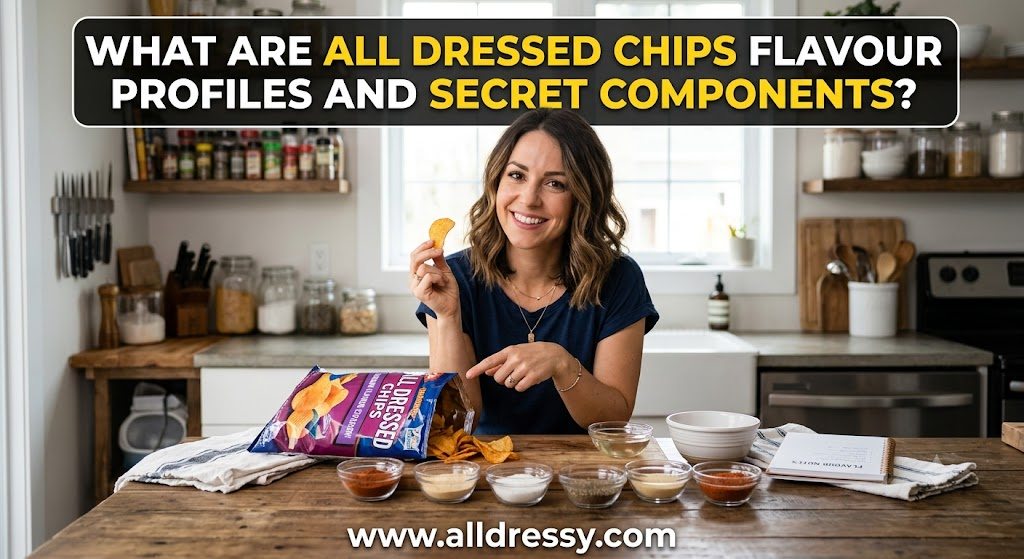
At its core, the all-dressed seasoning is not a brand-new, chemically isolated lab invention. Rather, it is a maximalist orchestration of the world’s most popular standalone potato chip dusts. To construct a traditional all-dressed chip, flavor engineers combine the distinctive flavor elements of four distinct chip varieties into a singular, heavy-duty coating.
The All-Dressed Flavor Quadrant:
┌──────────────────────────────────────┬──────────────────────────────────────┐
│        Barbecue (BBQ) Base           │           Tomato Ketchup             │
├──────────────────────────────────────┼──────────────────────────────────────┤
│ • Smoke, brown sugar, molasses notes │ • Tangy, vinegary, sweet tomato acid │
│ • Provides: Deep, savory foundation  │ • Provides: High-frequency brightness│
├──────────────────────────────────────┼──────────────────────────────────────┤
│          Salt and Vinegar            │        Sour Cream and Onion          │
├──────────────────────────────────────┼──────────────────────────────────────┤
│ • Acetic acid punch, heavy salinity  │ • Creamy lactic notes, savory allium │
│ • Provides: Lip-puckering bite       │ • Provides: Mellow, smooth finish    │
└──────────────────────────────────────┴──────────────────────────────────────┘
1. The Smoky Sweetness of Barbecue (BBQ)
The foundation of the all-dressed profile relies heavily on traditional barbecue chip seasoning. This layer provides a deep, warm base note dominated by brown sugar, molasses, torula yeast, and natural smoke flavors. The smoky sweetness acts as the baseline canvas, ensuring the chip has an earthy, slow-burning savory quality that grounds the more aggressive flavor components.
2. The Tangy Zest of Canadian Ketchup
You cannot analyze a true northern all-dressed experience without acknowledging the influence of ketchup seasoning. Unlike standard American tomato powders, Canadian ketchup chip seasoning is incredibly bright, highly acidic, and carries a punchy, artificial tomato sweetness. This element injects a vibrant red hue to the chip dusting and introduces a fruity, high-frequency brightness that immediately wakes up the taste buds.
3. The Lip-Puckering Bite of Salt and Vinegar
Just when the sweetness of the BBQ and ketchup begins to dominate your palate, the salt and vinegar component strikes. Utilizing heavy doses of sodium diacetate and malic acid, this element provides a sharp, mouth-watering sour punch. The intentional sharpness cuts cleanly through the oily richness of the fried potato slice, creating a refreshing bite that encourages you to reach back into the bag for another handful.
4. The Mellow Allium Depth of Sour Cream and Onion
The unsung hero of the entire all-dressed equation is the sour cream and onion component. To keep the intense acidity of the vinegar and ketchup from overwhelming the consumer, flavor chemists introduce onion powder, garlic powder, and subtle lactic acid components. This addition introduces a smooth savory depth, mimicking the cooling, savory effect of green onion dip.
The History and Etymology of “Toute Garnie”
To fully appreciate the genius of the all-dressed chip, it helps to understand where the name comes from. The term “all-dressed” is a direct Canadianism, heavily rooted in the unique French-English bilingual food culture of Quebec.
Linguistic Evolution of the Term:
    [Quebec Pizzerias: Pizza "Toute Garnie"]
                       ↓
    [Translated to English: Pizza "All-Dressed" (The Works)]
                       ↓
    [Adapted by Snack Industry: Potato Chips Assaisonnées (Everything on It)]
In Quebecois pizzerias, a pie ordered with “the works”—meaning pepperoni, green peppers, mushrooms, and onions—is traditionally ordered as a pizza toute garnie. When translated into local English vernacular, this became an “all-dressed” pizza.
In the late 1970s, legendary Quebec-based snack manufacturer Yum Yum looked to capture this “everything-on-it” philosophy in a snack bag, formally introducing a multi-seasoned potato chip variety to the public in 1978. On French-language packaging, these chips are labeled simply as assaisonnées (seasoned) or toute garnie, while English packaging proudly proclaims them as “All Dressed”. What started as a regional Quebecois experiment quickly spread across the maritime provinces and throughout Canada, establishing itself as a permanent pillar of the national identity.
Chemical Gastronomy: How the Brain Processes the Flawless Mashup
Why does combining four seemingly conflicting chip seasonings result in an incredibly addictive snack rather than a muddy, unpalatable mess? The answer lies in the complex science of human taste receptors and the psychological concept of sensory-specific satiety.
The Five Tastes Simultaneous Activation
The human tongue is hardwired to seek out five core tastes: sweet, salty, sour, bitter, and umami. Most potato chips target only one or two of these zones at a time. For example, a standard salt and vinegar chip hammers the salty and sour receptors, while a sweet BBQ chip targets sweet and umami.
The all-dressed chip is a masterclass in culinary engineering because it activates four out of the five taste receptors simultaneously:
- Sweet: Driven by sugar, dextrose, and molasses notes.
- Salty: Driven by fine-grain sodium chloride and potassium chloride.
- Sour: Driven by sodium diacetate, citric acid, and malic acid.
- Umami: Driven by yeast extracts, torula yeast, onion, garlic, and monosodium glutamate (MSG).
Because your brain receives a balanced burst of signals from all sides at once, no single taste note dominates long enough to cause flavor fatigue. This constant rotation of sensory inputs tricks the brain, keeping your taste buds continuously engaged and making it exceptionally easy to finish an entire bag in a single sitting.
The Ingredient Blueprint: Decoding the Back of the Bag
To understand exactly how major snack manufacturers pull off this multi-layered flavor profile, we must read past the marketing copy and analyze the precise chemical components listed in the manufacturing ingredients. While exact spice ratios are fiercely guarded trade secrets, the foundational building blocks of all-dressed seasoning follow a strict structural framework.
The All-Dressed Chemical Breakdown:
├── Acidifiers: Sodium Diacetate, Malic Acid, Citric Acid (The Sour Punch)
├── Sweeteners: Sugar, Dextrose, Corn Maltodextrin (The Flavor Carrier)
├── Flavor Enhancers: Torula Yeast, Yeast Extract, MSG (The Savory Depth)
└── Aromatics: Onion Powder, Garlic Powder, Paprika Extracts (The Colors & Scents)
The Acidifiers (Sodium Diacetate, Malic Acid, Citric Acid)
These dry acids are responsible for the sharp bite of the chip. Sodium diacetate is a molecular compound that bonds sodium acetate with free acetic acid, delivering a dry, highly concentrated burst of white vinegar flavor without making the fried potato soggy. Malic acid—the same acid found in sour green apples—prolongs the sour experience, giving the chip its mouth-watering finish.
The Sweeteners and Carriers (Sugar, Dextrose, Corn Maltodextrin)
Maltodextrin, derived from corn starch, acts as a microscopic, highly porous sponge. It serves as the physical vehicle that allows liquid flavors and volatile oils to be turned into a fine, free-flowing dry dust that adheres perfectly to the ridges of a chip. Pure cane sugar and dextrose balance out the harshness of the dry acids, creating a highly craved sweet-and-sour matrix.
The Umami Engines (Torula Yeast, Yeast Extract, MSG)
To give the chips their addictive, savory finish, brands rely on natural glutamates found in yeast extracts and torula yeast. Torula yeast is highly prized in the snack food industry because it delivers a rich, smoky, almost meaty undertone that forms the backbone of the BBQ component. Combined with MSG, these components trigger the umami receptors, signaling deep savory satisfaction to the brain.
Brand Showdown: Ruffles vs. Lay’s vs. Humpty Dumpty
While the core conceptual quadrant of BBQ, ketchup, salt & vinegar, and sour cream & onion remains constant, different snack food conglomerates execute the seasoning mix with drastically different priorities.
Brand Profile Matrix:
┌──────────────────────────────┬──────────────────────────────┬──────────────────────────────┐
│      Ruffles All Dressed     │       Lay's All Dressed      │     Humpty Dumpty / Old Dutch │
├──────────────────────────────┼──────────────────────────────┼──────────────────────────────┤
│ • Texture: Deeply Ridged     │ • Texture: Thin & Crispy     │ • Texture: Classic Ripple     │
│ • Profile: Vinegar-Dominant  │ • Profile: Sweet BBQ Bias    │ • Profile: Heavy Ketchup/MSG │
│ • Vibe: Intense & Bold       │ • Vibe: Light & Accessible   │ • Vibe: Aggressive & Savory  │
└──────────────────────────────┴──────────────────────────────┴──────────────────────────────┘
1. Ruffles All Dressed: The Heavyweight Champion
For decades, Ruffles has been the undisputed global ambassador of the all-dressed style.
- The Execution: Ruffles utilizes deep, rigid waves that act as physical traps for the seasoning powder. Their specific recipe leans heavily into the salt, vinegar, and onion quadrant. When you bite into a Ruffles version, the initial hit is intensely tart and acidic, followed closely by a rich, salty onion finish. It is a bold, uncompromising take built for extreme flavor lovers.
2. Lay’s All Dressed: The Smooth Contoured Cut
Formally pushed into international spotlight campaigns—including major U.S. launches featuring Super Bowl advertisements—Lay’s offers a completely different structural experience.
- The Execution: Built on a classic, thin-shaved potato chip slice, the seasoning distribution is completely uniform. The Lay’s recipe trends noticeably sweeter, prioritizing the warm brown sugar of the BBQ base and the sweet fruitiness of the tomato ketchup component over the aggressive, lip-puckering bite of vinegar. It serves as a fantastic, highly accessible entry point for beginners.
3. Humpty Dumpty and Old Dutch: The East Coast Icons
Dominating the snack landscape across Eastern Canada and parts of New England, these regional powerhouses stay true to old-school, rustic snack traditions.
- The Execution: Their all-dressed variations feature a deep, dark orange-red coating that leans heavily into the savory umami territory. The ketchup and smoky BBQ notes are pushed to maximum intensity, creating an incredibly rich, highly savory snacking experience.
The Cross-Border Migration: How America Discovered the Secret
For decades, all-dressed chips remained a closely guarded Canadian secret. American tourists returning from northern trips would routinely pack their suitcases full of purple bags, treating the snack like rare black-market contraband. However, the global snack landscape began to shift dramatically as food corporations recognized a massive, untapped market for maximalist flavor profiles.
The Keefe Group and “The Whole Shabang”
Fascinatingly, the first major wave of mainstream American exposure to the all-dressed flavor profile didn’t happen in standard supermarkets, but rather within the state and federal prison commissary systems. Produced by the Keefe Group, a chip brand called “The Whole Shabang” gained an absolute cult following among inmates due to its intense mix of BBQ, salt, vinegar, and garlic notes. The chips were so highly revered that ex-inmates actively petitioned the company to release them to the general public, which they formally did in 2016, proving that American consumers were entirely ready for everything-on-it chips.
The Frito-Lay Global Push
Sensing a major shift in consumer habits, Frito-Lay initiated limited-time test markets for Ruffles All Dressed across the United States in late 2015 and 2016. The response was overwhelmingly positive, leading to permanent shelf placement in select regions.
The expansion reached its absolute peak when Frito-Lay rolled out Lay’s All Dressed nationwide in the United States, cementing the Canadian flavor profile as a permanent global phenomenon. Modern snack lovers no longer view all-dressed as an eccentric regional oddity, but rather as an elite, tier-one option in the competitive universe of salty snacks.
Frequently Asked Questions (FAQs)
What does the “all-dressed” flavour actually taste like?
Because all-dressed chips are a hybrid flavor style, the exact taste sensation varies as you chew. The initial hit to your palate is a sharp, mouth-watering sour pop driven by vinegar and salt. This is followed closely by a deep, smoky sweetness from the barbecue base and the bright, tangy profile of Canadian ketchup. The experience finishes with a smooth, savory aftertaste of mild onion and garlic, preventing the extreme acidity from overwhelming your tongue.
Are all-dressed chips available outside of Canada?
Yes. While all-dressed chips were historically a strictly Canadian snack staple, their massive popularity led to global expansion. Frito-Lay permanently introduced Ruffles All Dressed to the United States market following wildly successful limited-time campaigns. Major snack brands have expanded their rollouts to target experimental snack lovers globally.
Do all-dressed chips contain actual dairy or meat products?
Though the seasoning incorporates “sour cream and onion” and “smoky barbecue” profiles, many mainstream variations rely entirely on artificial and plant-based flavor substitutes to achieve these tastes. The creamy notes are often replicated using lactic acid and whey, while the smoky, meaty depth is pulled from torula yeast rather than actual meat byproducts. However, dietary profiles vary widely by manufacturer—always read the rear ingredient panel if you are managing a strict vegan or dairy-free lifestyle.
Why is the packaging for all-dressed chips almost always purple?
In the snack food industry, bag colors serve as visual anchors to help consumers differentiate between core flavor profiles at a quick glance (such as red for barbecue, blue for regular salted, and green for sour cream). When all-dressed chips began dominating the Canadian retail space, brands adopted a deep, high-visibility purple color scheme to distinguish the maximalist blend from standalone flavors. This color choice has become an unofficial industry rule, keeping the flavor recognizable on any supermarket shelf.
Conclusion
The all-dressed potato chip stands as a brilliant masterclass in modern sensory food science and regional culinary pride. By defying standard flavoring conventions and embracing a maximalist mashup of barbecue, ketchup, salt and vinegar, and sour cream and onion, flavor chemists created a unique snack that targets multiple taste receptors simultaneously. This sweet, salty, tangy, and savory configuration effectively hacks sensory-specific satiety, making it one of the most addictive chip styles on Earth. From its humble roots in Quebec’s bilingual food scene to its major expansion into international markets, the all-dressed chip proves that when it comes to classic snack foods, sometimes choosing “everything on it” is the ultimate recipe for success.