
A dress provides a beautiful, clean canvas, but adding a scarf is what transforms it from a simple outfit into a curated look. Knowing how to tie a scarf on a dress is one of the most versatile style skills you can master. It allows you to breathe new life into a basic capsule wardrobe, transition a summer sleeveless dress into chilly autumn weather, or instantly add a pop of color and texture to a monochrome look.
Many people hesitate to pair these two items because they worry about looking bulky, dated, or cutting off their silhouette. However, by understanding the interplay of fabric weights, dress necklines, and knotting techniques, you can master how to tie a scarf on a dress to flatter your frame and express your personal aesthetic.
This comprehensive guide breaks down the precise mechanics of pairing scarves with dresses, ranging from classic Parisian folds to advanced structured draping.
1. Matching Scarf Fabrics to Your Dress Silhouette
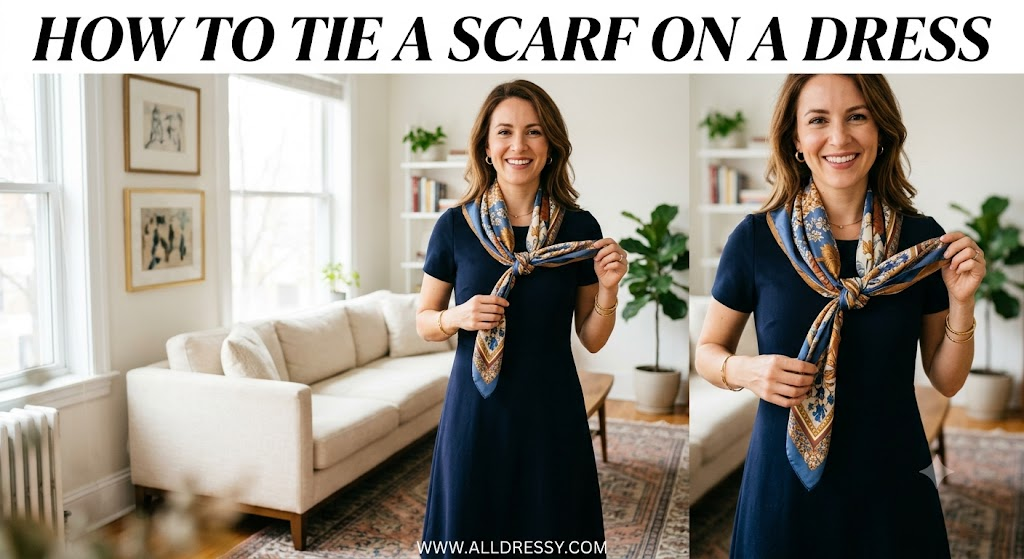
Before tying your first knot, you must evaluate the fabric compatibility. Pairing the wrong type of scarf with a dress can cause the outfit to bunch, pull, or look visually unbalanced.
Lightweight and Silk Scarves
Silk, chiffon, satin, and lightweight rayon scarves are exceptionally fluid. They draping beautifully without adding bulk, making them the premier choice for:
- Fitted sheath dresses
- Formal evening gowns
- Delicate slip dresses
- A-line dresses with lightweight cotton or linen blends
Because these materials are thin, they allow for intricate, multi-layered knots that sit cleanly against your chest or collarbone without overwhelming the dress’s natural tailoring.
Medium-Weight Cotton and Modal Scarves
Modal, jersey, and fine-gauge cotton blends offer a bit more structure while maintaining drape. These work best with:
- Casual shirt dresses
- Denim or utility dresses
- Fit-and-flare knit dresses
These fabrics excel at mid-tier knots like the infinity loop or a casual wrap-and-tuck, adding an effortless, everyday texture to casual daytime dresses.
Heavyweight, Wool, and Blanket Scarves
Chunky knits, cashmere, and oversized blanket scarves provide immense warmth and dramatic visual texture. They pair seamlessly with:
- Heavy sweater dresses
- Structured wool shift dresses
- Long-sleeved winter maxi dresses
When learning how to tie a scarf on a dress using heavier textiles, the goal shifts from creating intricate knots to managing volume. The draping must be deliberate so it complements—rather than swallows—your silhouette.
2. Classic Knotting Techniques: How to Tie a Scarf on a Dress
These timeless methods serve as the foundation of scarf styling. They are highly adaptable and work across an array of dress styles.
The French Twist
The French Twist is an incredibly chic, polished method that sits neatly to one side of the neck. It works beautifully with high-neck or boatneck dresses, offering a retro, flight-attendant-inspired elegance.
Step 1: Fold a square silk scarf into a long, narrow band (the bias fold).
Step 2: Wrap the band around your neck, crossing the ends behind you and bringing them back to the front.
Step 3: Tie a loose double knot on the left or right side of your collarbone.
Step 4: Let the tails drape downward naturally, adjusting the loop around your throat so it rests comfortably.
The Cowl Drape (The Fake Infinity)
If you want the cozy, layered look of an infinity scarf but only have a standard long oblong scarf, this technique is your solution. It works perfectly with high-neck knit dresses or simple shift dresses.
Step 1: Drape the oblong scarf evenly over your neck.
Step 2: Take the two loose ends and tie them together in a secure, small double knot at the absolute tips.
Step 3: Twist the loop you've created into a figure-eight shape.
Step 4: Lift the bottom loop of the eight and place it over your head.
Step 5: Adjust the layers so the knot is hidden at the back of your neck, leaving a full, cascaded cowl effect in front.
The Classic Loop and Pull-Through (The European Knot)
This is a low-bulk, high-security knot that is excellent for keeping you warm while showcasing the pattern of a medium-weight scarf against a solid-colored dress.
Step 1: Fold your long oblong scarf directly in half lengthwise.
Step 2: Drape it behind your neck so you have the open tails on one side and the folded loop on the other.
Step 3: Feed both loose tails through the loop.
Step 4: Slide the loop upward toward your neck to tighten, adjusting the tension so it sits flat against your chest.
3. Advanced and Structured Draping for Formal Dresses
When dressing for a formal event, a cocktail party, or a professional gala, your scarf should function less like a winter accessory and more like an architectural extension of the dress itself.
The Asymmetric Shoulder Drape
For sleeveless, strapless, or slip-style formal dresses, a long silk or satin wrap can be styled asymmetrically to mimic the elegant lines of a one-shoulder gown.
To achieve this, drape a wide silk wrap over your left shoulder, allowing one side to hang down your back to the waist and the other side to cover your front chest. Take the front tail, bring it under your right arm, across your back, and secure it softly to the back tail at your left hip using a vintage brooch or a subtle hidden safety pin. This creates an elegant, Grecian-style overlay that moves beautifully when you walk.
The Back-Drop Drape
If you are wearing a dress with a dramatic low back or an open-back design, reversing the traditional direction of your scarf can emphasize this design feature.
Using a sheer chiffon or fine silk oblong scarf, place the center of the scarf against the front of your throat, crossing the two tails behind your neck. Instead of bringing them back to the front, let the long tails trail down your bare back. You can leave them loose to flutter as you move, or lightly tie them in a low drape across your shoulder blades.
4. How to Tie a Scarf on a Dress Based on Necklines
The golden rule of learning how to tie a scarf on a dress is to respect the neckline of the garment. Your scarf should enhance your neck and chest area, not compete with or crowd it.
| Dress Neckline | Recommended Scarf Style | Primary Goal |
| V-Neck & Scoop Neck | Ascot Knot, Internal Tuck, Matrix Fold | Fill the open skin area without overlapping the dress fabric. |
| Boatneck & Off-the-Shoulder | French Twist, Side-Knot | Keep the clavicle line clean while adding lateral visual interest. |
| High Neck & Turtleneck | Long Hanging Drape, Loose Blanket Wrap | Elongate the torso and prevent the neck from looking shortened. |
| Strapless & Spaghetti Strap | Classic Wrap, Shoulder Pashmina | Provide elegant upper-body coverage and warmth. |
Styling for V-Neck and Scoop Neck Dresses
Deep necklines leave a lot of open skin exposed. A scarf is a great tool to fill this space, but if the scarf overlaps the actual fabric of the dress haphazardly, it looks messy.
Try an Ascot Knot: take a square silk scarf folded into a triangle, place the point facing down over your chest, wrap the ends around your neck, bring them back to the front, and tie them over the front point. This creates a smooth bib of fabric that nests perfectly within the V-shape of your dress.
Styling for Boatneck and High-Neck Dresses
Boatnecks open up your frame horizontally. To balance this, opt for a tight, off-center accent like a Side-Knot. Avoid large, bulky wraps here, as they smash the horizontal line of the dress and make your shoulders look disproportionately broad.
For high-neck or turtleneck sweater dresses, avoid tight neck knots entirely. Instead, use a long oblong scarf draped loosely over your shoulders without any knots at all, letting the long vertical lines extend down to your thighs to visually elongate your torso.
5. Cinch and Belt Methods: Defining Your Waist
One of the biggest complaints people have when figuring out how to tie a scarf on a dress is that the scarf hides their waistline, making them look boxy. Belting your scarf completely solves this issue, shifting the focus back to your waist while creating an editorial, high-fashion look.
The Full-Length Belted Vest
This method works spectacularly well with a fitted sheath dress, a monochrome bodycon dress, or a simple long-sleeved shirt dress. It essentially turns a long scarf into a temporary patterned vest overlay.
Step 1: Put on your dress and select a long, wide oblong scarf (modal, linen, or lightweight wool work best).
Step 2: Open the scarf up fully across its width and drape it evenly over the back of your neck.
Step 3: Pull both sides flat down over your chest, ensuring they lie completely smooth and parallel over your bust and stomach.
Step 4: Take a thin or medium-width belt and fasten it around your natural waist, directly over both the dress and the scarf.
Step 5: Gently tug the scarf fabric right above the belt to create a slight, relaxed blouse effect, ensuring the panels stay aligned down to the hem of your dress.
The Single-Shoulder Belted Sash
For a more avant-garde, structural look, you can belt just one side of a scarf. Take a medium-sized oblong scarf and drape it over your right shoulder only. Let one tail hang straight down your front and the other straight down your back. Bring a belt around your waist and secure it tightly, locking the scarf pieces flat against the right side of your dress while leaving the left side of your dress completely unencumbered. This asymmetrical line draws the eye diagonally up and down, creating a slimming effect.
6. Seasonal Styling: Adjusting Your Look Year-Round
The techniques you use to tie a scarf on a dress should shift alongside the changing seasons to ensure your outfit remains both practical and stylistically appropriate.
Spring and Summer Dress Accents
Warm-weather scarf styling relies entirely on small footprints and breathable fabrics. When wearing a linen sundress or a cotton tiered dress, a large scarf will feel oppressive.
Instead, look to the mini neckerchief or bandana-sized silk scarf. Twist it into a thin band and tie a tight double knot around your neck, leaving the tiny tails sticking out like a vintage neckerchief. This adds a playful accent of color near your face without trapping body heat, pairing wonderfully with sleeveless or short-sleeved dresses.
Autumn and Winter Dress Layering
Cold-weather styling demands that your scarf provide functional insulation while complementing your winter dresses. When wearing a heavy knit or ribbed sweater dress, look to oversized plaid or cashmere scarves.
A great approach is the Tossed Shoulder: fold a large blanket scarf into a giant triangle, drape the bulk of it across your chest, and toss one long end loosely over your opposite shoulder. This creates a cozy, voluminous shield against the wind that mirrors the chunky, comfortable texture of winter knitwear.
7. Color, Pattern, and Texture Coordination Theory
Successfully executing how to tie a scarf on a dress requires an eye for visual harmony. If your scarf and dress are fighting for attention, the overall outfit will feel chaotic.
The Rule of Contrast
The easiest way to ensure a cohesive look is to follow the rule of singular focus:
- If your dress is heavily patterned (florals, stripes, houndstooth, abstract prints), your scarf should be a solid color. For the best cohesion, select a solid scarf that matches the underdominant accent color hidden within the dress’s pattern.
- If your dress is a solid color, you have free rein to use a vibrant, wildly patterned scarf. The scarf will act as the statement piece of your outfit, drawing eyes upward toward your neckline and face.
Mixing Textures for Monochrome Outfits
If you are putting together an all-black, all-cream, or fully monochromatic outfit, you can use a scarf to add depth through textural contrast rather than color.
For example, pairing a matte cotton dress with a highly reflective, glossy satin scarf adds an instant layer of sophistication. Similarly, pairing a smooth, sleek knit dress with a highly textured, fringed wool scarf creates visual separation between the two items, keeping the monochromatic look from feeling flat or boring.
8. Proportions and Body Shape Strategy
A scarf is a powerful tool for optical illusion. By changing how you drape and tie it, you can direct the eye to highlight your favorite features or balance out your natural body proportions.
For Petite Frames
If you are on the shorter side, avoid massive blanket scarves or heavy cowl drapes that bunch up directly under your chin. This cuts off your neck line and makes you look shorter. Instead, focus on long, vertical lines. Use long, thin silk or modal scarves that hang loose without knots, or utilize the belted vest method. The unbroken vertical lines created by the hanging fabric will visually elongate your frame, making you appear taller.
For Broad Shoulders or Inverted Triangle Shapes
If your shoulders are significantly wider than your hips, avoid the French twist, side-knots, or wide boatneck capes, as these details emphasize horizontal width across the collarbone.
Instead, opt for knots that pull downward and create a strong central vertical or V-shape line. The European loop-and-pull-through or a long, loosely knotted low ascot will draw the eye inward toward the center of your torso, softening the width of your shoulders.
For Pear Shapes and Enhancing the Bust
If you want to add volume to your upper body to balance out wider hips, thick cowl wraps, layered infinity loops, and intricately knotted silk bibs are your best friends. By adding texture and fullness right at the chest and neckline, you draw the eye upward and create a beautifully balanced, hourglass-mimicking proportion against your dress’s skirt.
Frequently Asked Questions About How to Tie a Scarf on a Dress
How do I choose the right scarf for my dress?
Choose a scarf that complements your dress in both color and fabric. Lightweight silk, chiffon, or satin scarves work well with formal dresses, while cotton and linen scarves are ideal for casual and summer outfits. For colder seasons, wool or cashmere scarves pair beautifully with sweater dresses.
What is the easiest way to tie a scarf on a dress?
The classic loop is one of the easiest methods. Fold a long scarf in half, place it around your neck, and pull the loose ends through the loop. This simple style looks elegant and works with most dress types.
Can I use a scarf as a belt on a dress?
Yes. A long, lightweight scarf can be folded into a narrow strip and tied around your waist to create a stylish belt. This technique defines your waist and adds a pop of color to a plain dress.
Which scarf fabric is best for formal dresses?
Silk and satin scarves are the best choices for formal dresses because they have a smooth texture, elegant drape, and luxurious appearance. Chiffon scarves are another excellent option for weddings and evening events.
Can I wear a patterned scarf with a printed dress?
Yes, but it’s important to maintain balance. If your dress has bold prints, choose a scarf with a subtle pattern or a solid color that matches one of the shades in the dress. This creates a coordinated and stylish look.
How do I tie a scarf on a dress during winter?
For winter, choose thicker fabrics like wool or cashmere and use styles such as the infinity wrap, double loop, or oversized shoulder wrap. These techniques provide warmth while enhancing your outfit.
What colors of scarves are the most versatile?
Neutral colors like black, white, beige, gray, and navy are the most versatile because they pair well with almost any dress. Adding a few scarves in bright colors or floral patterns can also help create a variety of stylish looks.
How can I keep my scarf looking new?
Follow the care instructions on the label, wash delicate fabrics gently, avoid harsh detergents, air dry whenever possible, and store scarves neatly folded or rolled. Proper care helps maintain their color, texture, and shape.
Conclusion
Learning how to tie a scarf on a dress is an easy way to refresh your wardrobe and express your personal style without investing in new clothing. A well-chosen scarf can add elegance, color, texture, and versatility to any dress, making it suitable for casual outings, professional settings, formal events, and seasonal occasions.
By selecting the right fabric, choosing colors that complement your outfit, and experimenting with different tying techniques, you can create countless stylish combinations from a single dress. Whether you prefer a classic loop, a sophisticated French knot, a waist belt, or a graceful shoulder drape, each style offers a unique way to enhance your overall appearance.
With the tips, styling ideas, and techniques covered in this guide, you can confidently wear scarves throughout the year and enjoy endless outfit possibilities. A versatile collection of scarves is a timeless wardrobe investment that allows you to transform simple dresses into polished, fashionable ensembles for every occasion.