
Knowing how to measure yourself for dress is the first and most important step toward finding clothing that fits beautifully. Whether you’re buying a casual dress online, ordering a custom evening gown, sewing your own garment, or working with a tailor, accurate body measurements help ensure a flattering fit and reduce the chances of returns or costly alterations.
Many people rely on standard clothing sizes like Small, Medium, or Large, but these sizes vary significantly between brands and countries. That’s why understanding how to measure yourself for dress is far more reliable than simply guessing your size. A dress that matches your exact body measurements will feel more comfortable, enhance your natural shape, and give you greater confidence.
This complete guide explains every body measurement needed for dresses, including bust, waist, hips, shoulders, arm length, torso length, and dress length. You’ll also learn measuring techniques used by professional tailors, how different dress styles affect measurements, common measuring mistakes to avoid, and expert tips for achieving the most accurate results.
Why Learning How to Measure Yourself for Dress Is Important
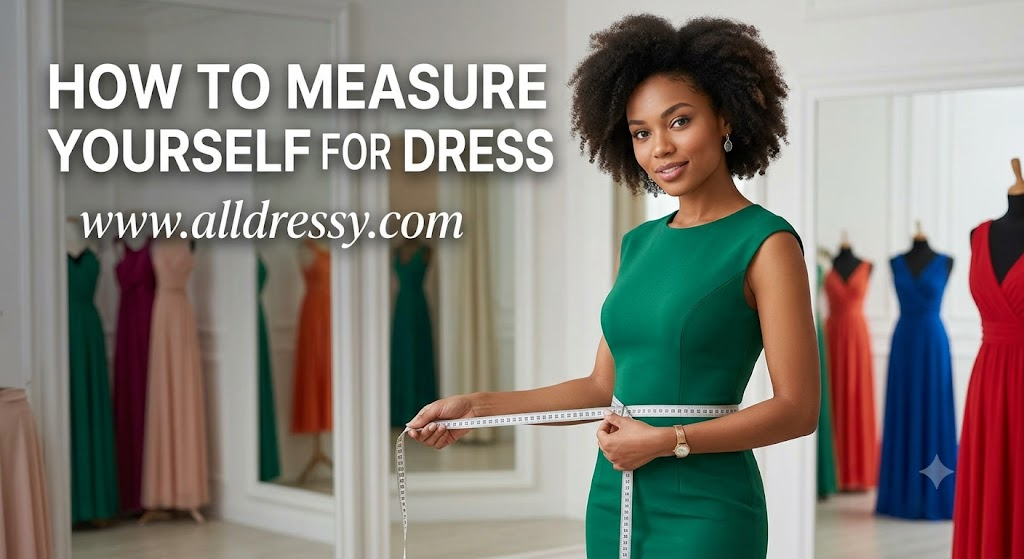
Taking accurate measurements provides many benefits beyond simply choosing the right size.
Advantages include:
- Better fitting dresses
- Fewer online returns
- Easier custom tailoring
- More confident online shopping
- Improved overall appearance
- Reduced alteration costs
- Greater comfort throughout the day
- More accurate sewing patterns
- Better understanding of your body proportions
Whether purchasing ready-made clothing or custom garments, measurements are the foundation of a perfect fit.
Tools You Need Before Measuring Yourself
Fortunately, measuring yourself requires only a few inexpensive tools.
Gather the following:
- Flexible measuring tape
- Full-length mirror
- Notebook or phone for recording measurements
- Lightweight fitted clothing or undergarments
- Hair tie (if you have long hair)
- A trusted friend or family member for assistance (recommended)
Professional tailors always use soft measuring tapes because they wrap naturally around the body.
What Clothing Should You Wear While Measuring?
Your clothing affects the accuracy of every measurement.
For best results wear:
- Lightweight camisole
- Thin T-shirt
- Leggings
- Properly fitting bra
- Bare feet
Avoid:
- Hoodies
- Sweaters
- Thick jeans
- Bulky undergarments
- High heels
The less bulk between the tape and your body, the more accurate your measurements will be.
Should You Measure Yourself Alone?
Although many people measure themselves successfully, assistance improves accuracy considerably.
Another person can help with:
- Shoulder width
- Back width
- Arm length
- Full dress length
- Back waist length
If you’re measuring alone, use a large mirror to keep the measuring tape level.
Understanding Dress Measurements
Different dressmakers request different measurements depending on the garment.
Common measurements include:
- Bust
- High bust
- Underbust
- Waist
- High hip
- Full hip
- Shoulder width
- Shoulder to bust
- Shoulder to waist
- Back waist length
- Armhole
- Bicep
- Wrist
- Sleeve length
- Dress length
- Height
Knowing each measurement helps you choose dresses more confidently.
How to Measure Bust for a Dress
The bust measurement is one of the most important measurements for any dress.
Step 1
Stand naturally with relaxed shoulders.
Step 2
Wrap the measuring tape around the fullest part of your bust.
Usually this passes across the nipples and around your shoulder blades.
Step 3
Keep the tape parallel to the floor.
Step 4
Do not pull the tape tightly.
The tape should rest comfortably against your body.
Record the measurement.
How to Measure High Bust
High bust measurements are commonly used for fitted dresses and bridal gowns.
Wrap the tape above your bust under your armpits.
This measurement helps determine the correct bodice size.
How to Measure Underbust
Measure directly beneath the bust where the bra band normally sits.
Keep the tape level.
Do not inhale deeply.
How to Measure Waist
Your natural waist is the narrowest part of your torso.
To locate it:
Stand straight.
Bend sideways.
The crease that forms marks your natural waist.
Wrap the measuring tape around this area.
Keep one finger beneath the tape for comfort.
Avoid sucking in your stomach.
How to Measure High Hip
The high hip sits approximately 3–4 inches below your waist.
Measure completely around this area.
This measurement is useful for fitted sheath dresses.
How to Measure Full Hip
Measure around the fullest part of your hips and buttocks.
Stand with feet together.
Ensure the tape stays level.
This measurement affects skirts and fitted dresses significantly.
How to Measure Shoulder Width
Shoulder width influences how the dress hangs.
Measure from one shoulder bone to the other across your upper back.
A helper makes this measurement much easier.
How to Measure Shoulder to Bust
Measure from the highest point of the shoulder down to the fullest part of your bust.
This measurement helps position bust darts correctly.
How to Measure Shoulder to Waist
Place the tape at the highest shoulder point.
Measure vertically over the bust to your natural waist.
Tailors use this measurement to create balanced bodices.
How to Measure Back Waist Length
Measure from the base of your neck to your natural waist.
Keep your back straight.
Avoid leaning forward.
How to Measure Armhole
Wrap the tape around your shoulder where the sleeve attaches.
Professional custom dresses often require this measurement.
How to Measure Bicep
Measure around the widest part of your upper arm.
Relax your muscles.
This ensures sleeves remain comfortable.
How to Measure Wrist
Wrap the measuring tape around your wrist.
Add approximately half an inch if the dress includes fitted cuffs.
How to Measure Sleeve Length
Start from the shoulder point.
Measure over the slightly bent elbow.
Continue to the wrist bone.
Bent elbows provide better movement allowance.
How to Measure Dress Length
Dress length depends on the style.
Measure from:
Top of shoulder
Down the front
To your preferred hemline.
Common lengths include:
- Mini
- Above knee
- Knee length
- Midi
- Tea length
- Ankle
- Floor length
How to Measure Height
Stand barefoot against a wall.
Keep your head level.
Measure from floor to top of your head.
Many formal dress manufacturers use height alongside dress length.
Measuring for Different Dress Styles
Every dress style fits differently.
Examples include:
- Wrap dress
- Shift dress
- Sheath dress
- Fit-and-flare
- A-line
- Empire waist
- Mermaid
- Ball gown
- Bodycon
- Maxi dress
Each style emphasizes different measurements.
Measurements for A-Line Dresses
A-line dresses generally require:
- Bust
- Waist
- Hip
- Shoulder
- Dress length
Because the skirt flares naturally, hip measurements are slightly more forgiving.
Measurements for Bodycon Dresses
Bodycon dresses require very accurate measurements.
Focus on:
- Bust
- Waist
- Hip
- Shoulder
- Sleeve
- Length
Small measuring errors become noticeable with tight-fitting garments.
Measuring for Maxi Dresses
Maxi dresses require precise length measurements.
Measure while barefoot if you’ll wear flats.
Measure while wearing heels if they’ll be worn regularly with the dress.
Measuring for Evening Gowns
Formal gowns often require additional measurements.
Examples:
- Hollow to floor
- Shoulder to waist
- Waist to floor
- Shoulder to shoulder
- Bust point
- Back width
These measurements help create elegant silhouettes.
Measuring for Wedding Dresses
Wedding gowns are among the most detailed garments.
Professional measurements often include:
- Neck circumference
- Upper bust
- Bust
- Underbust
- Waist
- Hip
- Hollow to hem
- Arm circumference
- Wrist
- Shoulder slope
Precision is essential.
Measuring Yourself for Online Dress Shopping
When buying dresses online:
Always compare:
- Bust
- Waist
- Hip
- Height
- Dress length
Ignore generic size labels whenever possible.
Actual body measurements are much more reliable.
Understanding Dress Size Charts
Every manufacturer creates unique sizing.
A size 10 from one company may fit like a size 8 or 12 elsewhere.
Always compare your measurements against the brand’s published chart before placing an order.
Measuring an Existing Dress
If you own a dress that fits perfectly:
Lay it flat.
Measure:
- Bust width
- Waist width
- Hip width
- Shoulder
- Sleeve
- Total length
Double flat measurements where appropriate to estimate garment circumference.
How Fabric Affects Measurements
Fabric influences fit significantly.
Stretch fabrics:
- More forgiving
- Better movement
- Closer fit
Non-stretch fabrics:
- Require precise measurements
- Need additional ease
- Allow less flexibility
Understanding fabric properties helps choose the correct size.
Ease Allowance Explained
Ease is the extra space built into clothing beyond body measurements.
There are two main types:
Wearing ease
Allows breathing and movement.
Design ease
Creates the intended style.
Loose dresses include more design ease.
Slim dresses include much less.
Body Posture During Measuring
Stand naturally.
Avoid:
- Puffing your chest
- Holding your breath
- Looking downward
- Leaning
- Locking your knees
Natural posture creates consistent measurements.
Best Time of Day to Measure Yourself
Morning is generally best.
Measure:
- Before large meals
- Before workouts
- While hydrated
- Under consistent conditions
Avoid measuring immediately after exercise, as temporary muscle swelling can affect certain measurements.
Common Measuring Mistakes
Many sizing issues result from avoidable errors.
Never:
- Pull the tape too tightly
- Leave the tape too loose
- Measure over bulky clothing
- Wear thick bras with padding
- Guess measurements
- Skip difficult areas
- Round numbers excessively
Always repeat each measurement at least twice.
Recording Your Measurements
Create a permanent measurement record.
Include:
- Date
- Bust
- High bust
- Underbust
- Waist
- High hip
- Full hip
- Shoulder
- Sleeve
- Wrist
- Bicep
- Height
- Dress length
Update your measurements after significant weight or body changes.
How Weight Changes Affect Dress Measurements
Even small changes in body weight can influence how a dress fits. Weight gain or loss may affect your bust, waist, hips, arms, and thighs differently. For this reason, it’s recommended to remeasure yourself whenever your weight changes noticeably rather than relying on older measurements.
If you’re between sizes after a weight change, compare your current measurements with the brand’s size chart instead of assuming your previous size will still fit.
Professional Tips for the Most Accurate Measurements
Professional tailors follow a few simple practices to ensure precision every time:
- Use a high-quality flexible measuring tape.
- Measure over properly fitted undergarments.
- Keep the tape level with the floor.
- Stand naturally without holding your breath.
- Record measurements immediately.
- Measure each area at least twice.
- Ask someone to help with difficult measurements like shoulders and back length.
- Keep a digital or written record for future shopping and tailoring.
These habits improve accuracy and help you achieve a consistently better fit.
Final Measurement Checklist Before Ordering a Dress
Before purchasing a dress or submitting measurements for a custom garment, verify that you have accurately recorded the following:
- Height
- High bust
- Full bust
- Underbust
- Natural waist
- High hip
- Full hip
- Shoulder width
- Shoulder to bust
- Shoulder to waist
- Back waist length
- Armhole
- Bicep
- Wrist
- Sleeve length
- Preferred dress length
Frequently Asked Questions (FAQs)
How do I measure yourself for dress correctly?
To measure yourself for a dress correctly, use a flexible measuring tape and record your bust, waist, hips, shoulders, sleeve length, and dress length while standing naturally. Wear lightweight clothing or fitted undergarments, keep the measuring tape level, and avoid pulling it too tightly. For the most accurate results, ask someone to help with hard-to-reach measurements.
What measurements are needed for a dress?
The most common dress measurements include:
- Bust
- High bust
- Underbust
- Natural waist
- High hip
- Full hip
- Shoulder width
- Shoulder to waist
- Sleeve length
- Armhole
- Wrist
- Dress length
- Height
Custom-made dresses may also require additional measurements depending on the design.
Should I measure myself with or without clothes?
You should measure yourself while wearing lightweight clothing or properly fitted undergarments. Avoid bulky clothing such as sweaters or jackets because they can add extra inches and lead to inaccurate measurements.
How do I find my natural waist?
Your natural waist is the narrowest part of your torso. To locate it, bend sideways slightly. The crease that forms is your natural waistline. Measure around this point while standing comfortably without sucking in your stomach.
How do I measure my bust for a dress?
Wrap a soft measuring tape around the fullest part of your bust while wearing a well-fitting bra. Keep the tape parallel to the floor and snug against your body without compressing your bust.
How do I measure my hips for a dress?
Stand with your feet together and wrap the measuring tape around the fullest part of your hips and buttocks. Make sure the tape remains level all the way around your body for the most accurate hip measurement.
Can I measure myself without another person?
Yes, you can measure yourself using a mirror and a flexible measuring tape. However, having another person assist you often provides more accurate measurements for shoulder width, back length, sleeve length, and overall dress length.
How often should I measure myself for dresses?
It’s recommended to update your measurements every six to twelve months or whenever you experience noticeable weight changes, muscle gain, pregnancy, or significant body changes. Keeping current measurements helps ensure a better fit when shopping online.
Why do dress sizes vary between brands?
Every clothing manufacturer uses its own sizing standards. A size 8 from one brand may fit like a size 10 from another. Instead of relying on the size label, compare your body measurements with each brand’s size chart before purchasing.
What are the most common mistakes when measuring yourself for a dress?
Some of the most common mistakes include measuring over thick clothing, pulling the tape too tightly, standing in an unnatural posture, holding your breath, guessing measurements, and failing to measure twice. Taking your time and recording accurate measurements helps avoid sizing problems.
Conclusion
Learning how to measure yourself for dress is one of the easiest ways to improve the fit, comfort, and appearance of every dress you wear. Accurate body measurements allow you to shop confidently online, order custom-made garments, choose the correct size across different brands, and reduce the need for costly alterations.
By carefully measuring your bust, waist, hips, shoulders, sleeves, and dress length, you create a reliable set of measurements that can be used for everything from casual everyday dresses to formal gowns and special occasion outfits. Since body measurements can change over time, it’s also important to update them regularly and compare them with each brand’s sizing chart before making a purchase.
Taking just a few minutes to measure yourself properly can save time, money, and frustration while helping you achieve a flattering, comfortable fit every time you buy or tailor a dress.