
Learning how to measure self for dress is one of the most valuable skills for anyone who shops for clothing online, orders custom-made dresses, sews garments, or visits a tailor. Accurate body measurements help you select the correct size, reduce returns, minimize alteration costs, and ensure every dress fits comfortably and flatters your figure.
Many people assume they know their dress size, but sizing varies significantly between brands, countries, and designers. That’s why relying solely on a size label often leads to disappointment. Instead, knowing how to measure self for dress provides precise measurements that can be compared with any size chart, making shopping much easier and more reliable.
Whether you’re buying a casual summer dress, a bridesmaid gown, a wedding dress, a cocktail dress, or a custom evening gown, taking accurate measurements is essential. This comprehensive guide explains every step of the process, including the tools you’ll need, how to measure each part of your body, common mistakes to avoid, tips for different body types, and expert advice to help you achieve the perfect fit.
Why Accurate Dress Measurements Matter
Every dress manufacturer uses its own sizing standards. A size 8 from one brand may fit like a size 10 or size 6 from another.
Proper measurements help you:
- Choose the correct size.
- Shop confidently online.
- Order custom dresses accurately.
- Reduce returns and exchanges.
- Save money on alterations.
- Improve overall comfort.
- Achieve a more flattering appearance.
Instead of guessing your size, accurate measurements provide the information needed to select the best-fitting dress every time.
Tools You’ll Need
Before measuring yourself, gather the following items:
- Flexible tailor’s measuring tape
- Full-length mirror
- Notebook or smartphone
- Well-fitting bra
- Fitted clothing or undergarments
- Hair tie for long hair (optional)
A soft measuring tape is essential because it easily follows the natural curves of your body.
What Should You Wear While Measuring?
The clothing you wear affects measurement accuracy.
For the best results:
- Wear lightweight clothing or undergarments.
- Use a properly fitted bra.
- Avoid bulky sweaters or jackets.
- Remove belts and heavy accessories.
- Stand barefoot on a flat surface.
If measuring for a formal dress, wear the type of undergarments you plan to use with the finished garment.
Proper Measuring Posture
Stand naturally while measuring.
Keep:
- Feet together.
- Shoulders relaxed.
- Arms resting comfortably at your sides.
- Head facing forward.
Avoid:
- Holding your breath.
- Puffing out your chest.
- Pulling in your stomach.
- Slouching.
Relaxed posture produces the most accurate measurements.
How to Measure Self for Dress Step by Step
Measure Your Bust
The bust is measured around the fullest part of your chest.
Steps:
- Wrap the measuring tape around your back.
- Position it across the fullest part of your bust.
- Keep the tape level and parallel to the floor.
- Ensure it is snug but not tight.
- Record the measurement.
This is one of the most important measurements for dress sizing.
Measure Your Waist
Your natural waist is usually the narrowest part of your torso.
To find it:
- Bend slightly to one side.
- The crease that forms is your natural waistline.
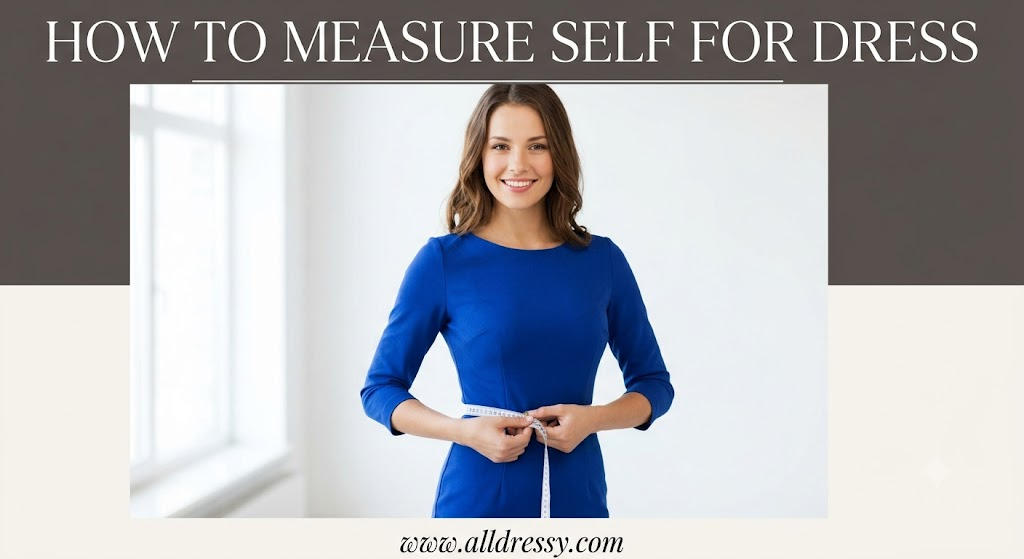
Wrap the measuring tape around this area.
Keep the tape comfortably snug without compressing your skin.
Measure Your Hips
Hip measurements should include the fullest part of your hips and buttocks.
Stand with your feet together.
Wrap the tape evenly around the widest point.
Check in a mirror to ensure the tape remains level.
Measure Your Shoulders
For fitted dresses, shoulder width matters.
Measure across your back from one shoulder edge to the other.
Having another person help with this measurement usually improves accuracy.
Measure Your Neck
Some dresses feature high necklines or collars.
Measure around the base of your neck where a necklace naturally rests.
Leave enough room to fit one finger comfortably beneath the tape.
Measure Sleeve Length
If your dress includes sleeves:
- Place one end of the tape at the top of your shoulder.
- Bend your arm slightly.
- Measure down to your wrist.
Bent arms produce a more comfortable sleeve length.
Measure Arm Circumference
Measure around the fullest part of your upper arm.
This measurement helps ensure sleeves fit comfortably without feeling tight.
Measure Wrist Circumference
Wrap the tape around your wrist bone.
This is useful for dresses with fitted cuffs or long sleeves.
Measure Dress Length
Dress length depends on the style.
Common options include:
- Mini
- Knee-length
- Midi
- Tea-length
- Maxi
- Floor-length
Measure from the highest point of your shoulder to your desired hemline.
Wear the shoes you plan to use with the dress if heel height will affect the final length.
Measure Shoulder to Waist
Some custom dresses require torso length.
Measure from:
- Top of shoulder
- Across the bust
- Down to the natural waist
This measurement improves bodice fit.
Measure Waist to Floor
For long dresses:
Measure from your waist to the floor while wearing your event shoes.
This helps achieve the desired finished length.
High Bust vs Full Bust
Many dressmakers request both measurements.
High Bust
Measure above the fullest part of the bust, under the arms.
Full Bust
Measure around the fullest part of the bust.
Comparing these measurements helps with fitting structured dresses.
Underbust Measurement
Some dresses with built-in support require an underbust measurement.
Measure directly beneath your breasts while keeping the tape level.
Inseam Measurement
Although not commonly needed for dresses, jumpsuits and certain styles may require an inseam measurement.
Measure from the crotch to the desired hemline.
Measuring Yourself vs Having Someone Help
Self-measuring works well for many body measurements.
However, assistance improves accuracy for:
- Shoulder width
- Back width
- Dress length
- Sleeve length
If measuring alone, use a full-length mirror to ensure the tape stays straight.
Understanding Size Charts
Always compare your measurements with the manufacturer’s size chart.
Do not assume your usual dress size will fit every brand.
Pay attention to:
- Bust
- Waist
- Hips
If your measurements fall into different sizes, choose the size that fits your largest measurement and have the garment tailored if necessary.
Measuring for Different Dress Styles
Bodycon Dresses
Require highly accurate bust, waist, and hip measurements due to their close-fitting design.
A-Line Dresses
Offer more flexibility through the hips but still require precise bust and waist measurements.
Empire Waist Dresses
Focus primarily on bust and upper torso measurements.
Mermaid Dresses
Demand accurate measurements from bust to hips because of their fitted silhouette.
Ball Gowns
Often have structured bodices, making bust and waist measurements especially important.
Measuring for Wedding Dresses
Bridal gowns usually have little or no stretch.
For the best results:
- Measure several times.
- Wear your bridal undergarments if available.
- Consider professional measurements for expensive gowns.
- Record all measurements carefully.
Common Measuring Mistakes
Using the Wrong Tape
Always use a flexible tailor’s tape measure.
Measuring Over Thick Clothing
Bulky clothing adds extra inches.
Pulling the Tape Too Tight
The tape should rest comfortably against your body.
Letting the Tape Sag
Keep it level around your body.
Guessing Measurements
Never estimate. Measure carefully every time.
Tips for Online Dress Shopping
When buying dresses online:
- Measure yourself within the last few weeks.
- Compare your measurements with the seller’s size chart.
- Read sizing reviews from other customers.
- Check whether the fabric has stretch.
- Review the return policy before ordering.
These simple steps can greatly improve your chances of selecting the correct size.
How Often Should You Measure Yourself?
Your body can change over time.
Update your measurements:
- Before ordering custom clothing.
- Before major events.
- After significant weight changes.
- Every three to six months if you shop online frequently.
Keeping current measurements ensures better-fitting garments.
Tips for Plus-Size Measurements
For more accurate plus-size measurements:
- Wear supportive undergarments.
- Keep the tape level around your body.
- Avoid compressing the skin.
- Ask someone to assist if possible.
Accurate measurements improve comfort and overall garment fit.
Recording Your Measurements
Create a personal measurement chart that includes:
- Bust
- High bust
- Underbust
- Waist
- Hips
- Shoulder width
- Neck
- Sleeve length
- Arm circumference
- Wrist
- Dress length
- Height
Store the information on your phone or in a notebook for easy access while shopping.
Professional Tailor vs Self-Measurement
While self-measurement is sufficient for most everyday dresses, professional measuring is recommended for:
- Wedding gowns
- Prom dresses
- Evening gowns
- Couture garments
- Formal wear
- Custom-made dresses
Professional tailors have experience identifying posture differences, body asymmetry, and fitting adjustments that can improve the final result.
Expert Tips for the Most Accurate Dress Measurements
- Measure yourself in front of a full-length mirror.
- Wear the undergarments you plan to wear with the dress.
- Stand naturally without sucking in your stomach.
- Keep the measuring tape level and parallel to the floor.
- Record measurements immediately after taking them.
- Measure each area at least twice for accuracy.
- Ask someone to help with difficult measurements like shoulders and sleeve length.
- Compare your measurements with every brand’s specific size chart.
- Consider the fabric type, as non-stretch fabrics require more precise measurements.
- Update your measurements regularly, especially before purchasing formal or custom-made dresses.
Why Knowing How to Measure Self for Dress Saves Time and Money
Accurate body measurements do more than help you choose the correct size—they also reduce unnecessary returns, minimize alteration costs, and improve your confidence when shopping online or ordering custom garments. Instead of relying on inconsistent size labels, you’ll have a reliable set of measurements that works across different brands and designers.
Whether you’re shopping for a casual sundress, a business dress, a cocktail dress, or a once-in-a-lifetime wedding gown, learning how to measure self for dress ensures that every purchase has the best chance of fitting beautifully. With the right tools, proper measuring techniques, and a little practice, you can take professional-quality measurements from the comfort of your home and enjoy better-fitting dresses for every occasion.
Here are SEO-friendly FAQs and a Conclusion for your article on “how to measure self for dress.”
FAQs
1. How do I measure myself for a dress at home?
To measure yourself for a dress at home, use a flexible measuring tape and wear a well-fitting bra with lightweight clothing or undergarments. Measure your bust, natural waist, hips, shoulders, and dress length while standing naturally. Compare your measurements with the brand’s size chart before purchasing a dress.
2. What measurements are needed for a dress?
The most important measurements for a dress are your bust, waist, and hips. Depending on the dress style, you may also need shoulder width, neck circumference, sleeve length, arm circumference, shoulder-to-waist length, and the desired dress length.
3. Should I measure myself with or without clothes?
For the most accurate results, measure yourself while wearing lightweight clothing or the undergarments you plan to wear with the dress. Avoid bulky clothing, jackets, or thick sweaters, as they can affect the measurements.
4. How tight should the measuring tape be?
The measuring tape should be snug against your body without digging into your skin. It should lie flat and remain level around your body, allowing you to fit one finger comfortably underneath for an accurate measurement.
5. Can I measure myself without someone else’s help?
Yes. Most body measurements can be taken alone using a flexible measuring tape and a full-length mirror. However, having someone assist with measurements such as shoulder width, sleeve length, and dress length can improve accuracy.
6. How often should I measure myself for dresses?
It’s a good idea to update your measurements every three to six months, before purchasing a new dress online, after noticeable weight changes, or when ordering custom-made clothing.
7. Why don’t my measurements match my usual dress size?
Dress sizes vary between brands, designers, and countries. Instead of relying on the size printed on the label, always compare your body measurements with the manufacturer’s sizing chart to choose the best fit.
8. What should I do if my bust, waist, and hips fall into different sizes?
If your measurements fall into different size categories, choose the size that fits your largest measurement. A tailor can usually adjust the other areas to achieve a more customized and comfortable fit.
9. Do stretchy fabrics affect dress measurements?
Yes. Dresses made from stretchy fabrics like jersey or spandex blends are more forgiving and may accommodate slight measurement differences. Non-stretch fabrics such as satin, silk, or linen require more precise measurements for the best fit.
10. Is it necessary to measure before every online dress purchase?
Yes. Since body measurements can change over time and sizing differs among brands, measuring yourself before ordering a dress online helps reduce the risk of choosing the wrong size and minimizes returns or exchanges.
Conclusion
Knowing how to measure self for dress is an essential skill that makes shopping for dresses easier, more accurate, and less stressful. Taking precise body measurements allows you to confidently compare your size with any brand’s sizing chart, helping you choose dresses that fit comfortably and flatter your figure.
By using a flexible measuring tape, wearing the proper undergarments, maintaining good posture, and carefully measuring your bust, waist, hips, shoulders, and dress length, you can greatly reduce the chances of ordering the wrong size. Accurate measurements are especially important for custom-made dresses, formal gowns, wedding dresses, and online purchases where trying on garments beforehand isn’t possible.
Whether you’re shopping for an everyday dress, a cocktail dress, or a special occasion gown, following the techniques outlined in this guide will help you achieve a better fit, save money on alterations, and enjoy greater confidence in every purchase. Keep your measurements updated, refer to each manufacturer’s size chart, and you’ll be well prepared to find dresses that look and feel their best.