
Shopping for a dress can be exciting, but choosing the correct size is not always easy. Different clothing brands use different sizing systems, and a size that fits perfectly in one store may feel different in another. Online shopping can make the process even more confusing because you cannot try on the dress before purchasing it. If you have ever wondered, how do I determine my dress size, the best place to start is by understanding your measurements and comparing them with the specific brand’s size chart.
Determining your dress size involves more than looking at the number printed on a clothing label. You need to consider measurements such as your bust, waist, and hips, along with the dress design, fabric, cut, and intended fit. Other details, including dress length, shoulder width, and torso proportions, can also influence how comfortably a dress fits.
In this comprehensive guide, you will learn how to measure yourself accurately, understand dress size charts, compare different sizing systems, and choose a suitable size when shopping online or in stores. You will also discover how dress styles and fabric types affect sizing, how to handle measurements that fall between sizes, and how to avoid common shopping mistakes.
How Do I Determine My Dress Size?
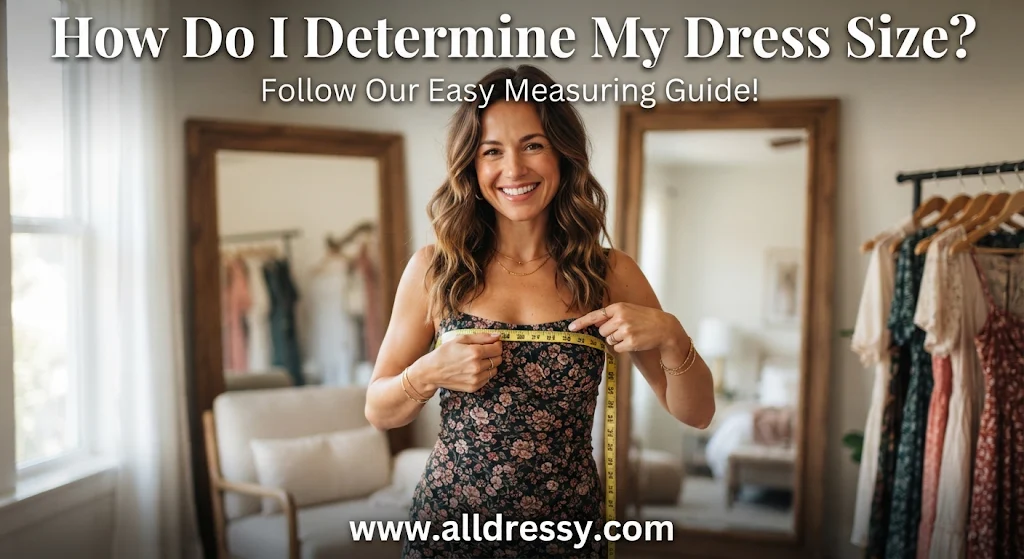
The most reliable way to determine your dress size is to measure your body and compare those measurements with the size chart provided by the clothing brand.
Most women’s dress size charts use three main measurements:
- Bust: The measurement around the fullest part of the chest.
- Waist: The measurement around the natural waistline.
- Hips: The measurement around the fullest part of the hips.
Some brands also provide additional measurements, such as shoulder width, sleeve length, and garment length.
Your measurements help you identify the size range that may fit best. However, remember that dress sizing is not completely standardized. A medium in one brand may have different measurements from a medium in another.
For the most accurate result, follow these steps:
- Find a flexible measuring tape.
- Measure your bust, natural waist, and hips.
- Record each measurement in inches or centimeters.
- Find the size chart for the dress you want to purchase.
- Compare your measurements with the chart.
- Consider the fabric and dress style before choosing a size.
- Review the brand’s fit information and return policy.
These steps provide a more dependable starting point than choosing a size based only on your usual clothing label.
1. How to Measure Your Bust for Your Dress Size
Bust measurement is one of the most important parts of determining dress size. It helps you understand how a dress may fit around the chest and upper body.
What You Need
You only need a flexible measuring tape and a mirror. If possible, ask someone to help you so the tape stays level.
How to Measure Your Bust
Follow these general steps:
- Stand naturally with your shoulders relaxed.
- Position the measuring tape around the fullest part of your chest.
- Keep the tape level across your back.
- Make sure the tape is comfortably positioned without pulling tightly.
- Read the measurement where the tape meets.
- Record the result in inches or centimeters.
Wear comfortable, well-fitting undergarments similar to those you would normally wear with the dress. This helps make the measurement more useful for clothing selection.
Why Bust Measurement Matters
The bust measurement is especially important when choosing dresses with fitted bodices, structured seams, buttons, or limited stretch.
For example, a dress with a fitted upper section may feel uncomfortable if the bust measurement is too small, even when the waist and hips fit well.
For dresses with a loose or relaxed upper section, the overall design may provide more flexibility.
2. How to Measure Your Waist Correctly
Your waist measurement helps determine how a dress fits around the middle section of the garment.
Many people confuse the natural waist with the waistband position of their trousers. These are not necessarily the same location.
Finding Your Natural Waist
Your natural waist is generally the narrower area between your rib cage and hips. It is often located above the belly button, although the exact position varies from person to person.
Steps to Measure Your Waist
- Stand comfortably without holding your breath.
- Find your natural waistline.
- Wrap the measuring tape around that area.
- Keep the tape level and comfortably fitted.
- Avoid pulling the tape tightly into your skin.
- Record the measurement.
It is important to measure naturally rather than trying to change your posture or hold your stomach in.
Why Waist Measurement Is Important
Waist measurements are particularly useful when shopping for:
- Fitted dresses.
- Wrap dresses.
- Belted dresses.
- Sheath dresses.
- Dresses with defined waist seams.
- Fit-and-flare dresses.
A dress with a fitted waist may require closer attention to this measurement than a loose or straight-cut design.
3. How to Measure Your Hips for the Correct Dress Size
Hip measurement is another essential part of determining dress size. It helps you understand whether a dress has enough room through the lower body.
How to Measure Your Hips
- Stand with your feet comfortably together.
- Place the measuring tape around the fullest part of your hips and seat.
- Check that the tape remains level around your body.
- Keep the tape comfortably positioned.
- Read and record the measurement.
Avoid measuring too high around the waist or too low around the upper thighs. The tape should go around the fullest hip area.
Why Hip Measurement Matters
Hip measurements are especially important for dresses with fitted skirts or narrow silhouettes.
Examples include:
- Pencil dresses.
- Bodycon dresses.
- Mermaid-style dresses.
- Fitted midi dresses.
- Straight-cut dresses.
A loose A-line or flowing dress may provide more room through the hips, but you should still compare your measurements with the manufacturer’s chart.
4. How Do I Determine My Dress Size Using a Size Chart?
After taking your measurements, the next step is to compare them with a clothing size chart.
A size chart shows the body measurements that a brand generally associates with each size.
For example, a simplified size chart may look like this:
| General Size | Bust | Waist | Hips |
|---|---|---|---|
| XS | 31–32 in | 24–25 in | 34–35 in |
| S | 33–34 in | 26–27 in | 36–37 in |
| M | 35–36 in | 28–29 in | 38–39 in |
| L | 37–39 in | 30–32 in | 40–42 in |
| XL | 40–42 in | 33–35 in | 43–45 in |
Important: These are illustrative measurements, not universal sizing standards. Actual size ranges vary between brands, countries, and clothing styles.
Compare All Three Measurements
Do not select a dress size based only on your bust measurement. Compare your bust, waist, and hips with the chart.
For example, the bust measurement may correspond to one size while the waist measurement corresponds to another. In that situation, consider the dress’s construction and which areas have a fitted design.
Check Whether the Chart Uses Body or Garment Measurements
This distinction is important.
Body measurements describe the person the clothing is designed to fit.
Garment measurements describe the actual dimensions of the finished dress.
A garment may be slightly larger than the body measurements it is intended to fit because clothing needs room for movement and comfort.
Always check the chart’s measurement instructions before comparing numbers.
5. How Do I Determine My Dress Size When Between Two Sizes?
Sometimes your measurements fall between two sizes on a chart. This is common because body measurements do not always match standard clothing categories exactly.
Instead of choosing randomly, consider the dress design and fabric.
Check the Most Fitted Area
If the dress has a structured bust, waist, or hip area, pay particular attention to the measurement for that section.
A fitted garment generally needs to accommodate the relevant body measurements.
Consider Fabric Stretch
Stretch fabrics may provide more flexibility than woven fabrics with little or no stretch.
However, stretch does not mean that every smaller size will fit comfortably. Check the manufacturer’s guidance and product description.
Think About the Intended Fit
A relaxed dress may be designed to have extra room, while a tailored dress may sit closer to the body.
Look for descriptions such as:
- Slim fit.
- Regular fit.
- Relaxed fit.
- Oversized fit.
- Stretch fit.
These descriptions help explain how the dress is intended to sit.
Review Customer Feedback
When shopping online, customer reviews may mention whether a dress runs small, large, or true to size.
Look for comments about specific areas, such as the bust, sleeves, waist, or length, rather than relying only on general statements.
6. Understanding Different Dress Sizing Systems
Dress sizes vary around the world. A size label used in the United States may not match the same label in the United Kingdom or Europe.
Understanding these differences is particularly useful when shopping from international retailers.
US Dress Sizes
United States women’s dress sizing commonly uses numerical labels, such as 0, 2, 4, 6, 8, and higher numbers.
Some brands also use letter-based sizing, including XS, S, M, L, and XL.
UK Dress Sizes
United Kingdom sizing commonly uses numerical labels such as 4, 6, 8, 10, 12, and higher numbers.
The numbers do not directly correspond to US sizes.
European Dress Sizes
European clothing commonly uses numerical sizing such as 32, 34, 36, 38, 40, and higher numbers.
European size charts should be checked separately because conversions are not always exact.
International Letter Sizes
Some international brands use XS, S, M, L, XL, and XXL.
These labels are convenient but can vary considerably between manufacturers.
Why Size Conversion Charts Are Only a Guide
A conversion chart can help you identify an approximate equivalent, but it should not replace the brand’s own measurements.
For example, a dress labeled medium may have different bust, waist, and hip measurements depending on the manufacturer.
When purchasing internationally, always compare the actual measurements rather than relying entirely on the number or letter.
7. How Dress Style Affects Your Dress Size
The design of a dress can influence how it fits. Two dresses with the same size label may feel very different because they have different cuts, seams, and construction.
A-Line Dresses
A-line dresses are generally fitted around the upper body and gradually widen toward the hem.
The bust and waist measurements may be particularly important when choosing this style.
Bodycon Dresses
Bodycon dresses are designed with a close-fitting silhouette.
Pay attention to the bust, waist, and hip measurements, as well as the fabric’s stretch and recovery.
Wrap Dresses
Wrap dresses often feature adjustable closures or ties.
This design can provide some flexibility around the waist and bust, but the fit still depends on the garment’s measurements and construction.
Fit-and-Flare Dresses
Fit-and-flare dresses generally have a more defined upper section and a skirt that becomes wider below the waist.
Bust and waist measurements are especially useful when selecting this style.
Maxi Dresses
Maxi dresses are usually longer than other dress styles. In addition to bust, waist, and hip measurements, check the garment length.
The length of a maxi dress can vary depending on the brand and design.
Shirt Dresses
Shirt dresses may have buttons, collars, and a relaxed or tailored fit.
Check the bust and shoulder measurements, particularly when the dress has a fitted upper section or non-stretch fabric.
8. How Fabric Type Affects Dress Sizing
Fabric plays an important role in how a dress fits and feels.
Two dresses with similar measurements may provide different levels of comfort because their materials have different properties.
Cotton
Cotton is commonly used in casual dresses. It may feel comfortable and breathable, but woven cotton usually has less stretch than knitted fabrics.
Check the measurements carefully, especially for fitted designs.
Polyester
Polyester is used in many types of dresses, including formal, casual, and everyday styles.
Its fit depends on the fabric construction, lining, and amount of stretch.
Spandex or Elastane Blends
Spandex and elastane are stretch fibers often blended with other materials.
They can help fabric move with the body, although the amount of stretch depends on the overall fabric composition.
Satin
Satin describes a fabric weave or finish rather than one specific fiber. Satin dresses can be made from different materials.
A structured satin dress may have limited stretch, so the size chart is particularly important.
Chiffon
Chiffon is generally lightweight and often used in flowing dresses.
Although the outer fabric may be loose, the lining or bodice may have a more fitted construction.
Knit Fabrics
Knit dresses can provide more flexibility than many woven fabrics.
However, knit fabrics vary in thickness, stretch, and recovery, so you should still check the garment details.
9. How Do I Determine My Dress Size When Shopping Online?
Online shopping offers convenience, but choosing the right dress size requires careful attention because you cannot physically try on the garment before purchasing it.
Use the following approach to make a more informed decision.
Read the Product Description
Look for information about the dress’s fit, fabric, lining, stretch, and model measurements.
Descriptions such as relaxed fit or slim fit can help you understand how the garment is designed to sit.
Use the Brand’s Specific Size Chart
Do not assume that your usual size will be the same across every online store.
Find the size chart for the exact product or brand.
Check Product Photos Carefully
Product photos may show how the dress falls around the shoulders, waist, and hem.
However, remember that styling, lighting, and garment adjustments can affect how a dress appears in photographs.
Review Customer Reviews
Customer feedback can provide practical information about sizing.
Look for repeated comments about:
- Whether the dress runs small or large.
- Whether the sleeves are short or long.
- Whether the dress length matches the description.
- Whether the fabric stretches.
- Whether the waist or bust feels fitted.
Check the Return Policy
Before purchasing, review the retailer’s return and exchange conditions.
This is particularly important when ordering from an unfamiliar brand or buying a dress for a specific event.
10. How to Determine Dress Length and Other Important Measurements
Bust, waist, and hip measurements are essential, but they are not the only factors that influence dress fit.
Other measurements may be important depending on the design.
Shoulder Width
Shoulder width can influence how a dress sits across the upper body.
It is particularly relevant for structured dresses, tailored styles, and garments with defined shoulder seams.
Sleeve Length
Sleeve length matters when choosing long-sleeve, three-quarter-sleeve, or other fitted sleeve designs.
Check the product measurements if sleeve coverage is important to you.
Dress Length
Dress length can vary considerably between brands.
Common dress lengths include:
- Mini.
- Above-the-knee.
- Knee-length.
- Midi.
- Maxi.
The listed length may be measured from the shoulder, waist, or another point, depending on the manufacturer. Check the measurement instructions.
Torso Length
Some dresses have defined waist seams or fitted bodices. Torso proportions can influence where those seams sit.
This is particularly relevant when choosing formal dresses, jumpsuits with dress-like styling, or designs with a clearly defined waistline.
11. Common Mistakes to Avoid When Determining Your Dress Size
Choosing the right dress size becomes easier when you avoid a few common mistakes.
Choosing Based Only on Your Usual Size
Your usual size may not be consistent across brands.
Always check the relevant size chart before purchasing.
Measuring Over Bulky Clothing
Thick clothing can affect your measurements.
Use a flexible measuring tape over light clothing or appropriate undergarments.
Pulling the Measuring Tape Too Tightly
The tape should sit comfortably against the body without squeezing.
A measurement taken too tightly may lead to choosing a dress that feels restrictive.
Using an Old Measurement
Measurements can change over time. If you have not checked your measurements recently, take them again before purchasing an important dress.
Ignoring the Fabric
A non-stretch dress may fit differently from a stretch dress, even if both have the same listed measurements.
Always consider the material.
Forgetting About Dress Length
A dress may fit well around the bust, waist, and hips but still be longer or shorter than expected.
Check the length information before ordering.
Assuming All Brands Follow the Same Standards
Sizing is not universal. Different brands may use different patterns, measurements, and fit preferences.
The brand’s own size chart is the most useful reference.
12. How to Keep Your Dress Size Measurements Organized
Keeping a simple record of your clothing measurements can make future shopping easier.
You can create a personal measurement note with the following information:
| Measurement | What to Record |
|---|---|
| Bust | Fullest chest measurement |
| Waist | Natural waist measurement |
| Hips | Fullest hip measurement |
| Shoulder | Shoulder width, when needed |
| Sleeve | Sleeve length, when needed |
| Dress length | Preferred garment length |
Record whether you used inches or centimeters so you do not confuse different units.
When shopping, compare your measurements with the chart for the specific dress. Update your record when you need a fresh measurement.
You can also keep notes about brands whose sizing information has been reliable. This may help make future purchases more convenient, although you should still check individual product charts.
13. Tips for Choosing a Comfortable and Well-Fitting Dress
A suitable dress should work with your everyday activities and the occasion for which you plan to wear it.
Beyond the size label, consider the following details.
Check ease of movement: Make sure the dress allows you to sit, walk, and move comfortably.
Consider the closure: Zippers, buttons, hooks, and wrap ties can influence how easy a dress is to wear.
Check lining: Some dresses include an inner lining that can affect comfort and fit.
Look at seam placement: Seams and darts influence how the dress is shaped.
Consider the occasion: A formal dress may have a different intended fit from a casual everyday dress.
Check care instructions: Some fabrics require special washing or dry-cleaning, which may influence how the garment maintains its shape.
Prioritize comfort: A dress should feel comfortable for the amount of time you expect to wear it.
14. How Do I Determine My Dress Size Without a Measuring Tape?
A measuring tape is the most reliable tool for taking clothing measurements, but there may be times when one is not available.
You can use a non-stretch string or ribbon and a ruler as an alternative.
Follow these steps:
- Wrap the string around the area you want to measure.
- Mark the point where the string meets.
- Lay the string flat on a surface.
- Use a ruler to measure the marked length.
- Record the result in inches or centimeters.
Make sure the string is not elastic or stretchy, as that can affect accuracy.
You can also measure a dress that already fits comfortably. Lay it flat and compare relevant garment measurements with the product’s garment-size information.
However, garment measurements are not the same as body measurements. Allow for differences in fabric, construction, and intended fit.
15. Why the Right Dress Size Is More Than a Number
A dress size label is simply a shopping reference. It does not define how clothing should fit every person, and it is not a universal measurement.
Two people with similar measurements may prefer different dress styles or levels of looseness. Similarly, two dresses with the same size label may have different proportions.
The best approach is to focus on the actual measurements, garment construction, fabric, and comfort.
A well-chosen dress should allow natural movement and feel appropriate for its intended use. The number or letter on the label is less important than how the garment fits and feels.
Final Practical Tips for Determining Your Dress Size
If you want to make dress shopping easier, take accurate measurements, compare them with the brand’s size chart, and consider the design and material before making a purchase.
Pay particular attention to fitted areas, such as the bust, waist, and hips. Check shoulder width and dress length when the design requires additional measurements. When shopping online, read the product description, review customer feedback, and understand the return policy.
Most importantly, remember that dress sizing varies between brands. There is no single size label that guarantees the same fit everywhere.
By understanding your measurements and the way different dress styles are constructed, you can make more confident shopping decisions and choose clothing that feels comfortable and works well for your needs.
10 Frequently Asked Questions About How to Determine Your Dress Size
1. How do I determine my dress size accurately?
To determine your dress size, measure your bust, natural waist, and hips using a flexible measuring tape. Compare these measurements with the specific clothing brand’s size chart. Also consider the dress style, fabric, and intended fit before choosing a size.
2. What three measurements do I need to find my dress size?
The three main measurements are bust, waist, and hips. Some brands also recommend measuring shoulder width, sleeve length, and dress length for a more accurate fit.
3. Should I choose my dress size based on bust or waist measurements?
You should consider all three main measurements rather than relying on only one. However, pay particular attention to the most fitted area of the dress. For example, bust measurements are especially important for structured bodices, while hip measurements matter for fitted skirts.
4. How often should I measure myself for dress sizing?
It is helpful to update your measurements whenever you notice that your usual clothing fit has changed or before purchasing an important dress. Fresh measurements can help you avoid relying on outdated sizing information.
5. What should I do if my measurements fall between two dress sizes?
Check the dress’s fabric, design, and fit description. For a non-stretch fitted dress, pay close attention to the measurements of the most fitted area. For a relaxed or adjustable design, the fit may offer more flexibility. Always follow the brand’s sizing guidance.
6. Are US, UK, and European dress sizes the same?
No. US, UK, and European sizing systems use different numerical labels. A size in one country does not automatically match the same number in another. Use an international conversion chart as a guide, but always check the brand’s actual measurements.
7. Does fabric affect dress sizing?
Yes. Stretch fabrics may provide more flexibility, while woven fabrics with little stretch may require closer attention to measurements. Cotton, polyester, satin, chiffon, and knit fabrics can all behave differently depending on their construction.
8. How do I determine my dress size when shopping online?
Measure your bust, waist, and hips, then compare the results with the retailer’s specific size chart. Read the product description, check customer reviews, look at garment measurements, and review the return policy before purchasing.
9. Can I determine my dress size without a measuring tape?
Yes. You can use a non-stretch string or ribbon and a ruler. Wrap the string around the measurement area, mark where it meets, and measure the string with a ruler. A flexible measuring tape is still the preferred option for accuracy.
10. Why does the same dress size fit differently between brands?
Brands use different sizing standards, patterns, fabrics, and garment constructions. A medium from one retailer may have different measurements from a medium at another store. That is why checking individual size charts is important.
Conclusion
Understanding how do I determine my dress size can make shopping easier and help you choose dresses that feel comfortable and fit properly. The most reliable method is to measure your bust, waist, and hips and compare those measurements with the size chart provided by the brand.
Remember that dress sizing is not universal. Different manufacturers use different measurements, and fabric, design, and construction can all influence how a dress fits. A bodycon dress, for example, may require different sizing considerations from a loose A-line or maxi dress.
Before purchasing, especially online, review the product description, customer feedback, garment measurements, and return policy. If your measurements fall between two sizes, consider the dress’s fabric and the area where it fits most closely.
Ultimately, the best dress size is not about the number on the label. It is about choosing a dress that feels comfortable, allows you to move naturally, and suits the occasion.