
If you have ever wondered how did Vikings dress, the answer is much more interesting than the stereotypical image of warriors wearing horned helmets and heavy fur. Viking clothing was practical, layered, and strongly influenced by climate, occupation, wealth, geography, and social status. The Vikings lived primarily across Scandinavia and traveled widely throughout Europe and beyond during the Viking Age, roughly from the late eighth to the mid-eleventh century. Their clothing had to protect them from cold weather, rain, wind, and difficult outdoor conditions while also allowing them to work, travel, trade, and fight.
Viking clothing was generally made from materials that were available locally, including wool, linen, leather, and animal skins. Wealthier people could obtain finer fabrics, imported textiles, decorative metalwork, colorful dyes, and silk. Men and women wore different basic garments, but both relied heavily on layers to stay warm.
Understanding how did Vikings dress also requires looking beyond popular movies and television shows. Archaeological discoveries, preserved textiles, graves, tools, jewelry, artwork, and written descriptions provide clues about Viking clothing. These sources suggest that Viking fashion could be colorful, carefully constructed, and surprisingly sophisticated.
How Did Vikings Dress in Everyday Life?
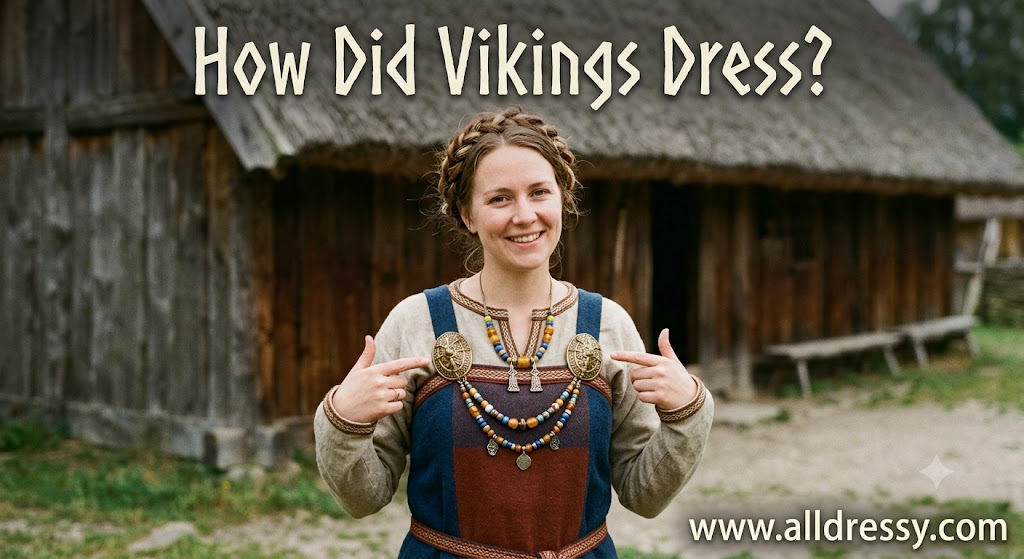
For everyday life, Vikings generally wore practical clothing suited to their environment and occupation. Most people needed garments that could withstand physical work, travel, farming, sailing, and changing weather conditions.
A typical Viking outfit consisted of several layers. A person might wear a linen undergarment next to the skin, a woolen tunic or dress over it, and an additional cloak or coat for warmth. Clothing could be secured with belts, brooches, pins, or ties.
Wool was especially important because it provided warmth even in cold and damp conditions. Linen was lighter and more comfortable against the skin, making it useful for undergarments and some lighter clothing.
Viking clothing was not necessarily dull brown or gray. People had access to natural dyes that could produce shades of red, yellow, blue, green, and other colors. The availability and intensity of particular colors depended on the materials and dyeing methods used.
The average Viking’s clothing was therefore both functional and expressive. Even practical garments could include decorative details, colored trims, embroidery, tablet-woven bands, or metal accessories.
What Did Viking Men Wear?
When examining how did Vikings dress, men’s clothing is one of the most frequently discussed subjects. Viking men generally wore tunics, trousers or breeches, cloaks, belts, footwear, and various accessories.
Viking Tunics
The tunic was one of the most recognizable pieces of Viking men’s clothing. It was usually a loose-fitting garment that extended somewhere around the thighs or knees, although the exact length and construction varied.
Tunics were commonly made from wool or linen. Wool provided warmth, while linen was useful for lighter garments.
Some tunics could be relatively plain, while others included decorative borders or contrasting fabrics. The style could also reflect the wearer’s wealth and circumstances.
A working farmer might have a simple, durable tunic, whereas an elite individual could afford better-quality textiles and more elaborate decoration.
Viking Trousers and Breeches
Viking men wore various types of trousers or breeches. There was no single universal Viking trouser style.
Some trousers appear to have been relatively loose, while others may have been closer fitting around the legs. Certain styles were particularly practical for horseback riding, traveling, or outdoor work.
Trousers could be made from wool or other textiles and were sometimes combined with leg coverings. Some Viking clothing reconstructions show wrapped fabric around the lower legs, although the exact styles probably varied significantly by region and period.
Viking Cloaks
Cloaks were extremely useful in the Scandinavian climate. A wool cloak could provide protection against wind and cold while also serving as an additional layer during travel.
Cloaks could be secured at the shoulder using a brooch or pin. Some archaeological finds indicate that cloaks and other outer garments could feature decorative woven bands.
For someone traveling by ship, riding across the countryside, or working outdoors, a warm cloak was more than a fashion accessory—it was an important piece of protective clothing.
Viking Belts
Belts were practical and decorative. A Viking man could use a belt to hold tools, pouches, knives, and other small objects.
Some belts included decorated metal fittings. The quality of these fittings could indicate social status or wealth.
Because the belt was positioned prominently around the waist, it also offered an opportunity for personal decoration.
What Did Viking Women Wear?
Women’s Viking clothing differed from men’s clothing, although there was also considerable regional and social variation.
A common reconstruction of Viking women’s clothing includes an underdress, an overdress or apron-like garment, a cloak, footwear, and accessories.
Viking Underdresses
Women could wear a linen underdress beneath heavier clothing. Linen was particularly suitable as a base layer because it was relatively comfortable and could be washed more easily than heavy wool garments.
The length and cut of women’s clothing could vary. Archaeological evidence suggests that Viking women’s garments were not all identical.
Viking Dresses
One of the garments associated with Viking women is the long dress or overdress. Depending on the reconstruction, it may have been fitted or loose and could have included shoulder straps or other fastening systems.
Some archaeological evidence suggests the use of paired brooches on the upper chest. These brooches are particularly associated with women’s graves and have become an important clue in reconstructing Viking women’s clothing.
However, historians must be cautious. Not every woman necessarily wore exactly the same style, and clothing traditions could change over time and from one region to another.
Apron Dresses
The so-called apron dress is one of the most recognizable garments in modern interpretations of Viking women’s fashion.
It is generally reconstructed as a garment worn over an underdress, often fastened with brooches at the shoulders.
Decorative elements, beads, chains, and other accessories could be attached around the upper body.
The term “apron dress” is useful for describing a particular archaeological reconstruction, but historians continue to debate the exact appearance and construction of some Viking women’s garments.
What Materials Did Vikings Use for Clothing?
To understand how did Vikings dress, it is essential to understand what their clothes were made from.
Wool
Wool was one of the most important Viking textile materials. Scandinavia had a strong sheep-raising tradition, making wool relatively accessible.
Wool was valuable because it was warm, durable, and useful for producing different types of textiles.
Different weaving techniques could create fabrics with different thicknesses and textures. Heavy wool was useful for outer clothing, while lighter fabrics could be used for other garments.
Linen
Linen came from the flax plant and was another important textile.
It was particularly useful for undergarments because it could feel lighter and smoother than wool. Producing linen required considerable labor, so it was not necessarily a cheap material.
Leather
Leather was used for footwear, belts, pouches, gloves, and other practical items.
Shoes made from leather were particularly important because Vikings traveled on foot, horseback, and by ship.
Leather was durable but required maintenance, especially in wet environments.
Animal Skins and Fur
Animal skins and fur could provide additional warmth, particularly in cold climates.
However, popular depictions sometimes exaggerate the role of fur in ordinary Viking clothing. Fur certainly existed, but Viking clothing was not simply made from animal skins.
Textiles such as wool and linen were fundamental to everyday dress.
Did Vikings Wear Bright Colors?
One of the biggest misconceptions about Viking clothing is that it was always dark, gray, or brown.
Evidence indicates that Viking textiles could be dyed in various colors.
Natural dyes could create shades such as red, yellow, blue, and green. Some dyes required specific plants, minerals, or imported materials, meaning certain colors could be more expensive or difficult to produce than others.
Red was particularly valuable in many historical societies, and blue could also be produced using plants such as woad.
The availability of color depended on location, wealth, trade connections, and the quality of the dyeing process.
Therefore, when asking how did Vikings dress, it is more accurate to imagine a range of natural and dyed colors rather than a population dressed entirely in black, brown, and gray.
Did Vikings Wear Fur?
Yes, Vikings could use fur and animal skins, especially for warmth and practical purposes. However, the popular image of every Viking wearing a huge fur coat is misleading.
The Scandinavian climate made warm materials valuable, but woven wool was extremely important.
Fur could be used as an additional insulating material or for particular garments and accessories. Wealth and availability likely affected who could access certain types of fur.
Modern Viking costumes often use large fur pieces because they create a dramatic appearance, but historical Viking clothing was generally more varied.
How Did Vikings Dress for Winter?
Winter required careful layering.
A Viking living in Scandinavia could combine a linen base layer with woolen garments and a heavy cloak. Additional materials could provide protection against cold wind and snow.
Head coverings, gloves, socks, and warm footwear could also be important.
Instead of relying on a single extremely thick garment, layering allowed people to adjust their clothing according to temperature and activity.
This was particularly useful for people who worked outdoors. A farmer, sailor, hunter, or traveler needed clothing that could provide warmth without making movement unnecessarily difficult.
How Did Vikings Dress for War?
Viking warriors generally needed clothing that allowed movement while offering protection from the weather.
It is important to distinguish normal clothing from protective military equipment. A tunic, trousers, cloak, and shoes were clothing; shields, helmets, and body armor were protective equipment.
Some warriors could have worn mail armor, particularly those with greater resources. Others may have relied primarily on ordinary clothing and shields.
The famous horned Viking helmet is not supported by archaeological evidence as a standard Viking combat helmet. Actual Viking-age helmets that have been discovered are designed for protection rather than the theatrical appearance often seen in modern entertainment.
This distinction is important when considering how did Vikings dress in historical reality.
What Shoes Did Vikings Wear?
Viking footwear was generally made from leather.
Shoes had to cope with rough terrain, wet conditions, and extensive travel. Archaeological discoveries of Viking-age shoes show that leatherworking was an important craft.
Different shoe shapes and construction techniques existed. Some footwear was ankle-high, while other styles provided additional coverage.
Because leather could become damaged by moisture, footwear required care and replacement.
People who traveled frequently, worked outdoors, or lived in wet environments would have had particularly strong reasons to maintain their shoes.
What Did Viking Children Wear?
Children generally wore clothing similar in basic construction to adult garments but adapted to their size.
Because textiles required substantial labor, children’s clothing was valuable. Garments could potentially be repaired, altered, or reused as children grew.
Children involved in farm work or household activities needed durable clothing just like adults.
Archaeological evidence for children’s clothing is more limited than evidence for adult clothing, so reconstructions often depend on broader textile evidence and comparisons with adult garments.
How Did Viking Women Use Jewelry With Clothing?
Jewelry played an important role in Viking appearance.
Women’s graves have produced numerous brooches, beads, pendants, rings, and other objects. Brooches were not simply decorative—they could also help fasten clothing.
Paired brooches are particularly associated with reconstructed women’s outfits.
Beads could be worn around the neck or attached to clothing. Chains and pendants could also be incorporated into an outfit.
Jewelry could communicate wealth, identity, family connections, cultural traditions, and personal taste.
How Did Viking Men Use Accessories?
Men could also wear jewelry and decorative accessories.
Rings, brooches, belt fittings, arm rings, and pendants have been found in Viking contexts.
Belts could feature decorative metal components, while weapons and tools sometimes had highly elaborate designs.
Accessories therefore formed an important part of Viking appearance. Clothing was not merely about staying warm.
Did Viking Clothing Show Social Status?
Yes. Clothing could communicate social and economic position.
High-quality textiles required labor, and certain dyes, imported fabrics, embroidery, decorative metalwork, and silk were more difficult to obtain.
Silk is particularly significant because archaeological discoveries demonstrate that it reached the Viking world through long-distance trade networks.
A wealthy Viking could therefore demonstrate status through textiles and accessories that were unavailable or impractical for ordinary farmers.
At the same time, expensive clothing was not necessarily used every day. Some special garments may have been reserved for ceremonies, feasts, religious occasions, or other important events.
Did Vikings Wear Silk?
Silk was available in parts of the Viking world through extensive trade connections.
Viking-age sites have produced evidence of silk and other imported luxury materials. Silk would have been significantly more expensive and prestigious than ordinary wool or linen.
Its presence demonstrates how connected Viking societies were to broader trade networks.
The existence of silk in Viking contexts also challenges the idea that Viking society was isolated from the rest of the world.
How Did Viking Clothing Reflect Geography?
Viking clothing could vary depending on where people lived.
Scandinavia included different environments, from coastal areas to inland settlements. Vikings also established communities in places such as the British Isles, Iceland, Greenland, and parts of Eastern Europe.
Climate, local resources, cultural traditions, and trade opportunities influenced clothing.
Someone living in a colder northern environment had different practical requirements from someone living in a relatively milder region.
Therefore, there was never one single “Viking outfit.”
How Accurate Are Modern Viking Costumes?
Modern Viking costumes often combine historically inspired elements with fantasy.
Common inaccuracies include universal horned helmets, exaggerated fur coats, extremely dirty clothing, and standardized leather outfits.
Historical clothing was primarily textile-based, particularly wool and linen.
Modern reconstructions can still be useful when they are based on archaeological evidence, but they should not automatically be treated as exact representations.
The Viking Age lasted for several centuries, and clothing changed over time just as modern fashion changes.
What Did Viking Clothing Look Like for Special Occasions?
Special occasions provided opportunities to display wealth and craftsmanship.
At feasts or ceremonies, people could wear better-quality textiles, decorative accessories, jewelry, embroidered elements, or imported materials.
A person’s best clothing could communicate status and social identity.
Feasting was an important part of elite culture, and appearance could matter during diplomatic gatherings, weddings, religious ceremonies, and other major events.
Clothing therefore served both practical and social purposes.
How Was Viking Clothing Made?
Making clothing required significant time and skill.
Producing wool involved raising sheep, collecting wool, cleaning it, spinning fibers into yarn, and weaving the yarn into fabric.
Linen production involved cultivating flax, processing the plant fibers, spinning them, and weaving them into cloth.
After producing fabric, craftspeople had to cut and sew garments.
Textile production was therefore a major part of household and community life.
Viking women are often associated with textile production because archaeological finds include spindle whorls, weaving tools, needles, and other equipment. However, textile production involved a broader network of labor and skill.
How Did Vikings Keep Their Clothes Warm?
Layering was one of the most effective methods.
A person could wear a linen undergarment, a woolen tunic or dress, additional wool layers, and an outer cloak.
Loose garments could trap warm air, while wool provided insulation even when somewhat damp.
Cloaks were particularly useful because they could be wrapped around the body or removed as conditions changed.
For extreme cold, additional animal materials could supplement textile garments.
How Did Vikings Maintain Their Clothing?
Clothing represented valuable labor, so people had reasons to repair and reuse it.
Worn garments could be patched, adjusted, or repurposed. Woolen textiles could sometimes be recycled into other items.
Needles and textile tools discovered at Viking sites demonstrate the importance of sewing and repair.
Keeping clothing functional was particularly important in communities where producing a new garment required considerable time and resources.
What Did Viking Clothing Tell Us About Viking Society?
Clothing provides clues about much more than appearance.
Textiles can reveal trade connections, technological skills, economic differences, gender roles, and environmental adaptation.
Imported silk indicates long-distance commerce. Fine metal brooches suggest specialized craftsmanship. Spinning and weaving tools demonstrate the importance of textile production.
Clothing also reveals that Viking society was not culturally uniform.
The Vikings were part of a complex network of communities connected through migration, trade, warfare, settlement, and cultural exchange.
Common Myths About How Vikings Dressed
Several popular myths continue to influence modern ideas about Viking fashion.
Myth 1: Vikings Always Wore Horned Helmets
There is no good archaeological evidence that horned helmets were normal Viking combat equipment. The famous horned Viking image largely comes from much later artistic and popular representations.
Myth 2: Vikings Only Wore Brown and Gray
Viking textiles could be dyed in various colors. Clothing was not necessarily colorless.
Myth 3: Every Viking Wore Fur
Fur existed and could be useful, but wool and linen were fundamental textile materials.
Myth 4: Vikings Dressed Only for War
Most Vikings spent their lives farming, fishing, trading, crafting, sailing, raising families, and performing household work. Their ordinary clothing had to support these activities.
Myth 5: All Vikings Dressed the Same
Viking clothing varied according to gender, wealth, region, occupation, climate, period, and access to trade goods.
How Did Vikings Dress Differently by Social Class?
Social class could significantly affect clothing.
A wealthy individual might own finely woven fabrics, imported silk, elaborate jewelry, decorated brooches, and high-quality dyes.
A poorer person was more likely to rely on practical, locally produced wool and linen.
However, social status was not communicated through clothing alone. Jewelry, weapons, housing, food, horses, and other possessions could also indicate wealth.
Why Is Viking Clothing Difficult to Reconstruct?
Very few complete Viking garments have survived.
Textiles decay easily, especially in ordinary soil. As a result, archaeologists often work with fragments rather than complete outfits.
Fortunately, unusual burial environments, waterlogged conditions, and other preservation circumstances have allowed some textiles and clothing-related objects to survive.
Researchers also examine textile fragments, weaving techniques, jewelry positions in graves, artwork, tools, and written sources.
This means that some aspects of Viking clothing are well supported, while other details remain uncertain.
What Can Archaeology Tell Us About Viking Fashion?
Archaeology is one of the most important sources for understanding how did Vikings dress.
Textile fragments reveal materials and weaving techniques. Brooches can indicate how garments were fastened. Beads can show how clothing was decorated. Leather shoes reveal footwear construction. Spindle whorls and loom weights demonstrate textile production.
Burial evidence can be particularly useful because objects may survive in association with the body.
However, archaeologists must interpret these discoveries carefully. The position of an object in a grave does not always prove exactly how it was worn in everyday life.
How Did Vikings Dress on Ships?
Sailing required practical clothing.
Viking sailors needed protection from cold wind, spray, and changing weather. Woolen garments and cloaks were therefore especially valuable.
Loose clothing had to allow movement without becoming dangerously cumbersome around ropes, sails, and other equipment.
Footwear also needed to provide sufficient grip and protection while moving around a wooden ship.
A sailor’s clothing was therefore primarily designed for durability and weather protection.
How Did Vikings Dress for Farming and Daily Work?
Farmers needed durable garments that could survive physical labor.
Simple woolen tunics, trousers, dresses, aprons, belts, and leather footwear could support agricultural work.
Clothing could become worn or damaged through repetitive work, so repair and reuse were important.
This practical side of Viking clothing is sometimes overlooked because modern popular culture focuses heavily on warriors.
In reality, farming and household production were fundamental to Viking communities.
How Did Vikings Dress Compared With Medieval Europeans?
Viking clothing shared several features with clothing found elsewhere in medieval Europe.
This is not surprising because the Viking world was connected to neighboring societies through trade, migration, warfare, and cultural exchange.
Wool and linen were widely used across Europe. Tunics, cloaks, trousers, dresses, belts, and leather footwear were not exclusively Viking inventions.
What makes Viking clothing distinctive is the combination of Scandinavian traditions with influences and materials acquired through extensive contact with other regions.
Why Does Viking Clothing Still Influence Fashion Today?
Viking-inspired fashion remains popular because it combines practicality, history, craftsmanship, and dramatic visual elements.
Modern designers and costume creators often draw inspiration from wool cloaks, leather belts, woven patterns, brooches, tunics, boots, and Nordic-inspired decorations.
Historical reenactors also use archaeological evidence to create more accurate clothing.
The most historically responsible Viking-inspired clothing avoids treating popular fantasy as fact and instead uses evidence-based details.
How Did Vikings Dress? Key Facts to Remember
When answering how did Vikings dress, several points stand out:
- Vikings commonly used wool and linen for clothing.
- Leather was important for shoes, belts, pouches, and practical accessories.
- Fur and animal skins could provide additional warmth but were not the only clothing materials.
- Men commonly wore tunics, trousers or breeches, cloaks, belts, and leather footwear.
- Women commonly wore layered dresses or garments, often with underdresses and distinctive brooches.
- Clothing could be dyed in several colors.
- Wealthier people could own finer textiles, elaborate jewelry, imported goods, and silk.
- Clothing styles varied by region, period, occupation, gender, and social status.
- Vikings used layering to adapt to cold Scandinavian weather.
- Clothing was repaired, reused, and maintained because textiles required significant labor.
- Horned helmets are a modern myth rather than a typical Viking-warrior reality.
- Archaeological evidence is essential for reconstructing Viking clothing.
- Viking fashion was practical but could also communicate wealth, identity, and social position.
Understanding how did Vikings dress reveals that Viking fashion was far more sophisticated than the stereotypical image of rough warriors wearing fur and horned helmets. Their clothing was shaped by climate, available resources, skilled textile production, trade, social status, and individual needs. From everyday woolen tunics and linen undergarments to decorated brooches and imported silk, Viking clothing reflects a society that was practical, creative, and deeply connected to the wider medieval world
Frequently Asked Questions About How Did Vikings Dress
How did Vikings dress in everyday life?
Vikings generally wore practical, layered clothing made from materials such as wool and linen. Men commonly wore tunics with trousers or breeches, while women often wore layered dresses or overdresses. Cloaks, belts, leather footwear, and various accessories were also common.
What materials did Vikings use for clothing?
The most important materials included wool and linen. Leather was commonly used for shoes, belts, bags, and other practical items. Fur and animal skins were also used, particularly for warmth. Wealthier Vikings could obtain luxury materials such as silk through trade.
Did Vikings wear colorful clothes?
Yes. Viking clothing was not necessarily limited to brown, black, or gray. Natural dyes could produce colors such as red, yellow, blue, and green. The availability and quality of colors depended on local resources, dyeing techniques, and the wearer’s wealth.
Did Viking men wear dresses?
Men generally wore tunics and trousers or breeches rather than dresses. However, Viking clothing traditions varied by region and period, and some garments could have loose or robe-like designs. Modern ideas about strict clothing categories should not always be applied directly to Viking-age society.
What did Viking women wear?
Viking women commonly wore layered garments that could include a linen underdress and an outer dress or apron-like garment. Brooches were frequently used to fasten clothing, particularly in archaeological reconstructions of women’s outfits. Jewelry, beads, and decorative accessories could also be part of their appearance.
Did Vikings wear fur?
Vikings did use animal fur and skins, especially when additional warmth was needed. However, the idea that every Viking regularly wore large fur coats is exaggerated. Wool and linen were fundamental materials in Viking clothing.
Did Vikings wear horned helmets?
There is no strong archaeological evidence that horned helmets were standard Viking battle equipment. The familiar horned-helmet image became popular much later and is largely a product of modern artistic and popular representations.
What did Viking warriors wear?
A Viking warrior could wear ordinary clothing such as a tunic, trousers, cloak, belt, and leather footwear. Wealthier or better-equipped warriors could additionally use protective equipment such as helmets, shields, and mail armor. Military equipment should not be confused with everyday clothing.
Did Vikings wear silk?
Yes. Archaeological evidence shows that silk reached the Viking world through long-distance trade. Because silk was a luxury material, its presence could indicate wealth, status, or access to extensive trade networks.
How did Vikings stay warm?
Vikings relied heavily on layers of clothing. Woolen garments and cloaks provided insulation, while linen could be used as a lighter base layer. Fur and animal skins could provide additional warmth in particularly cold conditions.
What shoes did Vikings wear?
Viking footwear was generally made from leather. Different styles existed, but practical leather shoes and boots helped protect the feet during farming, travel, sailing, and other activities.
Did Viking clothing show social status?
Yes. Clothing quality could reflect wealth and social position. Fine textiles, imported materials, silk, elaborate dyes, decorative embroidery, expensive jewelry, and metal fittings were more accessible to wealthy individuals than to ordinary workers.
How accurate are modern Viking costumes?
Some modern Viking costumes are based on archaeological evidence, while others combine historical elements with fantasy. Horned helmets, excessive fur, and all-leather outfits are common examples of popular imagery that should not automatically be considered historically accurate.
How do historians know what Vikings wore?
Historians and archaeologists study surviving textile fragments, clothing-related artifacts, burial finds, jewelry, footwear, textile-production tools, artwork, and written evidence. Because complete garments are rare, some details of Viking clothing remain uncertain.
Conclusion
So, how did Vikings dress? Viking clothing was practical, layered, adaptable, and often more colorful and sophisticated than modern stereotypes suggest. Wool and linen were the primary textiles, while leather, fur, and other materials served specific practical purposes. Men commonly wore tunics, trousers or breeches, cloaks, belts, and leather shoes, while women often wore layered dresses secured with brooches and decorated with jewelry.
Clothing also reflected differences in wealth, occupation, geography, and social status. Wealthier Vikings could afford finer textiles, decorative accessories, imported materials, and silk, while ordinary people generally depended more heavily on locally produced wool and linen.
Perhaps the most important lesson is that there was no single universal Viking outfit. Clothing changed across regions and centuries and was shaped by climate, trade, technology, and individual circumstances. The familiar image of every Viking wearing a horned helmet and fur-covered outfit is largely a modern invention.
By examining archaeological discoveries and textile evidence, we can see Viking fashion as an important part of everyday life rather than simply a costume associated with warriors. Their clothing protected them from harsh weather, supported demanding work, expressed personal and social identity, and demonstrated the remarkable textile skills and trade connections of the Viking Age.