
Jewelry has the transformative power to turn a simple garment into an unforgettable fashion statement. Among all accessories, the necklace serves as the ultimate focal point, sitting directly in the line of sight and framing your face. However, successfully mastering how to wear necklaces with dresses is about more than just matching colors or picking a piece you like. It is a calculated exercise in visual architecture, textile weight, and geometric balance.
When you pair a dress with a necklace, the neckline of the dress acts as a frame, and the necklace is the artwork inside it. A mismatch can create visual clutter, cut off your silhouette, or make a high-end dress look uncoordinated. Conversely, matching the lines, textures, and proportions perfectly creates a polished, intentional look. To help you master this styling art, let’s look at the rules of accessorizing, mapping out how to pair necklaces with different dress cuts, fabric weights, and color palettes.
The Geometry of Styling: Matching Necklines to Necklace Silhouettes
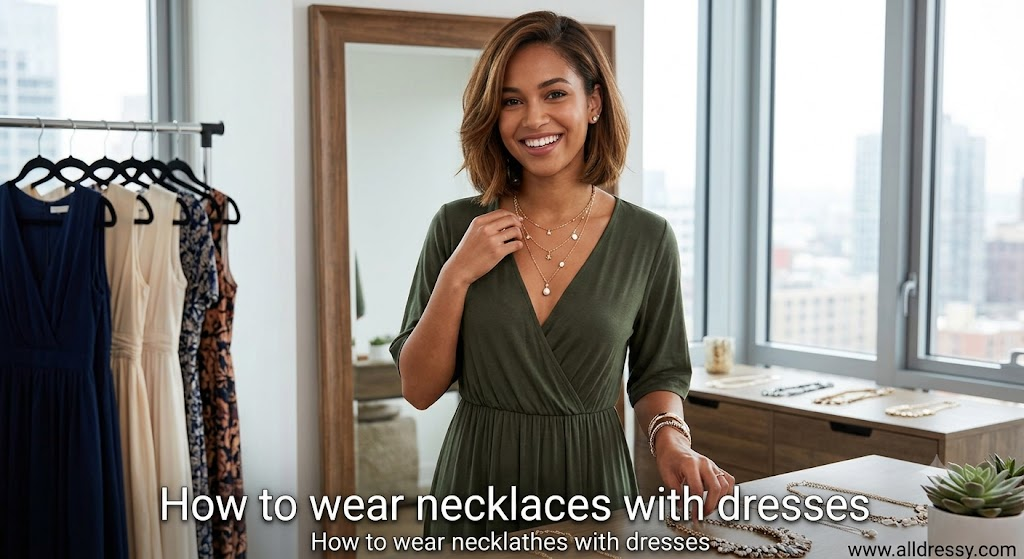
The golden rule of learning how to wear necklaces with dresses is simple: your jewelry should either mirror the shape of your neckline or completely fill the negative space it creates. When jewelry and necklines compete, the outfit loses its flow.
1. The V-Neck and Plunging Dress: Linear Elongation
A V-neck dress is designed to draw the eye downward, lengthening your neck and torso. Your necklace choice should support this vertical movement rather than interrupting it with rounded shapes.
- The Ideal Match: Pendant necklaces, Y-necklaces, and lariats.
- The Strategy: Choose a piece that sits on a delicate or medium-weight chain and tapers to a point, mirroring the V-shape of the dress.
- Proportional Placement: Keep at least one inch of bare skin between the bottom of your pendant and the fabric edge of the dress. If you are wearing a deep plunge, a long, dramatic lariat that trails down toward the navel adds a sophisticated touch without cluttering your chest. Avoid short, chunky chokers here, as they cut across the neck and ruin the elongating effect of the V-cut.
2. The Round and Crew Neck Dress: Symmetrical Harmony
Crew necks and high round necklines offer a solid canvas of fabric across the chest. This cut can sometimes look flat or constricting if left unaccessorized.
- The Ideal Match: High-impact chokers, collar necklaces, or long, layered chains.
- The Strategy: You have two options here. To accentuate the clean symmetry of a round neck, choose a statement collar or bib necklace that sits flat against the fabric, tracing the exact curve of the neckline like an embellished border.
- The Elongation Method: Alternatively, break up the solid block of fabric by layering two to three long, thin chains of varying lengths (such as 24-inch, 28-inch, and 32-inch strands). This creates a vertical line over the round neck, making your torso look longer. Avoid pointed or sharp, angular pendants that sit halfway on and halfway off the fabric line.
3. The Strapless and Off-the-Shoulder Dress: Framing Bare Skin
Strapless and off-the-shoulder gowns expose your collarbones, shoulders, and upper chest, leaving a large area of bare skin. This open canvas allows your jewelry to take center stage.
                  STRAPLESS FRAME GEOMETRY

                        (  @   @  )
                         \   -   /
                          |     |
                    ======|=====|======  <-- Statement Choker / Collar
                          |     |
                       .-'       '-.
                      /             \
         ============/===============\============  <-- Upper Dress Line
                     [ Exposed Chest Space ]
- The Ideal Match: Statement chokers, chunky collar necklaces, and princess-length strands (16 to 18 inches).
- The Strategy: Because the neckline is completely open, a bold, detailed necklace fills the space beautifully without fighting any fabric. A thick diamond, pearl, or gemstone choker highlights your collarbones and draws attention up to your face.
- What to Avoid: Skip long, dangling pendants or opera-length chains with strapless dresses. Long necklaces draw the eye down past the open space, breaking up the clean look that makes a strapless dress so striking.
4. The Square Neck Dress: Embracing Angular Lines
Square necklines offer a clean, structured frame. This geometric cut requires a careful choice between lean architectural lines or a soft touch of contrast.
- The Ideal Match: Short angular pendants, rigid torques, or round pearls for contrast.
- The Strategy: To lean into the modern look of a square neckline, opt for geometric jewelry—such as a square, rectangular, or minimalist bar pendant on a short, structured chain. If you want to soften the sharp corners of the dress, a classic strand of rounded pearls or a circular bezel-set diamond necklace resting on your collarbone provides a beautiful, soft contrast. Make sure the necklace stays well above the fabric line to keep the frame clear.
5. The Sweetheart Neckline: Enhancing Romantic Curves
The sweetheart neckline features a romantic, heart-shaped dip that accentuates the bust. This delicate curve needs a necklace that frames it without overwhelming it.
- The Ideal Match: Short pendant necklaces and curved, delicate drops.
- The Strategy: Choose a necklace with a soft, curved drape that nests perfectly within the heart-shaped dip. A single drop pearl, a small diamond cluster, or a delicate pendant on an 18-inch chain works beautifully. Avoid wide, heavy bib necklaces or flat collar pieces that cut across the sweetheart shape and hide its classic silhouette.
6. High-Neck and Turtleneck Dresses: Embracing Length
High-neck, mock-neck, and turtleneck dresses offer full coverage up to the throat. Shorter necklaces will get lost or look crowded against this style.
- The Ideal Match: Opera-length chains (26 to 36 inches), long lariats, and station necklaces.
- The Strategy: Treat a high-neck dress as a clean backdrop for longer jewelry. A long pendant or a series of layered chains cuts through the solid block of fabric, adding movement and a long, lean line to your torso.
- The Alternative Approach: If the dress fabric is highly detailed (like lace or sequins), skip the necklace entirely and shift the focus upward with a pair of dramatic chandelier earrings.
Fabric Dynamics: Balancing Metal Weight with Textile Texture
Understanding how to wear necklaces with dresses also requires looking at the fabric of your dress. The weight, sheen, and texture of the material should dictate the scale and finish of your jewelry.
+---------------------------------------------------------------------------------+
|                         FABRIC & METALS COMPATIBILITY                           |
+---------------------------------------------------------------------------------+
| Fabric Type             | Visual Weight | Best Necklace Texture                 |
+-------------------------+---------------+---------------------------------------+
| Heavy Velvet / Tweed    | High          | Thick Chains, Architectural Cuffs     |
| Silk Satin / Silk Slip  | High Sheen    | High-Polish Gold, Platinum, Diamonds  |
| French Lace / Brocade   | Intricate     | Minimalist Chains, Thin Solitaires    |
| Linen / Cotton Jersey   | Matte/Casual  | Brushed Gold, Raw Gemstones, Leather  |
+---------------------------------------------------------------------------------+
Heavy, Structured Fabrics
Dresses made of velvet, heavy wool crepe, tweed, or bonded satin have a strong visual weight. If you pair these structured fabrics with an ultra-thin, delicate chain, the necklace will get lost against the material. These dresses call for jewelry with some substance. Pair them with thick Cuban links, chunky collar pieces, or heavy architectural pendants that can hold their own against the substantial fabric.
Lightweight, Flowing Fabrics
Dresses crafted from silk chiffon, organza, lightweight tulle, or fine satin slips require a lighter touch. Heavy, chunky jewelry can pull on delicate fabrics or look clumsy next to a breezy dress. Opt for thin chains, delicate bezel settings, and lightweight, fluid pieces that mimic the soft movement of the fabric.
Busy Prints, Lace, and Embellishments
If your dress features a vibrant pattern, intricate beadwork, sequins, or lace overlays, the dress itself is already doing the visual work. Adding a massive statement necklace creates a chaotic look. When accessorizing a detailed dress, stick to minimalist styling: a simple, high-polish chain or a classic solitaire pendant. If the bodice is heavily embellished with crystals or metallic thread, skip the necklace completely and opt for a clean bracelet or simple stud earrings instead.
Color Theory: Coordinating Metals and Gemstones with Dress Tones
The color of your dress serves as the backdrop for your necklace. Using basic color theory ensures your jewelry pops rather than clashing with your outfit.
1. Warm-Toned Dresses
Dresses in warm shades—such as cream, ivory, rich chocolate brown, terracotta, olive green, warm red, and deep burgundy—pair beautifully with yellow gold. The warm undertones of gold enhance the richness of these colors, creating a cohesive look. When it comes to gemstones, warm-toned dresses look fantastic with amber, citrine, fire opal, and carnelian.
2. Cool-Toned Dresses
Dresses in cool colors—like navy blue, slate gray, ice blue, emerald green, lavender, and classic pure white—are elevated by silver, white gold, and platinum. These metals match the crisp, cool energy of the fabric. Complementary gemstones for these shades include sapphire, tanzanite, aquamarine, and labradorite.
3. The Power of Contrast and Complex Tones
If you want to make a bold statement, use contrasting colors on the color wheel to make your necklace stand out.
                       COLOR WHEEL CONTRAST

                           [ Yellow Dress ]
                                  |
                                  |  <-- Opposite Contrast
                                  v
                           [ Violet/Amethyst ]
A solid black dress offers total flexibility, serving as the perfect backdrop for high-shine gold, silver, or bright statement gems like emeralds and rubies. For a monochromatic, high-end look, match your gemstones exactly to the color of your dress—such as pairing a forest green crepe dress with a raw emerald pendant.
The Art of Layering: Building an Intentional Necklace Stack
Layering multiple necklaces over a dress is a fantastic way to showcase your personal style. However, an unguided stack can easily turn into a tangled mess. To build a clean, intentional necklace stack, follow this step-by-step formula:
                      THE THREE-TIER STACK

                        /=========\      <- Tier 1: 14-16" Choker / Chain
                       /  _______  \
                      /  /       \  \    <- Tier 2: 18" Medium Pendant
                     /  /         \  \
                    /  /           \  \  <- Tier 3: 22-24" Long Lariat
Step 1: The Base Layer (14 to 16 Inches)
Start with a short choker or a delicate chain that sits high on your collarbone. This piece defines the top of your stack and sets the anchor point for the look. It should be relatively simple—such as a thin snake chain, a dainty paperclip link, or a small beaded strand.
Step 2: The Focal Piece (18 to 20 Inches)
The second layer should sit two to three inches below your base layer to prevent tangling. This is where you introduce your main detail, like a coin pendant, an engraved medallion, or a vibrant gemstone. This piece should have a bit more visual weight than your top chain.
Step 3: The Extender (22 to 24 Inches)
Finish your stack with a longer, vertical piece that draws the eye downward. A long box chain, a thin lariat, or a sharp Y-necklace works perfectly here. This bottom layer grounds the entire stack, creating a beautiful cascading effect that sits gracefully over your dress.
Keeping Your Stack Tangle-Free
To stop your layered necklaces from twisting together throughout the day, mix your chain weights and styles. Do not stack three identical, lightweight cable chains. Instead, mix a smooth snake chain with a textured paperclip link and a twisted rope chain. The different textures and weights help keep the chains separate as you move.
Professional Tips for Flawless All-Day Wear
To ensure your jewelry looks perfect and stays put during long events, keep these styling tips in mind:
- The Double-Sided Tape Trick: If you are wearing a pendant necklace with a low-cut dress and find that the pendant constantly flips over, slides to the side, or slips inside the fabric, use a tiny piece of double-sided fashion tape. Stick it to the back of the pendant and secure it directly to your skin. This keeps the necklace perfectly centered all night long.
- Proportional Balance: Always balance your necklace with your earrings. If you choose a large statement collar or a thick layered stack, keep your earrings minimal with simple studs or tiny hoops. If you prefer to wear dramatic chandelier earrings, skip the necklace entirely or stick to a razor-thin, bare chain to keep from overcrowding your face.
- Mind the Closure: When accessorizing an open-back or low-back dress, remember that the back of your neck is on display. If your necklace has a large, clunky claw clasp or an unsightly extension chain, it can detract from a clean backless look. In this case, choose a necklace with a neat, integrated enclosure, or turn the look into a style choice by wearing a backdrop necklace that elegantly trails down your spine.
Frequently Asked Questions
Can I wear a necklace with an asymmetrical or one-shoulder dress?
As a general rule, it is best to avoid traditional necklaces with asymmetrical or one-shoulder dresses. The uneven neckline creates its own dramatic visual line, and a standard necklace will cut across that line awkwardly, creating visual confusion. If you want to accessorize a one-shoulder dress, leave your neck bare and shift the focus to a pair of striking statement earrings, a bold cuff bracelet on the bare arm, or an elegant cocktail ring.
How do I stop my necklaces from tangling when I layer them over a dress?
Tangling happens when chains are too similar in weight and texture. To prevent this, mix your chain styles—pair a flat, smooth snake chain with a textured paperclip link and a weighted rope chain. Additionally, ensure there is a clear distinction in length (at least 2 inches of space between each layer). You can also use a necklace layered clasp separator, a small jewelry gadget that anchors multiple chains at the back of your neck to keep them perfectly spaced.
Should my necklace touch the fabric of my dress or sit entirely on my skin?
It depends entirely on the neckline. For low-cut dresses like V-necks, scoop necks, and strapless gowns, your necklace should sit completely on your bare skin, leaving at least an inch of space before the fabric begins. For high-coverage dresses like crew necks, mock necks, and turtlenecks, your necklace must sit directly on top of the fabric; choose longer, weightier pieces so they drape smoothly over the textile rather than getting caught on it.
Can I wear a silver necklace if my dress has gold zippers or hardware?
Yes, you can absolutely mix metals, but it should look intentional rather than accidental. If your dress features prominent gold zippers or buttons, you can wear a silver necklace as long as you tie the look together with another mixed-metal piece—such as a dual-toned bracelet or a stack of silver and gold rings. This makes the combination look like a deliberate style choice rather than a mismatch.
What kind of necklace works best with a halter-neck dress?
Halter-neck dresses already draw the eye upward and create a sharp, triangular line around your neck, meaning they rarely require a necklace. Adding one can make the throat area look crowded. If the halter neck has a very deep, plunging front, you can occasionally pair it with a thin, delicate pendant that slips beneath the halter lines. Otherwise, it is best to skip the necklace and accessorize with a gorgeous set of earrings or hair accessories.
Conclusion
Mastering how to wear necklaces with dresses is the key to elevating any outfit from standard to spectacular. By treating the neckline of your dress as a structural frame, you can easily select a necklace silhouette that fills the empty space or mirrors the geometric lines of your garment. Whether you are using a sharp linear pendant to lengthen a plunging V-neck, a bold choker to anchor a strapless gown, or long, layered chains to add movement to a high turtleneck, balance is everything.
Beyond the shape, always consider how the weight of your jewelry interacts with your dress fabric, and use color theory to ensure your metals and gemstones stand out beautifully against your clothing. When you align the geometry, texture, and scale of your jewelry with your dress, you create an intentional, cohesive look that projects effortless confidence and style.