
If you have ever watched an indoor volleyball match, you may have wondered, “why does one volleyball player dressed differently?” While most players on a team wear matching uniforms, one player often wears a jersey in a noticeably different color or design. That player is usually the libero, a specialized defensive player whose role and playing restrictions are different from those of the other players.
The different jersey is not simply a fashion choice or a way to identify the team’s best player. It is an important part of volleyball’s rules because referees, teammates, and spectators need to be able to identify the libero quickly. Under the current FIVB rules, the libero’s uniform must clearly contrast with the rest of the team’s uniforms.
Understanding why does one volleyball player dress differently also means understanding what the libero does, why the position exists, how libero substitutions work, what the player can and cannot do, and why visual identification is so important during a fast-paced match.
Why Does One Volleyball Player Dress Differently in Volleyball?
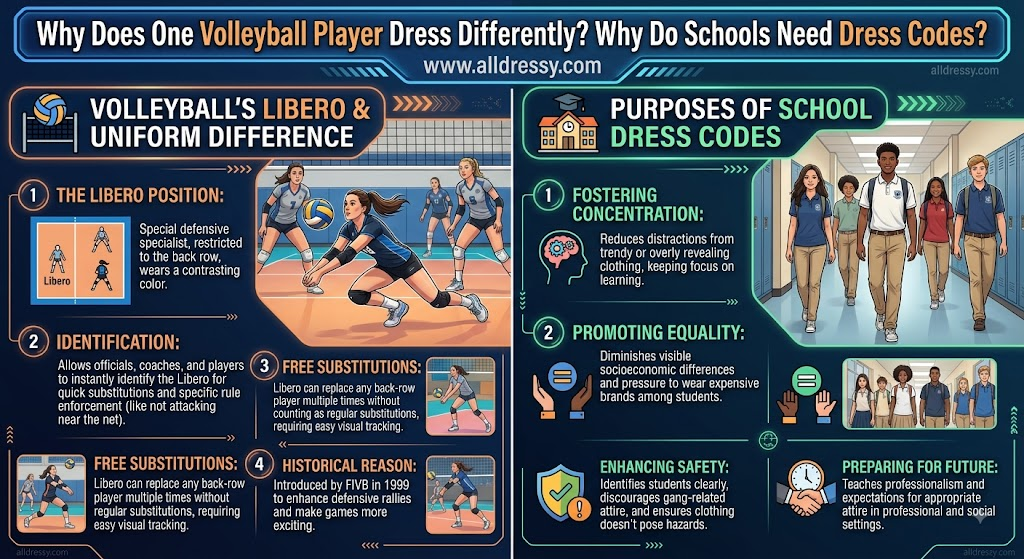
The simplest answer to why does one volleyball player dress differently is that the player is usually the team’s libero.
The libero is a specialist defensive player. Unlike ordinary players, the libero has specific restrictions on where they can play and what actions they can perform.
The Fédération Internationale de Volleyball (FIVB) explains that the libero is a specialized back-row player and must wear a uniform that has a different dominant color from the rest of the team. (FIVB)
This means the contrasting jersey serves an important practical purpose: everyone involved in the match can immediately recognize the player who is subject to the special libero rules.
What Is a Libero in Volleyball?
Before fully answering why does one volleyball player dress differently, it helps to understand the libero position.
The libero is a specialist whose primary responsibilities involve serve reception and back-row defense. FIVB describes the libero as an important part of a team’s defensive system, particularly in serve reception and defensive play. (FIVB)
A libero may replace players in back-row positions, allowing a team to strengthen its defensive organization.
Rather than being primarily responsible for attacking or blocking, the libero specializes in keeping the ball playable when the opposing team attacks.
Typical libero responsibilities include:
- Receiving serves
- Digging powerful attacks
- Covering teammates
- Keeping rallies alive
- Providing accurate defensive passes
- Helping organize back-row defense
- Replacing designated back-row players
This specialized role is why the libero has a unique place within the team.
Why Does the Libero Wear a Different Color Jersey?
The different jersey is primarily an identification tool.
Volleyball can move extremely quickly. Players rotate, substitute, attack, defend, and move around the court in a matter of seconds. Referees need to recognize the libero immediately because different rules apply to that player.
Under the current FIVB rules, the libero must wear a uniform with a clearly contrasting dominant color compared with the rest of the team. The libero’s uniform is also numbered like the other players’ uniforms. (FIVB)
So if five players are wearing one team color and one player is wearing a contrasting color, officials can immediately identify the specialist.
This makes the different jersey an important part of match administration rather than merely an aesthetic choice.
Why Does One Volleyball Player Dress Differently Instead of Everyone Wearing the Same Jersey?
If the libero wore the same uniform as everyone else, referees would have a harder time identifying the player who has special restrictions.
The contrasting uniform provides a simple visual signal.
Instead of having to remember which player is the libero based only on a lineup or substitution record, officials can quickly recognize the player on the court.
This is particularly useful because the libero can enter and leave the game frequently through the specialized replacement system.
The different jersey therefore makes the rules easier to apply during live play.
Why Does One Volleyball Player Dress Differently Because of Special Rules?
The libero does not have exactly the same playing permissions as other players.
According to the current FIVB rules, the libero:
- Is restricted to back-row play
- May replace a back-row player
- Cannot block
- Cannot attempt to block
- Cannot complete an attack hit when the ball is entirely above the top of the net
- Has specific restrictions concerning setting and attacking situations (FIVB)
These restrictions explain why officials need to know who the libero is.
The contrasting jersey allows referees to identify the specialist quickly and determine whether a particular action is permitted.
Why Does One Volleyball Player Dress Differently During Rotations?
Indoor volleyball involves rotation. Players rotate through different court positions as the team wins the right to serve.
The libero’s role interacts with this system differently because the libero specializes in back-row defense.
FIVB explains that each indoor volleyball team rotates positions after regaining the right to serve. Once the ball is served, players can move according to the rules, but back-row players have restrictions concerning blocking and attacking at the net. (FIVB)
The libero can replace players in back-row positions, making the position particularly useful for defensive organization.
Because the libero can enter and leave for back-row players, the contrasting uniform makes it much easier for officials to follow these changes.
Why Does One Volleyball Player Dress Differently When the Team Is Serving?
The libero’s different uniform does not mean that the player has a completely separate role whenever the team serves.
The libero remains a defensive specialist.
Under the current FIVB rules, the libero cannot serve in the international rules framework. (FIVB)
However, specific volleyball competitions and governing bodies can have their own regulations, especially at youth, school, collegiate, or domestic levels. Therefore, players should always follow the rules of the particular competition.
The important point is that the different jersey identifies the player whose participation is governed by special rules.
Why Does One Volleyball Player Dress Differently When Defending?
Defense is where the libero’s role becomes particularly obvious.
When the opposing team attacks, the libero is often positioned to help receive powerful hits and keep the ball from touching the floor.
A successful defensive player needs quick reactions, strong positioning, good anticipation, and accurate passing.
The libero often plays an important role in:
Serve Reception
The libero can help stabilize the team’s first contact after an opponent’s serve.
Digging
A dig is a defensive forearm pass used to control an opponent’s attack. FIVB identifies digging as an important defensive action and notes that the libero handles much of a team’s serve reception and backcourt defense. (FIVB)
Defensive Coverage
The libero can help cover areas behind or around attacking teammates.
Ball Control
Keeping the ball under control allows the setter to organize the next phase of the team’s attack.
Why Does One Volleyball Player Dress Differently But Still Wear the Same Team Number Style?
Although the libero’s jersey looks different, the player is still part of the same team.
The contrasting color does not indicate that the player belongs to another team.
The libero’s uniform still follows the team’s identification requirements. Under the current FIVB rules, libero uniforms are numbered like the rest of the team’s uniforms. (FIVB)
The purpose is to combine two things:
Team identification + libero identification
The player looks different enough to be recognized as the libero but remains clearly identifiable as a member of the team.
Why Does One Volleyball Player Dress Differently in Professional Matches?
The different jersey is particularly noticeable in professional and international volleyball because the libero position is highly specialized.
At major competitions, teams use organized defensive systems in which the libero can have a major role in serve reception and defense.
FIVB event regulations also specify that players of the same team generally wear the same color and design, with the libero being the specific exception. The libero uniform must have a contrasting color and be numbered. (FIVB)
This demonstrates that the different uniform is built directly into the competition regulations.
Why Does One Volleyball Player Dress Differently in School Volleyball?
If you see a player wearing a different jersey in a school or youth volleyball match, that player may also be the libero.
However, rules can vary between competitions.
School, club, collegiate, and national competitions may use rule sets that differ in certain details. The basic concept remains familiar: the libero is usually visually distinguished because of the position’s special responsibilities and restrictions.
Therefore, if you’re watching a school match, it is best to check that competition’s rules rather than assuming every detail is identical to international FIVB volleyball.
Why Does One Volleyball Player Dress Differently If the Libero Is Not the Team Captain?
The libero does not have to be the team captain.
The different jersey identifies the player’s position and special status, not leadership status.
Interestingly, under current FIVB rules, a libero can serve as team or game captain. FIVB approved this change in 2021, recognizing that there was no reason to prevent the libero from serving in that role simply because of the position’s specialized nature. (FIVB)
Therefore, these are separate concepts:
- Different jersey: identifies the libero.
- Captain designation: identifies team leadership.
A team can have a libero who is also a captain.
Why Does One Volleyball Player Dress Differently but Not Attack Like the Other Players?
Attacking is one of the major differences between the libero and other players.
The libero is primarily a defensive specialist.
Under FIVB rules, the libero cannot complete an attack hit when the ball is entirely above the top of the net. The libero also cannot block or attempt to block. (FIVB)
This is why you generally will not see the differently dressed player performing the same front-row attacking role as a typical outside hitter, opposite, or middle blocker.
The position is designed around defense rather than front-row attacking.
Why Does One Volleyball Player Dress Differently and Enter the Court So Often?
One of the distinctive features of the libero position is the ability to replace back-row players.
This means the libero may enter the court when a teammate rotates into a back-row role and leave when that player needs to return to the court under the applicable substitution rules.
This allows teams to maintain stronger defensive skills in the back row while retaining specialized attackers and blockers for front-row situations.
Because these exchanges can occur throughout a match, the contrasting jersey helps everyone recognize the libero.
Why Does One Volleyball Player Dress Differently During Substitutions?
Libero replacements are not exactly the same as ordinary substitutions.
The libero has a specialized replacement system governed by volleyball rules. The current FIVB rules identify the libero as a player who can replace players in back-row positions. (FIVB)
This is another reason the different uniform matters.
A referee can quickly determine:
- Who is the libero?
- Which player is being replaced?
- Where the libero is allowed to play?
- Whether the player’s actions comply with the rules?
The visual distinction simplifies these decisions.
Why Does One Volleyball Player Dress Differently From the Other Five Players?
In a typical indoor volleyball lineup, six players are on the court.
The five ordinary players generally wear matching team uniforms, while the libero wears a contrasting uniform.
However, this does not mean that every match will always have exactly one differently dressed player on the court at every moment.
A team can designate more than one libero under FIVB rules, although only one libero may be on the court at a time. (FIVB)
Therefore, the important idea is not “one player always has a different jersey.” Instead, it is:
The active libero must be clearly distinguishable from the other players.
Can a Volleyball Team Have Two Liberos?
Yes.
The current FIVB rules allow a team to designate up to two specialist defensive players as liberos. In certain FIVB competitions, if a team has more than 12 players recorded on the scoresheet, two liberos are mandatory on the team list. Only one libero can be on the court at a time. (FIVB)
This means spectators might see two players wearing different libero uniforms at different points in a match.
Both can be designated for the specialized defensive position, but only one acts as the libero on court at a time.
Why Does One Volleyball Player Dress Differently in Terms of Team Strategy?
The libero is more than a player with a different shirt.
The position can influence a team’s overall strategy.
A team may use the libero to improve:
- Serve reception
- Defensive coverage
- Passing consistency
- Rally continuation
- Back-row organization
Strong defense can create better opportunities for the setter and attackers.
For example, when a libero makes a controlled first pass, the setter may have more options for organizing the team’s attack.
This illustrates an important volleyball principle: defense and offense are connected.
A good defensive play can become the foundation for a successful attack.
Why Does One Volleyball Player Dress Differently Than the Setter?
The setter and libero have different responsibilities.
The setter is generally responsible for organizing the team’s second contact and creating attacking opportunities.
The libero is primarily responsible for back-row defense and serve reception.
FIVB describes setting as a tactical center of volleyball because the setter directs the ball toward attacking options. (FIVB)
The libero, meanwhile, specializes in controlling the opponent’s attacks and serves.
Their different uniforms therefore do not indicate different levels of importance. They indicate different jobs.
Why Does One Volleyball Player Dress Differently Than the Outside Hitter?
An outside hitter usually has both offensive and defensive responsibilities.
The player may attack from the front row and contribute to serve reception and defense.
The libero is much more specialized toward back-row play.
This specialization allows a team to combine different skills:
- Attackers provide offensive power.
- Setters organize attacks.
- Middle blockers defend and attack around the net.
- The libero strengthens back-row defense.
The different jersey makes the libero’s specialized status immediately visible.
Common Misunderstandings About the Different Volleyball Jersey
There are several misconceptions about the differently dressed player.
It Does Not Mean the Player Is the Best Player
The libero may be an extremely important player, but the jersey does not indicate that the player is automatically the team’s best athlete.
It Does Not Mean the Player Is a Substitute
The libero can be actively playing on the court. The different jersey identifies the position, not a bench role.
It Does Not Mean the Player Is a Referee
The libero is a normal team player with specialized rules.
It Is Not Just a Fashion Choice
The contrasting jersey is required under FIVB rules for the libero. (FIVB)
It Does Not Mean the Player Cannot Touch the Ball
The libero can play the ball and is often heavily involved in defensive contacts.
Why Does One Volleyball Player Dress Differently? The Simple Explanation
If you only remember one thing about why does one volleyball player dress differently, remember this:
The differently dressed player is usually the libero, a specialized defensive player whose uniform is intentionally different so referees and spectators can identify them quickly.
The libero specializes in back-row defense and serve reception and has restrictions that ordinary players do not have. Under current FIVB rules, the libero cannot block or attempt to block, cannot complete an attack hit when the ball is entirely above the net, and is restricted to back-row play. (FIVB)
The contrasting jersey therefore connects the player’s appearance directly to the rules of the game.
Why Does One Volleyball Player Dress Differently? What Spectators Should Watch For
The next time you watch volleyball, look beyond the different jersey.
Watch how the libero:
- Moves into defensive positions
- Receives serves
- Digs attacks
- Communicates with teammates
- Covers attacking players
- Enters for back-row players
- Helps maintain passing quality
You may notice that the libero is frequently involved in the team’s first contact after a serve or attack.
This is because the position is designed to strengthen defensive consistency.
Why Does One Volleyball Player Dress Differently in Modern Volleyball?
The libero has become an established and strategically important part of modern indoor volleyball.
FIVB introduced the specialized libero position in 1996, and the organization describes the player as pivotal in backcourt defense and serve reception. (FIVB)
The contrasting uniform has therefore become one of the most recognizable visual features of indoor volleyball.
It provides a simple solution to a complicated problem: how can referees quickly identify a player who has specialized rules while a fast match is taking place?
The answer is straightforward—the player wears a clearly contrasting jersey.
Final Takeaway: Why Does One Volleyball Player Dress Differently?
The reason why does one volleyball player dress differently is closely connected to the libero position. The player is usually a specialized defensive player who has different responsibilities and restrictions from the rest of the team.
The contrasting uniform makes the libero easy to identify. This helps referees apply the rules, helps spectators understand the action, and allows teams to use a specialist defensive player within volleyball’s rotation and substitution system.
The libero cannot perform every action available to other players, but that does not make the position less important. In fact, strong serve reception and defense can be crucial to building successful rallies and creating opportunities for the team’s attackers. FIVB’s current rules specifically require the libero’s uniform to contrast with the rest of the team, making the different jersey an essential part of the position’s identity.
FAQs About Why Does One Volleyball Player Dress Differently
1. Why does one volleyball player dress differently?
The player who wears a different-colored jersey is usually the libero. The libero is a specialized defensive player with specific rules that differ from other players. The contrasting uniform allows referees, teammates, and spectators to identify the libero quickly.
2. What is the different-colored volleyball player called?
The player is called the libero. The libero specializes in back-row defense, serve reception, and digging attacks. The position is visually distinguished by a contrasting jersey.
3. Why does the libero wear a different jersey?
The libero wears a different jersey so officials can immediately recognize the player who has special playing restrictions. Under current FIVB rules, the libero’s uniform must have a clearly contrasting dominant color from the other team uniforms.
4. Can the libero attack the ball?
The libero can contact the ball and participate in defensive play, but there are restrictions on attacking. Under FIVB rules, the libero cannot complete an attack hit when the ball is entirely above the top of the net.
5. Can the libero block in volleyball?
No. Under current FIVB rules, the libero cannot block or even attempt to block. This is one of the important differences between the libero and front-row players.
6. Can the libero serve?
Under current international FIVB rules, the libero is not permitted to serve. However, rules can differ in some school, youth, collegiate, or other competitions, so players should check the regulations governing their particular competition.
7. Is the libero the best player on the volleyball team?
Not necessarily. The different jersey identifies the player’s specialized position, not their skill ranking. A libero can be extremely valuable because of excellent defensive and passing skills, but the jersey does not mean the player is automatically the team’s best player.
8. Can a volleyball team have more than one libero?
Yes. Under current FIVB rules, a team can designate up to two liberos, although only one libero can be on the court at a time.
9. Does the libero replace other players?
Yes. The libero can replace players in back-row positions according to the applicable libero-replacement rules. This allows teams to strengthen their defensive play while using specialized attackers and blockers in other rotations.
10. Is the libero important to a volleyball team?
Absolutely. The libero can be crucial to serve reception, digging, defensive coverage, and maintaining control during rallies. A strong libero can help the team produce accurate first contacts, giving the setter better opportunities to organize attacks.
Conclusion
Understanding why does one volleyball player dress differently becomes much easier once you understand the role of the libero. The differently dressed player is usually not wearing a special jersey for fashion or because they are a substitute. The contrasting uniform identifies a specialized defensive player whose responsibilities and restrictions are different from those of other players.
The libero plays an important role in serve reception, back-row defense, digging, and ball control. Because the position has special rules, officials need to be able to identify the libero immediately. This is why the contrasting jersey is such an important part of indoor volleyball.
The libero cannot block or complete an attack hit when the ball is entirely above the net under current FIVB rules, and the position is restricted to back-row play. These differences make visual identification particularly useful during a fast-moving match.
The next time you watch volleyball and notice one player wearing a different jersey, look closely at that player’s movements. You will likely see them spending much of the match receiving serves, defending attacks, and helping teammates keep difficult balls in pla